Exam-Style Problems
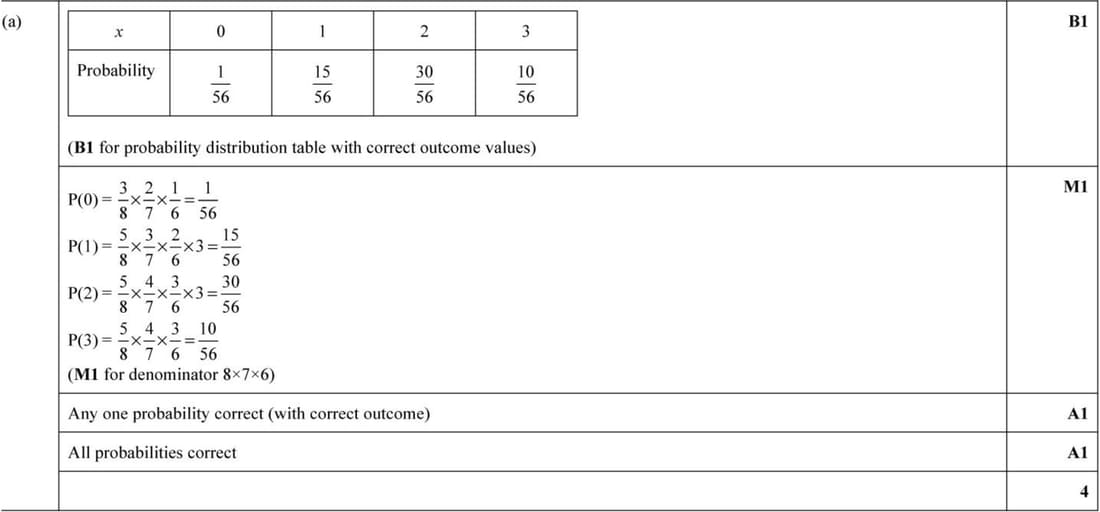
⬅ Back to SubchapterJune 2020 p51 q3
A company produces small boxes of sweets that contain 5 jellies and 3 chocolates. Jemeel chooses 3 sweets at random from a box.
Draw up the probability distribution table for the number of jellies that Jemeel chooses.
June 2023 p53 q3
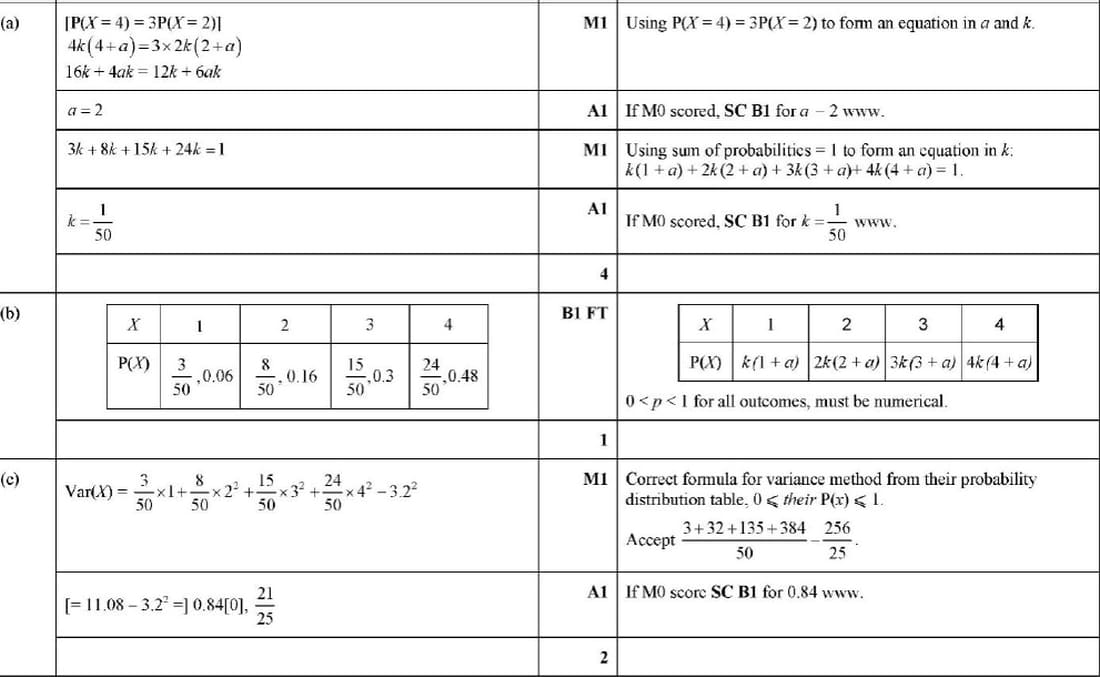
The random variable X takes the values 1, 2, 3, 4. It is given that \(P(X = x) = kx(x + a)\), where \(k\) and \(a\) are constants.
- Given that \(P(X = 4) = 3P(X = 2)\), find the value of \(a\) and the value of \(k\).
- Draw up the probability distribution table for X, giving the probabilities as numerical fractions.
- Given that \(E(X) = 3.2\), find \(\text{Var}(X)\).
Feb/Mar 2020 p52 q2
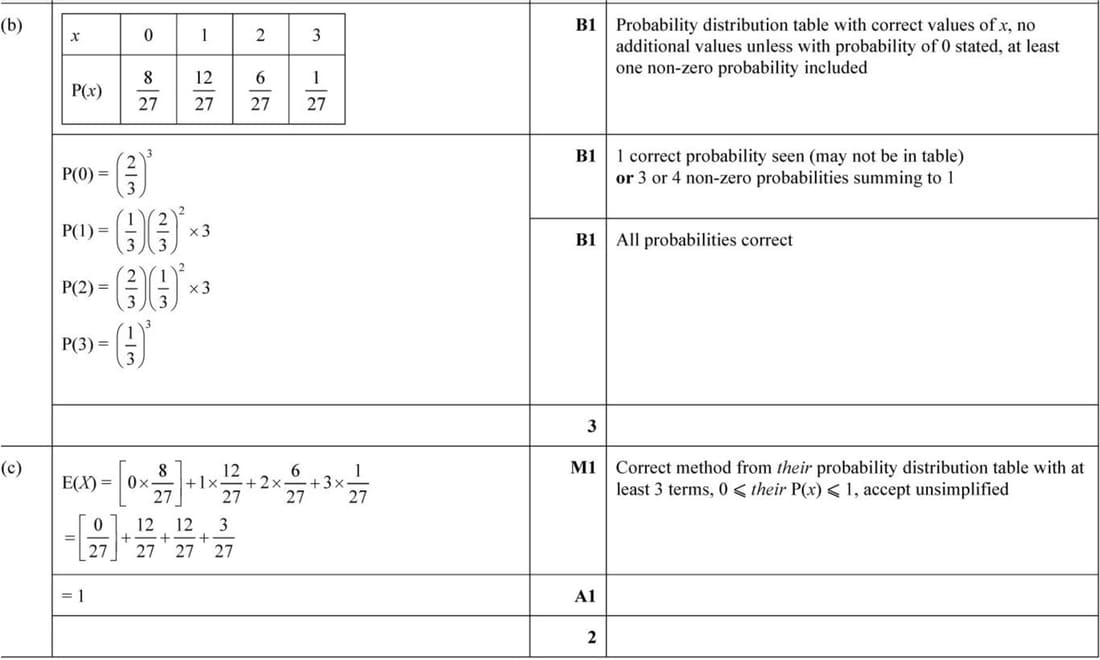
An ordinary fair die is thrown 3 times. The random variable X is the number of times that a 1 or a 6 is obtained.
(b) Draw up the probability distribution table for X.
(c) Find E(X).
Nov 2019 p63 q6
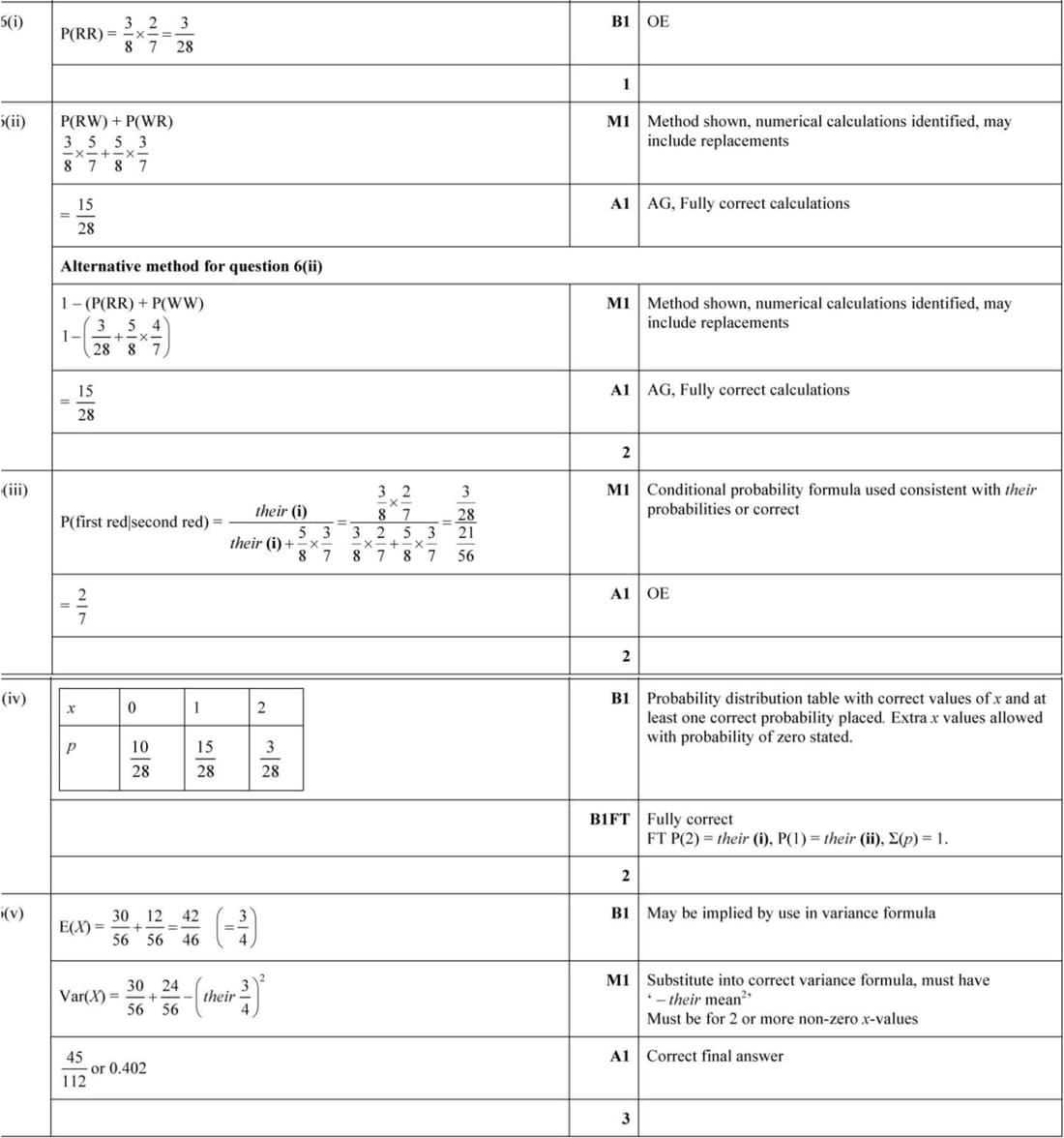
A box contains 3 red balls and 5 white balls. One ball is chosen at random from the box and is not returned to the box. A second ball is now chosen at random from the box.
- Find the probability that both balls chosen are red.
- Show that the probability that the balls chosen are of different colours is \(\frac{15}{28}\).
- Given that the second ball chosen is red, find the probability that the first ball chosen is red.
The random variable \(X\) denotes the number of red balls chosen.
- Draw up the probability distribution table for \(X\).
- Find \(\text{Var}(X)\).
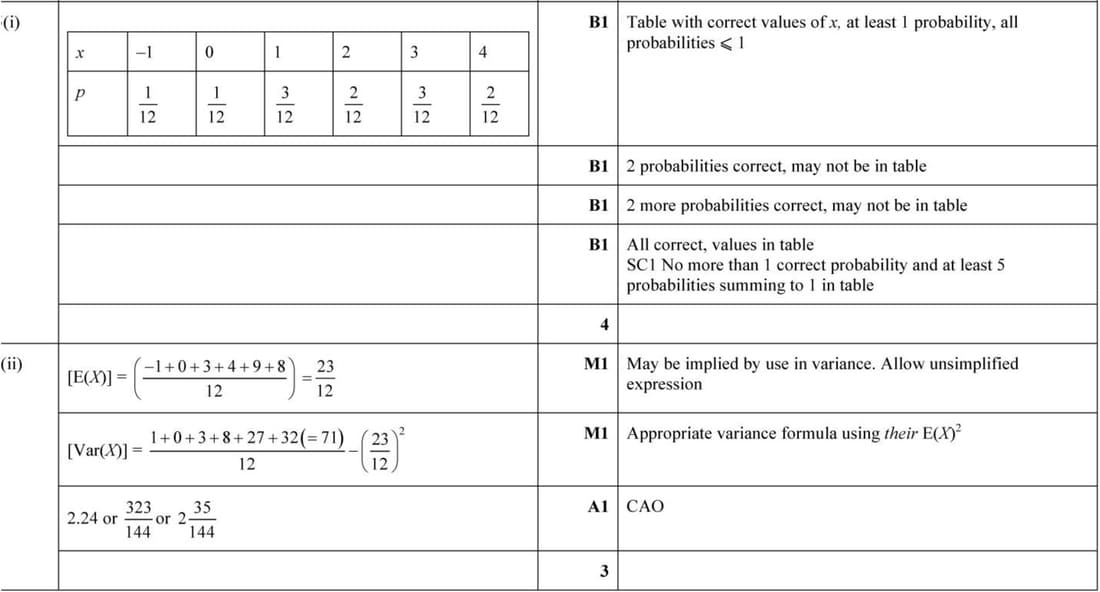
Nov 2019 p62 q5
A fair red spinner has four sides, numbered 1, 2, 3, 3. A fair blue spinner has three sides, numbered -1, 0, 2. When a spinner is spun, the score is the number on the side on which it lands. The spinners are spun at the same time. The random variable X denotes the score on the red spinner minus the score on the blue spinner.
(i) Draw up the probability distribution table for X.
(ii) Find \(\text{Var}(X)\).