Exam-Style Problems
⬅ Back to SubchapterJune 2015 p61 q3
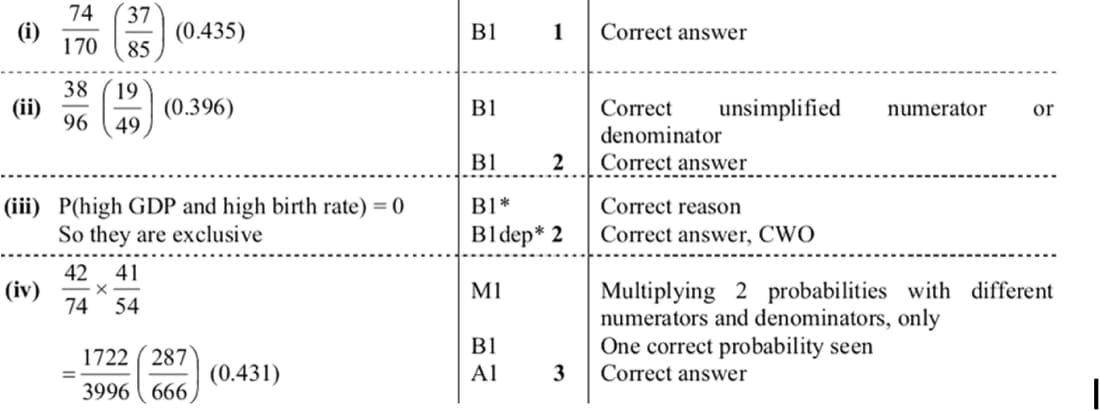
Jason throws two fair dice, each with faces numbered 1 to 6. Event A is ‘one of the numbers obtained is divisible by 3 and the other number is not divisible by 3’. Event B is ‘the product of the two numbers obtained is even’.
- Determine whether events A and B are independent, showing your working. [5]
- Are events A and B mutually exclusive? Justify your answer. [1]
Feb/Mar 2023 p52 q5
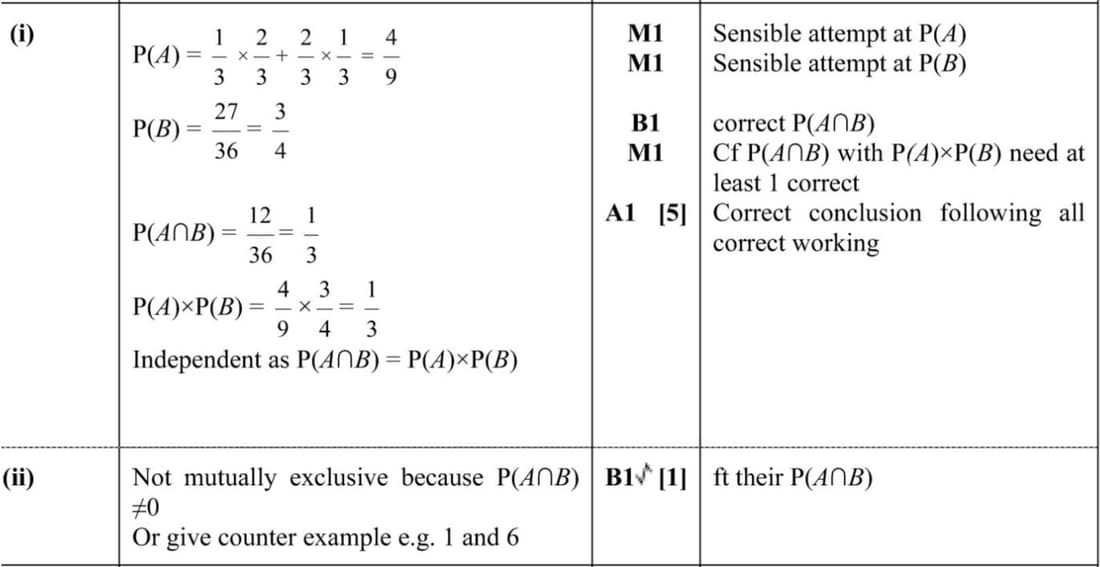
Marco has four boxes labelled K, L, M and N. He places them in a straight line in the order K, L, M, N with K on the left. Marco also has four coloured marbles: one is red, one is green, one is white and one is yellow. He places a single marble in each box, at random. Events A and B are defined as follows.
A: The white marble is in either box L or box M.
B: The red marble is to the left of both the green marble and the yellow marble.
Determine whether or not events A and B are independent.
Nov 2013 p62 q7
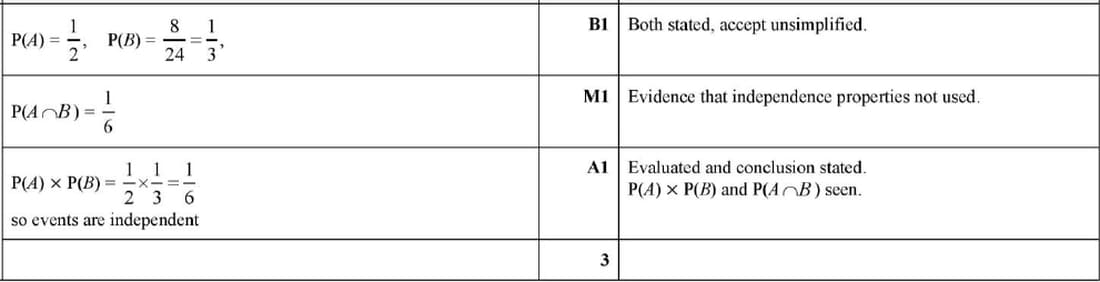
Rory has 10 cards. Four of the cards have a 3 printed on them and six of the cards have a 4 printed on them. He takes three cards at random, without replacement, and adds up the numbers on the cards. Event \(R\) is 'the sum of the numbers on the three cards is 11'. Event \(S\) is 'the number on the first card taken is a 3'.
(iii) Determine whether events \(R\) and \(S\) are independent. Justify your answer.
(iv) Determine whether events \(R\) and \(S\) are exclusive. Justify your answer.
June 2013 p63 q1
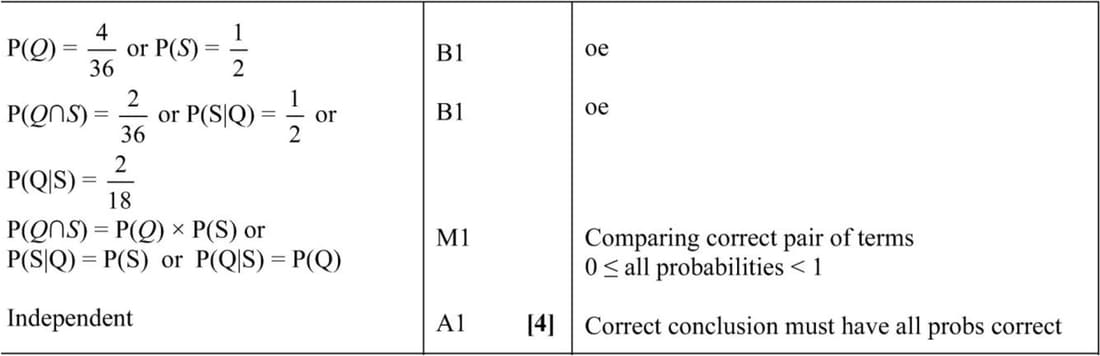
Q is the event ‘Nicola throws two fair dice and gets a total of 5’. S is the event ‘Nicola throws two fair dice and gets one low score (1, 2 or 3) and one high score (4, 5 or 6)’. Are events Q and S independent? Justify your answer.
Nov 2012 p63 q3
Ronnie obtained data about the gross domestic product (GDP) and the birth rate for 170 countries. He classified each GDP and each birth rate as either ‘low’, ‘medium’ or ‘high’. The table shows the number of countries in each category.
| Birth rate | |||
|---|---|---|---|
| GDP | Low | Medium | High |
| Low | 3 | 5 | 45 |
| Medium | 20 | 42 | 12 |
| High | 35 | 8 | 0 |
One of these countries is chosen at random.
- Find the probability that the country chosen has a medium GDP. [1]
- Find the probability that the country chosen has a low birth rate, given that it does not have a medium GDP. [2]
- State with a reason whether or not the events ‘the country chosen has a high GDP’ and ‘the country chosen has a high birth rate’ are exclusive. [2]
One country is chosen at random from those countries which have a medium GDP and then a different country is chosen at random from those which have a medium birth rate.
- Find the probability that both countries chosen have a medium GDP and a medium birth rate. [3]