Exam-Style Problems
⬅ Back to SubchapterNov 2012 p31 q6
2334
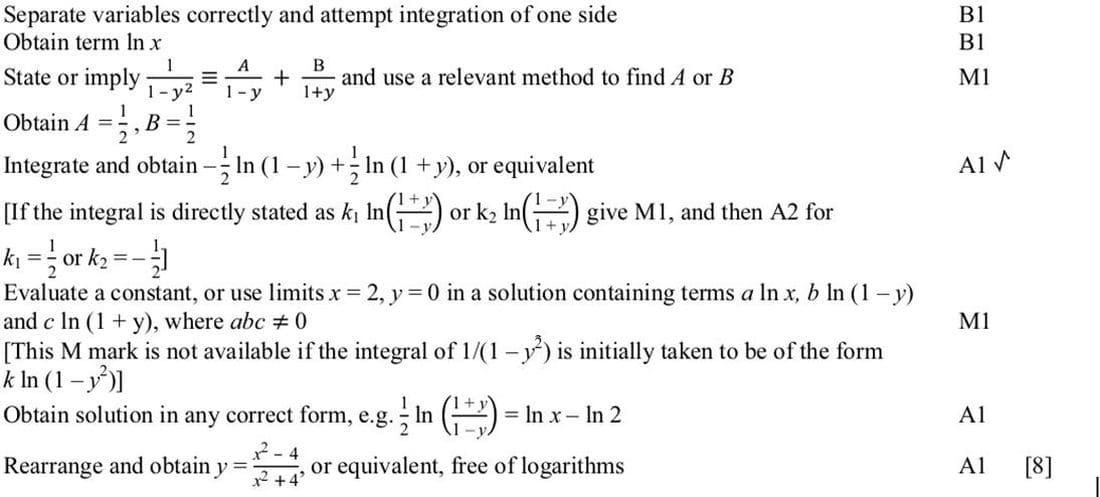
The variables x and y are related by the differential equation \(x \frac{dy}{dx} = 1 - y^2\).
When \(x = 2, y = 0\). Solve the differential equation, obtaining an expression for y in terms of x.
June 2022 p32 q6
2335
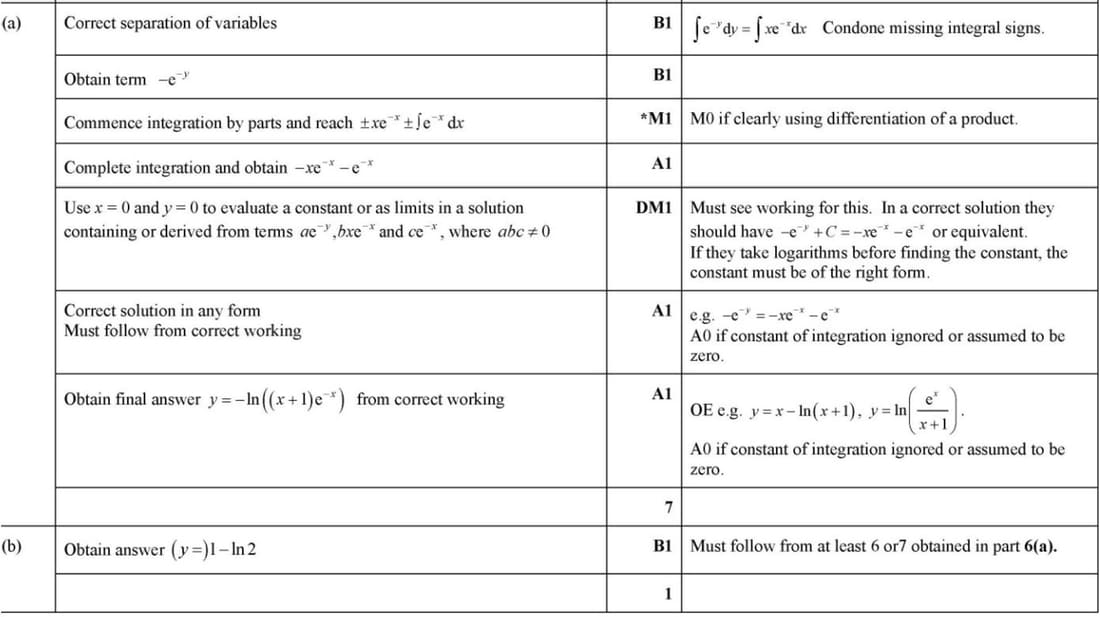
The variables x and y satisfy the differential equation \(\frac{dy}{dx} = xe^{y-x}\), and \(y = 0\) when \(x = 0\).
(a) Solve the differential equation, obtaining an expression for y in terms of x.
(b) Find the value of y when \(x = 1\), giving your answer in the form \(a - \ln b\), where a and b are integers.
Nov 2021 p32 q7
2336
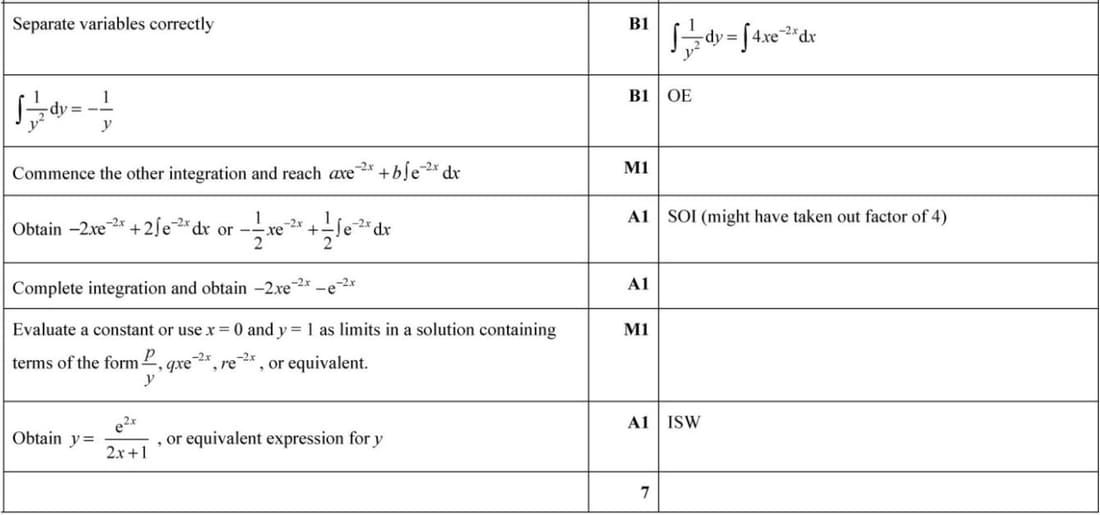
The variables x and y satisfy the differential equation
\(e^{2x} \frac{dy}{dx} = 4xy^2\),
and it is given that \(y = 1\) when \(x = 0\).
Solve the differential equation, obtaining an expression for y in terms of x.
June 2019 p32 q7
2337
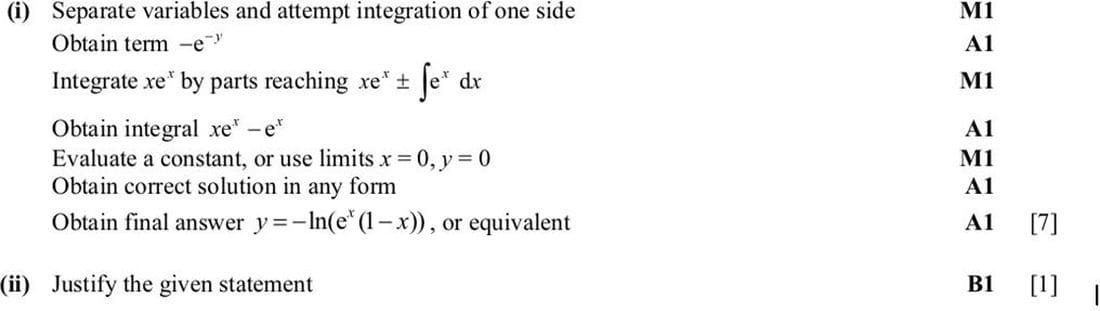
The variables x and y satisfy the differential equation \(\frac{dy}{dx} = xe^{x+y}\), and it is given that \(y = 0\) when \(x = 0\).
- Solve the differential equation and obtain an expression for y in terms of x.
- Explain briefly why x can only take values less than 1.
Nov 2014 p33 q8
2338
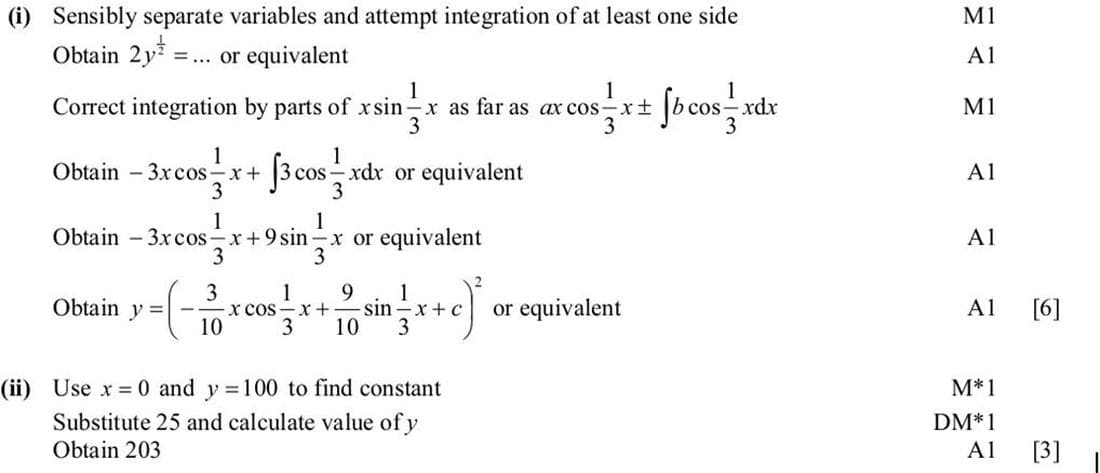
The variables x and y are related by the differential equation \(\frac{dy}{dx} = \frac{1}{5}x y^{\frac{1}{2}} \sin \left( \frac{1}{3}x \right)\).
(i) Find the general solution, giving y in terms of x.
\((ii) Given that y = 100 when x = 0, find the value of y when x = 25.\)