Exam-Style Problems
⬅ Back to SubchapterJune 2018 p31 q6
2289
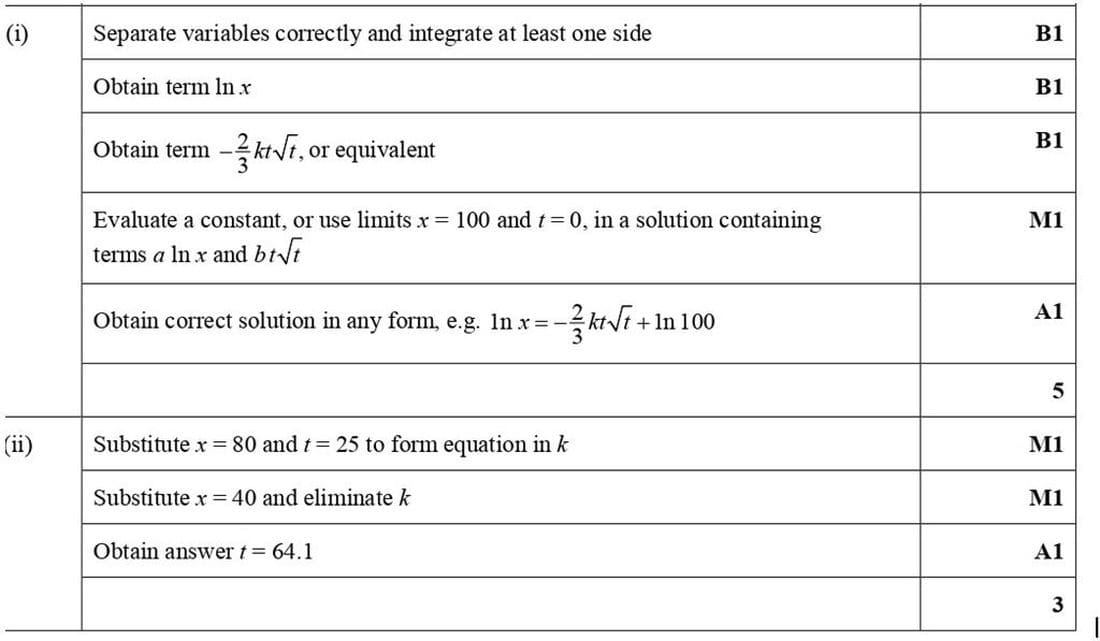
In a certain chemical reaction the amount, x grams, of a substance is decreasing. The differential equation relating x and t, the time in seconds since the reaction started, is
\(\frac{dx}{dt} = -\frac{kx}{\sqrt{t}}\),
\(where k is a positive constant. It is given that x = 100 at the start of the reaction.\)
- Solve the differential equation, obtaining a relation between x, t and k.
- Given that t = 25 when x = 80, find the value of t when x = 40.
Nov 2016 p31 q10
2290
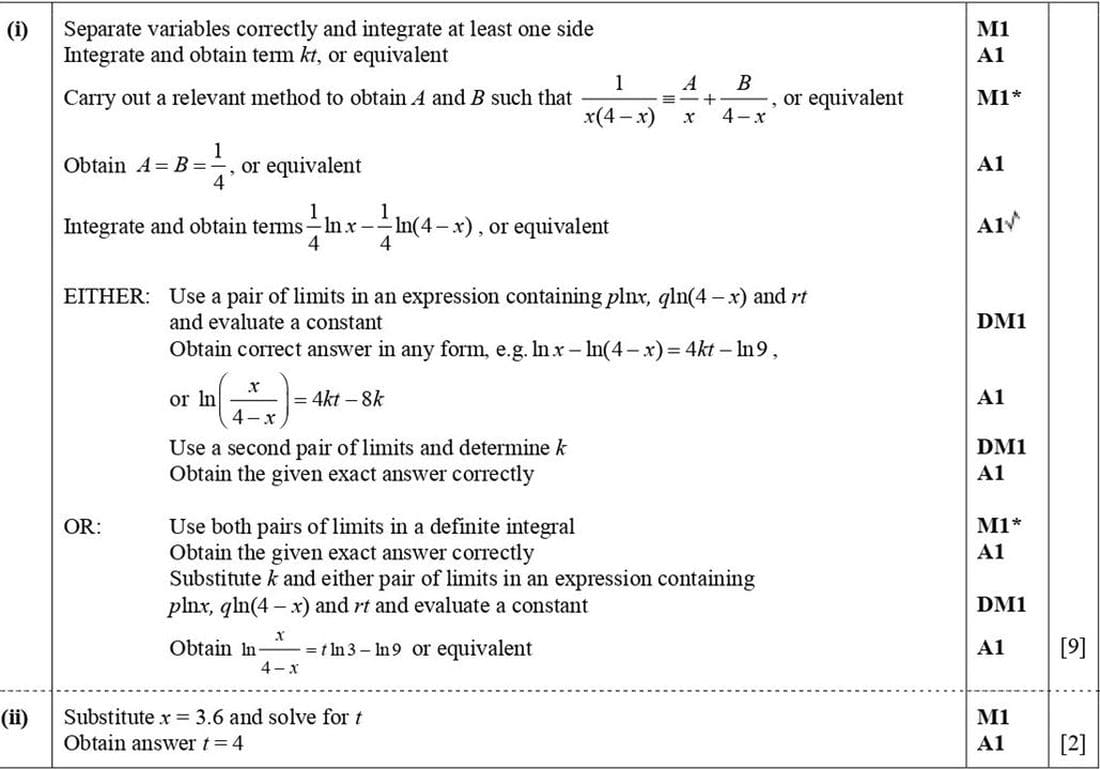
A large field of area 4 km2 is becoming infected with a soil disease. At time t years the area infected is x km2 and the rate of growth of the infected area is given by the differential equation \(\frac{dx}{dt} = kx(4-x)\), where k is a positive constant. It is given that when t = 0, x = 0.4 and that when t = 2, x = 2.
- Solve the differential equation and show that \(k = \frac{1}{4} \ln 3\).
- Find the value of t when 90% of the area of the field is infected.
June 2015 p33 q7
2291
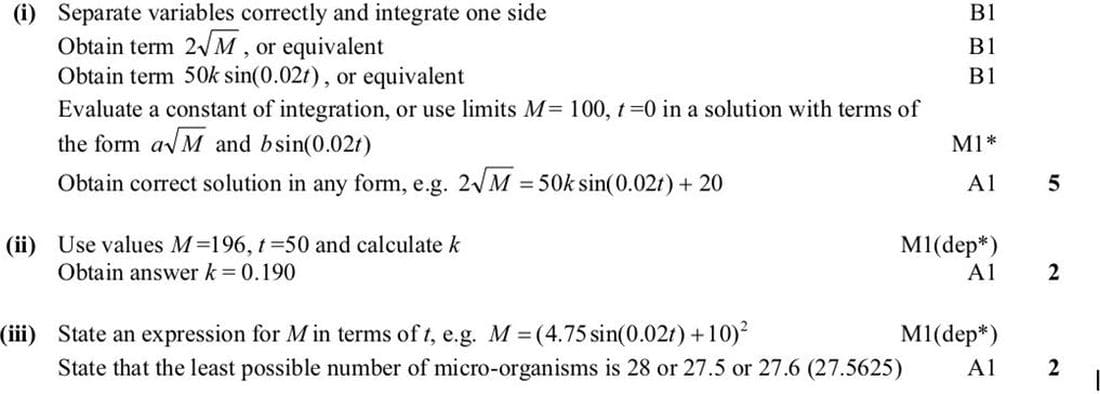
The number of micro-organisms in a population at time t is denoted by M. At any time the variation in M is assumed to satisfy the differential equation
\(\frac{dM}{dt} = k(\sqrt{M}) \cos(0.02t)\),
\(where k is a constant and M is taken to be a continuous variable. It is given that when t = 0, M = 100.\)
- Solve the differential equation, obtaining a relation between M, k and t.
- Given also that M = 196 when t = 50, find the value of k.
- Obtain an expression for M in terms of t and find the least possible number of micro-organisms.
June 2015 p32 q9
2292
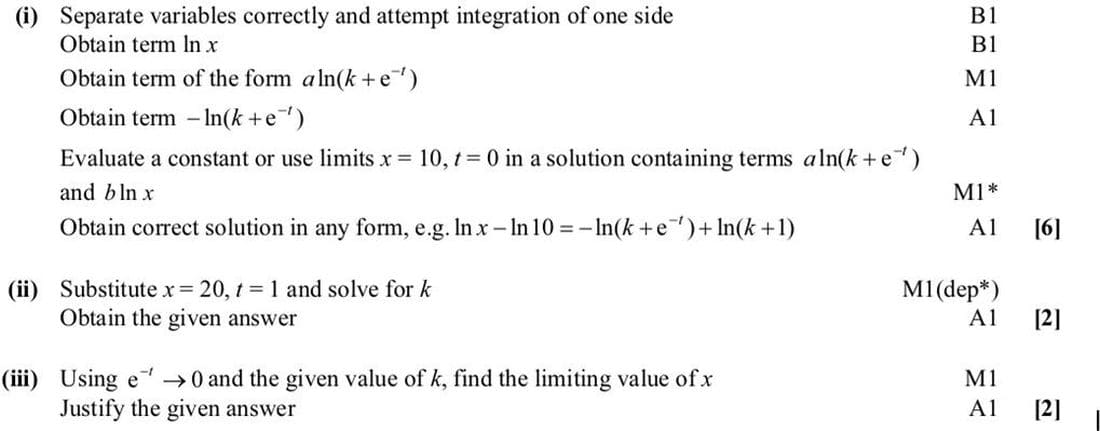
The number of organisms in a population at time t is denoted by x. Treating x as a continuous variable, the differential equation satisfied by x and t is
\(\frac{dx}{dt} = \frac{xe^{-t}}{k + e^{-t}},\)
where k is a positive constant.
- Given that x = 10 when t = 0, solve the differential equation, obtaining a relation between x, k, and t.
- Given also that x = 20 when t = 1, show that k = 1 - \(\frac{2}{e}\).
- Show that the number of organisms never reaches 48, however large t becomes.
Nov 2014 p31 q7
2293
In a certain country the government charges tax on each litre of petrol sold to motorists. The revenue per year is \(R\) million dollars when the rate of tax is \(x\) dollars per litre. The variation of \(R\) with \(x\) is modelled by the differential equation
\(\frac{dR}{dx} = R \left( \frac{1}{x} - 0.57 \right),\)
where \(R\) and \(x\) are taken to be continuous variables. When \(x = 0.5, R = 16.8\).
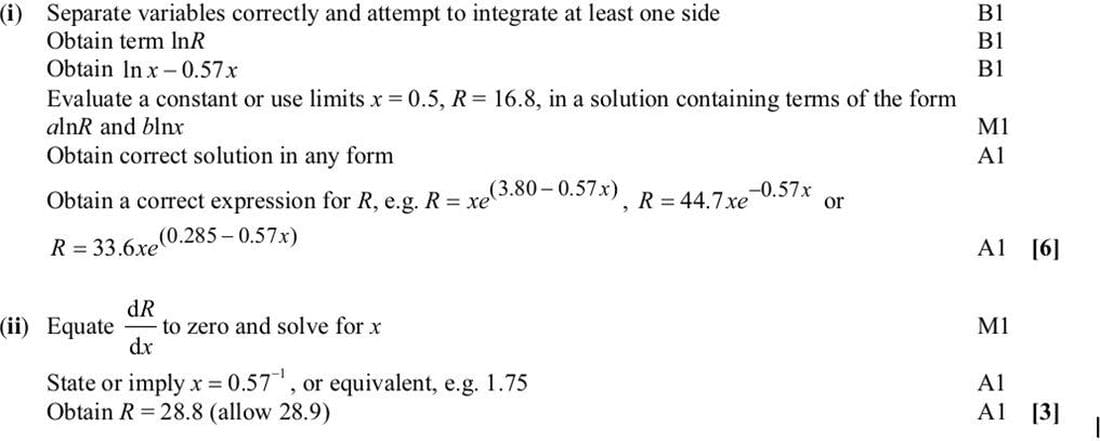
(i) Solve the differential equation and obtain an expression for \(R\) in terms of \(x\). [6]
(ii) This model predicts that \(R\) cannot exceed a certain amount. Find this maximum value of \(R\). [3]