Exam-Style Problems
⬅ Back to SubchapterNov 2018 p31 q5
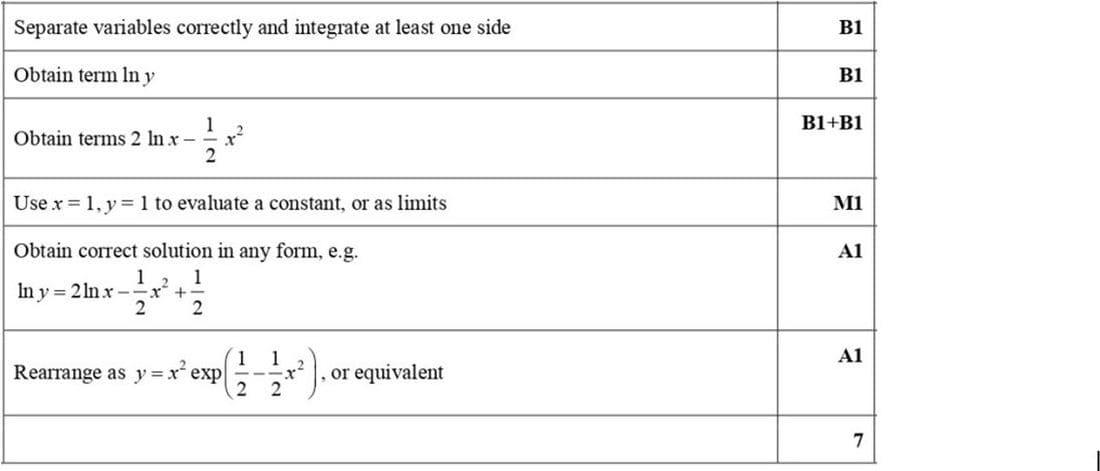
The coordinates \((x, y)\) of a general point on a curve satisfy the differential equation \(x \frac{dy}{dx} = (2 - x^2)y\).
The curve passes through the point \((1, 1)\). Find the equation of the curve, obtaining an expression for \(y\) in terms of \(x\).
Nov 2017 p32 q5
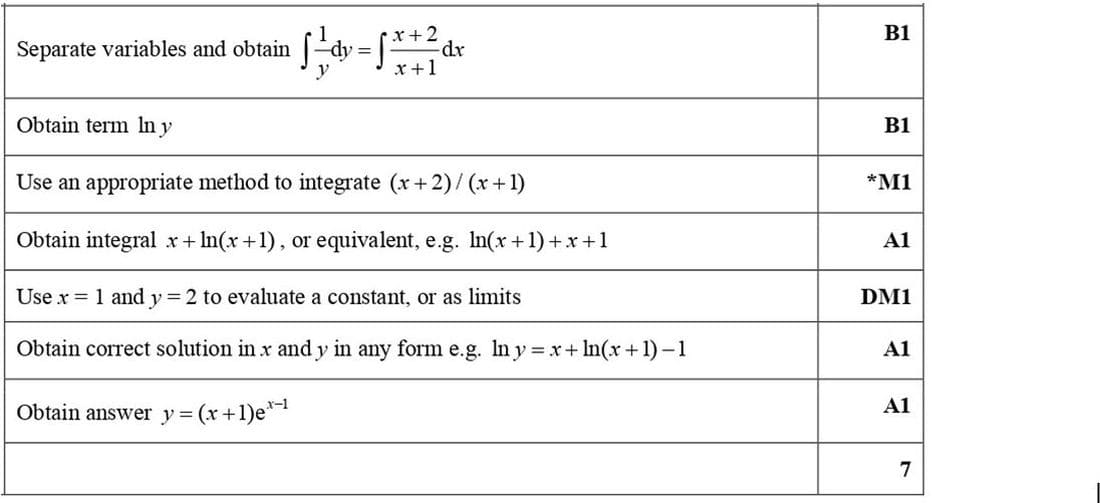
The variables x and y satisfy the differential equation
\((x+1) \frac{dy}{dx} = y(x+2),\)
and it is given that \(y = 2\) when \(x = 1\). Solve the differential equation and obtain an expression for \(y\) in terms of \(x\).
June 2016 p31 q4
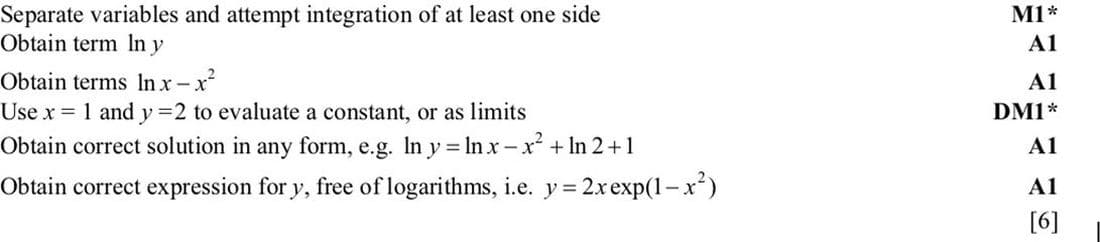
The variables x and y satisfy the differential equation
\(x \frac{dy}{dx} = y(1 - 2x^2)\),
and it is given that \(y = 2\) when \(x = 1\). Solve the differential equation and obtain an expression for y in terms of x in a form not involving logarithms.
June 2013 p33 q8
The variables x and t satisfy the differential equation
\(t \frac{dx}{dt} = \frac{k - x^3}{2x^2}\),
for \(t > 0\), where \(k\) is a constant. When \(t = 1, x = 1\) and when \(t = 4, x = 2\).
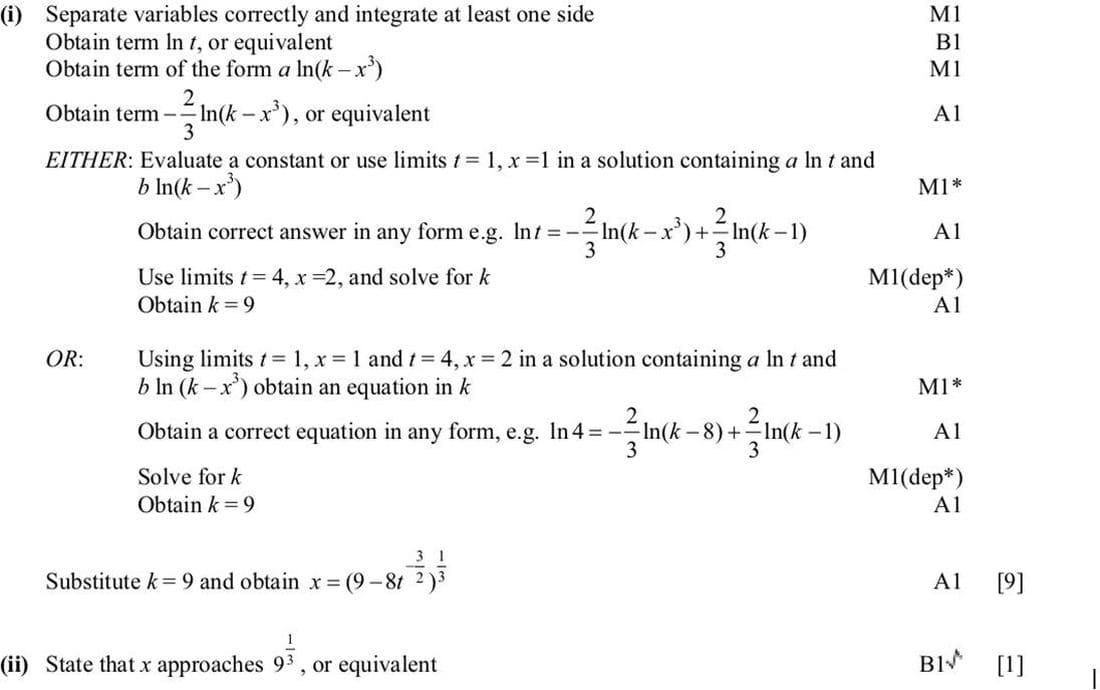
(i) Solve the differential equation, finding the value of \(k\) and obtaining an expression for \(x\) in terms of \(t\). [9]
(ii) State what happens to the value of \(x\) as \(t\) becomes large. [1]