Exam-Style Problems
⬅ Back to SubchapterJune 2014 p12 q7
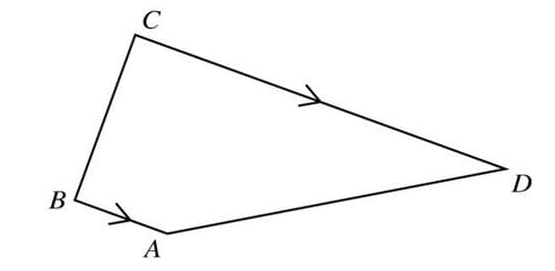
The diagram shows a trapezium ABCD in which BA is parallel to CD. The position vectors of A, B, and C relative to an origin O are given by
\(\overrightarrow{OA} = \begin{pmatrix} 3 \\ 4 \\ 0 \end{pmatrix}, \quad \overrightarrow{OB} = \begin{pmatrix} 1 \\ 3 \\ 2 \end{pmatrix}, \quad \text{and} \quad \overrightarrow{OC} = \begin{pmatrix} 4 \\ 5 \\ 6 \end{pmatrix}.\)
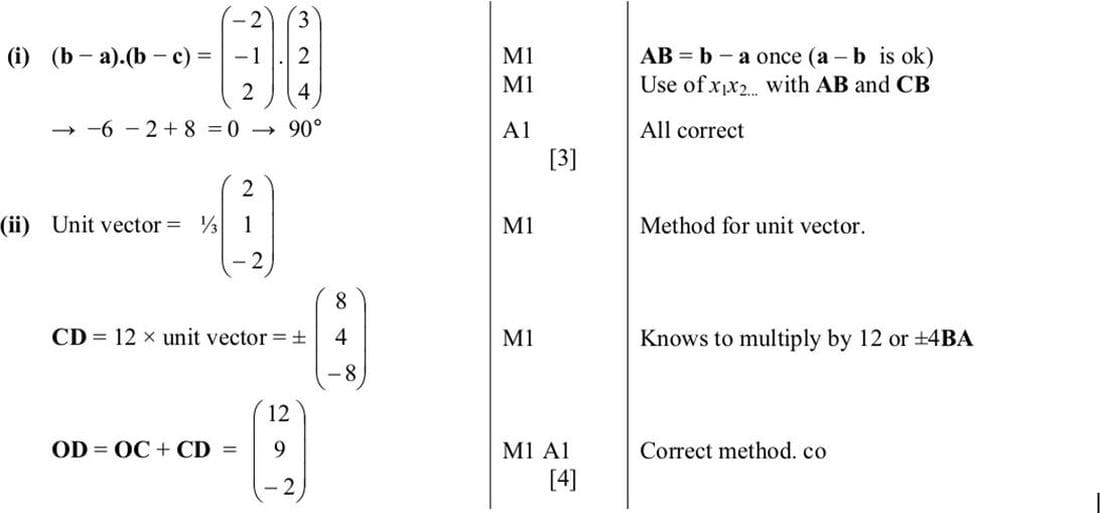
- Use a scalar product to show that AB is perpendicular to BC.
- Given that the length of CD is 12 units, find the position vector of D.
Nov 2022 p31 q11
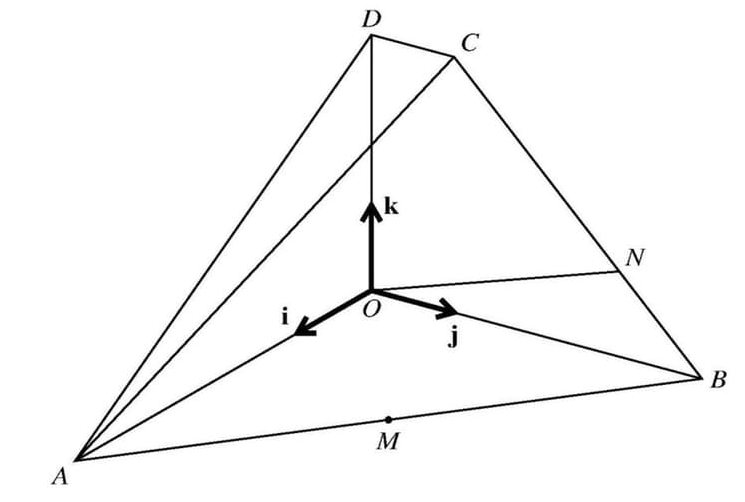
In the diagram, \(OABCD\) is a solid figure in which \(OA = OB = 4\) units and \(OD = 3\) units. The edge \(OD\) is vertical, \(DC\) is parallel to \(OB\) and \(DC = 1\) unit. The base, \(OAB\), is horizontal and angle \(AOB = 90^\circ\). Unit vectors \(\mathbf{i}, \mathbf{j}\) and \(\mathbf{k}\) are parallel to \(OA, OB\) and \(OD\) respectively. The midpoint of \(AB\) is \(M\) and the point \(N\) on \(BC\) is such that \(CN = 2NB\).
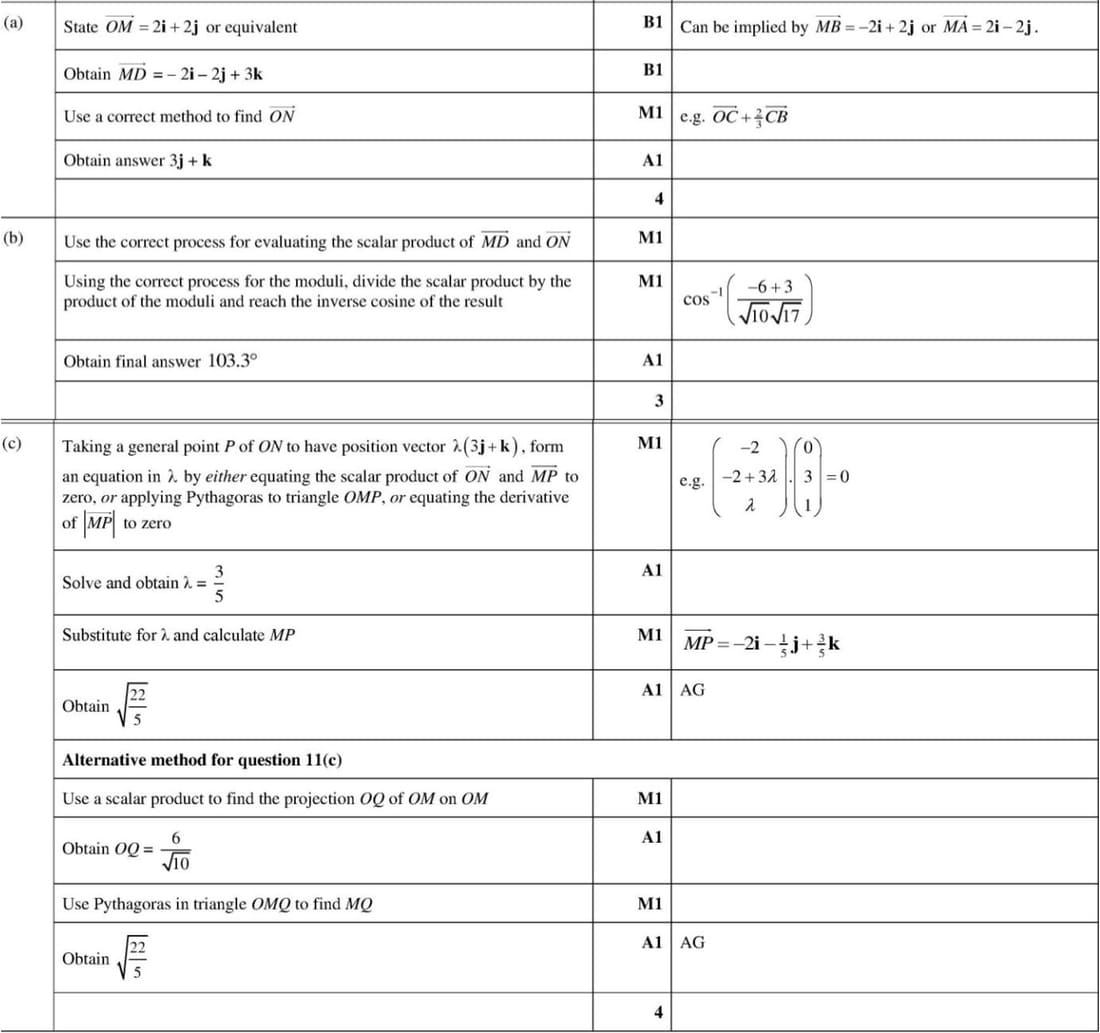
- Express vectors \(\overrightarrow{MD}\) and \(\overrightarrow{ON}\) in terms of \(\mathbf{i}, \mathbf{j}\) and \(\mathbf{k}\).
- Calculate the angle in degrees between the directions of \(\overrightarrow{MD}\) and \(\overrightarrow{ON}\).
- Show that the length of the perpendicular from \(M\) to \(ON\) is \(\sqrt{\frac{22}{5}}\).
Nov 2013 p13 q4
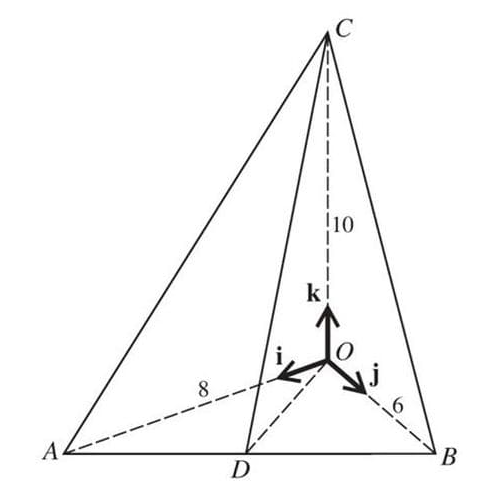
The diagram shows a pyramid OABC in which the edge OC is vertical. The horizontal base OAB is a triangle, right-angled at O, and D is the mid-point of AB. The edges OA, OB and OC have lengths of 8 units, 6 units and 10 units respectively. The unit vectors i, j and k are parallel to \(\overrightarrow{OA}\), \(\overrightarrow{OB}\) and \(\overrightarrow{OC}\) respectively.
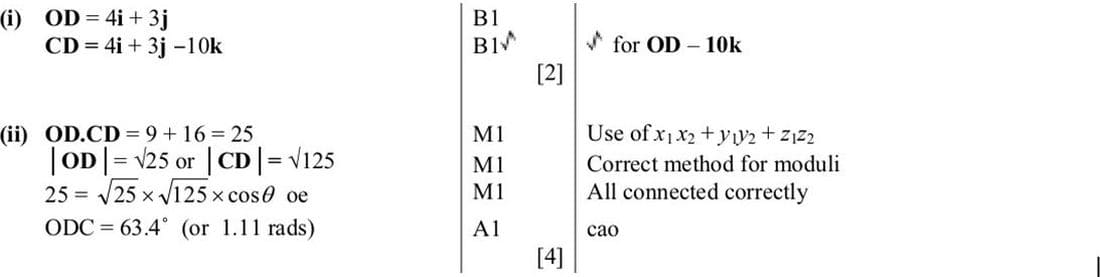
(i) Express each of the vectors \(\overrightarrow{OD}\) and \(\overrightarrow{CD}\) in terms of i, j and k.
(ii) Use a scalar product to find angle ODC.
Nov 2013 p11 q3
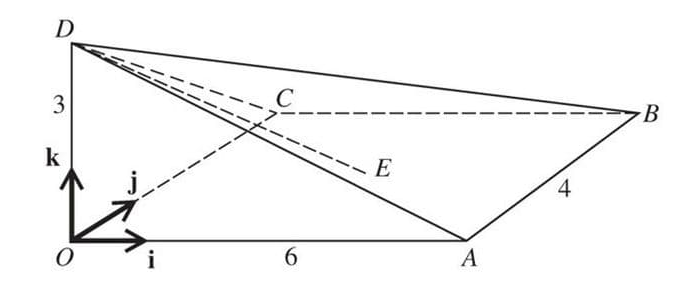
The diagram shows a pyramid OABCD in which the vertical edge OD is 3 units in length. The point E is the centre of the horizontal rectangular base OABC. The sides OA and AB have lengths of 6 units and 4 units respectively. The unit vectors i, j and k are parallel to \(\overrightarrow{OA}\), \(\overrightarrow{OC}\) and \(\overrightarrow{OD}\) respectively.
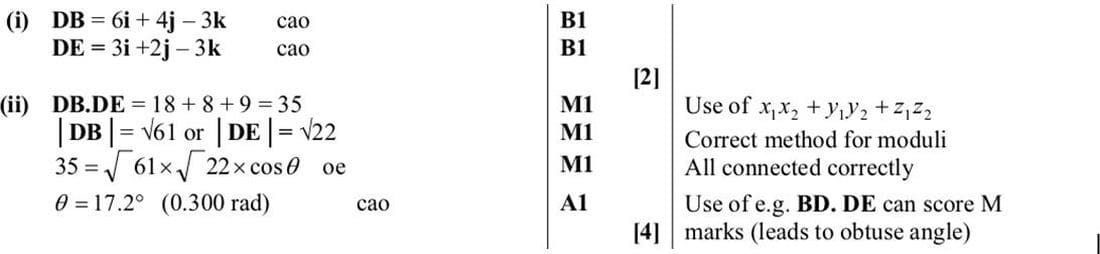
- Express each of the vectors \(\overrightarrow{DB}\) and \(\overrightarrow{DE}\) in terms of i, j and k.
- Use a scalar product to find angle BDE.
June 2013 p13 q8
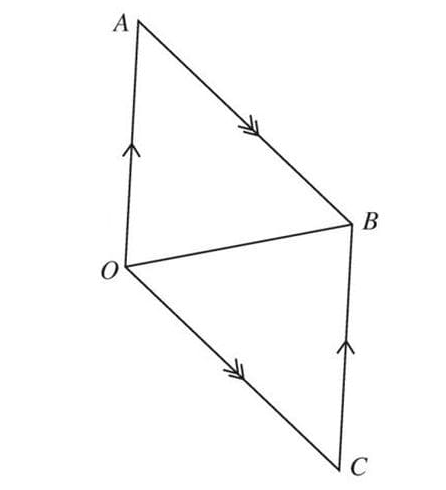
The diagram shows a parallelogram \(OABC\) in which
\(\overrightarrow{OA} = \begin{pmatrix} 3 \\ 3 \\ -4 \end{pmatrix}\) and \(\overrightarrow{OB} = \begin{pmatrix} 5 \\ 0 \\ 2 \end{pmatrix}\).
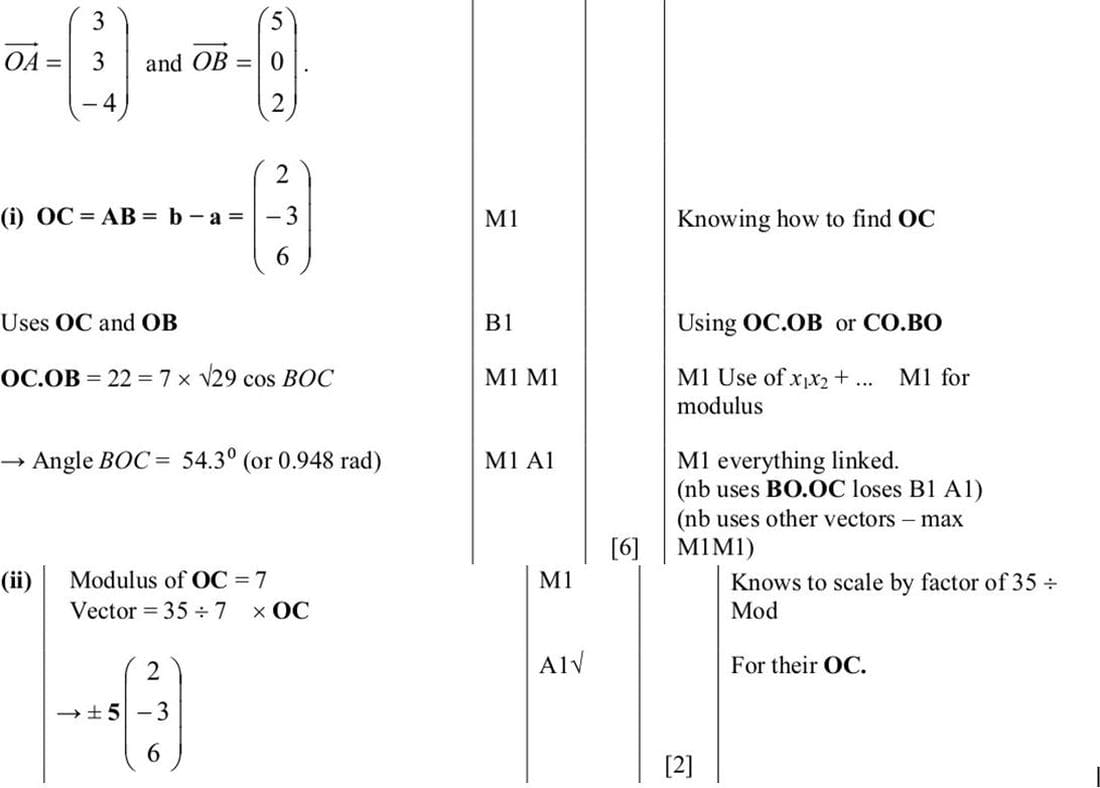
(i) Use a scalar product to find angle \(BOC\).
(ii) Find a vector which has magnitude 35 and is parallel to the vector \(\overrightarrow{OC}\).