Exam-Style Problems
⬅ Back to SubchapterNov 2015 p13 q5
Relative to an origin O, the position vectors of the points A and B are given by
\(\overrightarrow{OA} = \begin{pmatrix} p-6 \\ 2p-6 \\ 1 \end{pmatrix}\) and \(\overrightarrow{OB} = \begin{pmatrix} 4-2p \\ p \\ 2 \end{pmatrix}\),
where \(p\) is a constant.
(i) For the case where OA is perpendicular to OB, find the value of \(p\).
(ii) For the case where OAB is a straight line, find the vectors \(\overrightarrow{OA}\) and \(\overrightarrow{OB}\). Find also the length of the line OA.
Nov 2022 p32 q6
Relative to the origin O, the points A, B and C have position vectors given by
\(\overrightarrow{OA} = \begin{pmatrix} 1 \\ 3 \\ 1 \end{pmatrix}, \quad \overrightarrow{OB} = \begin{pmatrix} 3 \\ 1 \\ 2 \end{pmatrix} \quad \text{and} \quad \overrightarrow{OC} = \begin{pmatrix} 5 \\ 3 \\ -2 \end{pmatrix}.\)
(a) Using a scalar product, find the cosine of angle BAC.
(b) Hence find the area of triangle ABC. Give your answer in a simplified exact form.
Nov 2015 p12 q7
Relative to an origin \(O\), the position vectors of points \(A, B\) and \(C\) are given by
\(\overrightarrow{OA} = \begin{pmatrix} 0 \\ 2 \\ -3 \end{pmatrix}, \quad \overrightarrow{OB} = \begin{pmatrix} 2 \\ 5 \\ -2 \end{pmatrix} \quad \text{and} \quad \overrightarrow{OC} = \begin{pmatrix} 3 \\ p \\ q \end{pmatrix}.\)
(i) In the case where \(ABC\) is a straight line, find the values of \(p\) and \(q\).
(ii) In the case where angle \(BAC\) is \(90^\circ\), express \(q\) in terms of \(p\).
(iii) In the case where \(p = 3\) and the lengths of \(AB\) and \(AC\) are equal, find the possible values of \(q\).
June 2015 p13 q5
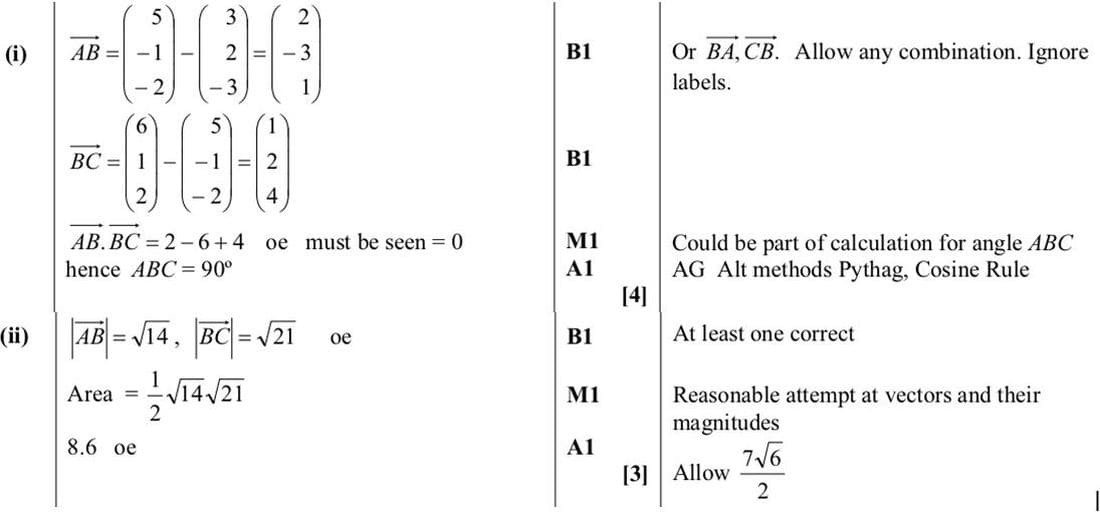
Relative to an origin O, the position vectors of the points A, B and C are given by
\(\overrightarrow{OA} = \begin{pmatrix} 3 \\ 2 \\ -3 \end{pmatrix}, \quad \overrightarrow{OB} = \begin{pmatrix} 5 \\ -1 \\ -2 \end{pmatrix} \quad \text{and} \quad \overrightarrow{OC} = \begin{pmatrix} 6 \\ 1 \\ 2 \end{pmatrix}.\)
(i) Show that angle \(ABC\) is \(90^\circ\).
(ii) Find the area of triangle \(ABC\), giving your answer correct to 1 decimal place.
June 2015 p12 q9
Relative to an origin O, the position vectors of points A and B are given by \(\overrightarrow{OA} = 2\mathbf{i} + 4\mathbf{j} + 4\mathbf{k}\) and \(\overrightarrow{OB} = 3\mathbf{i} + \mathbf{j} + 4\mathbf{k}\).
(i) Use a vector method to find angle \(AOB\).
The point C is such that \(\overrightarrow{AB} = \overrightarrow{BC}\).
(ii) Find the unit vector in the direction of \(\overrightarrow{OC}\).
(iii) Show that triangle OAC is isosceles.