Exam-Style Problems
⬅ Back to SubchapterJune 2020 p32 q10
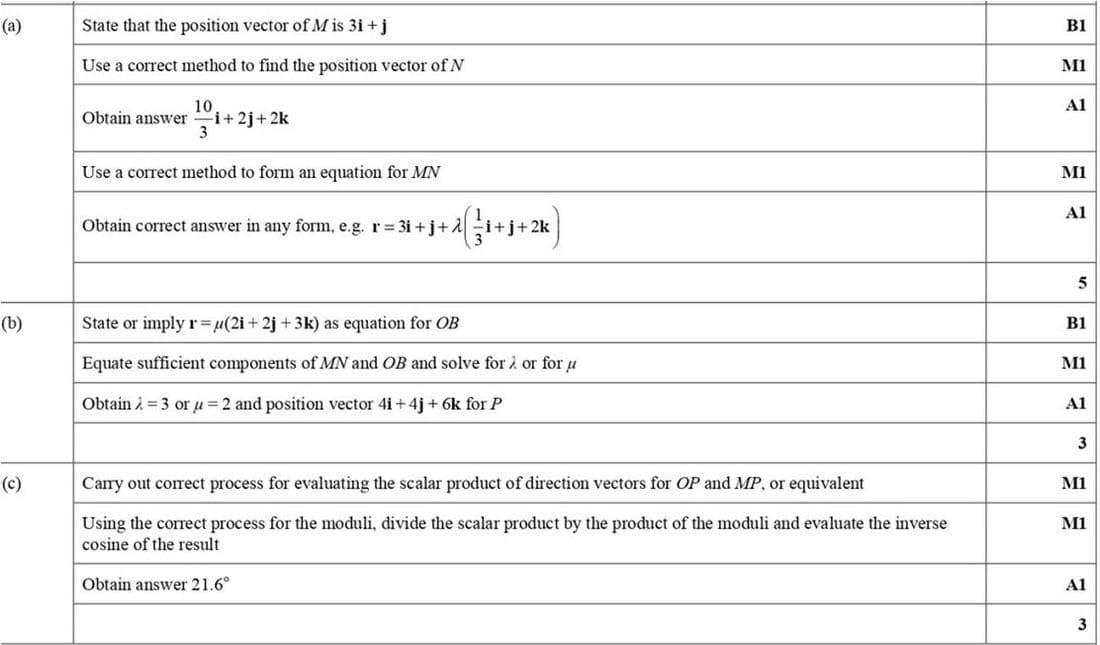
With respect to the origin O, the points A and B have position vectors given by \(\overrightarrow{OA} = 6\mathbf{i} + 2\mathbf{j}\) and \(\overrightarrow{OB} = 2\mathbf{i} + 2\mathbf{j} + 3\mathbf{k}\). The midpoint of OA is M. The point N lying on AB, between A and B, is such that \(AN = 2NB\).
(a) Find a vector equation for the line through M and N.
The line through M and N intersects the line through O and B at the point P.
(b) Find the position vector of P.
(c) Calculate angle OPM, giving your answer in degrees.
Nov 2023 p32 q10
The equations of the lines l and m are given by
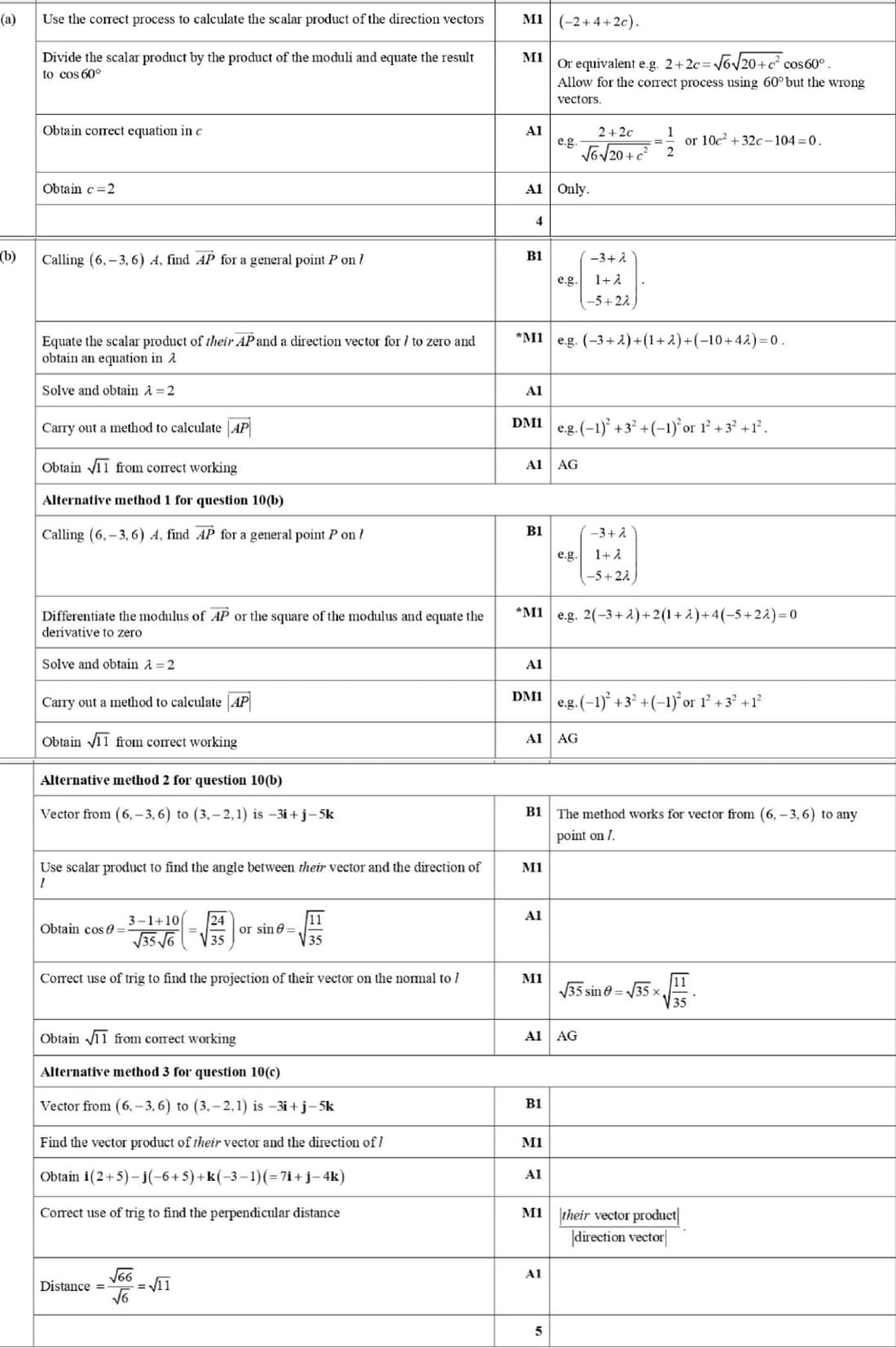
l: \(\mathbf{r} = \begin{pmatrix} 3 \\ -2 \\ 1 \end{pmatrix} + \lambda \begin{pmatrix} 1 \\ 1 \\ 2 \end{pmatrix}\) and m: \(\mathbf{r} = \begin{pmatrix} 6 \\ -3 \\ 6 \end{pmatrix} + \mu \begin{pmatrix} -2 \\ 4 \\ c \end{pmatrix}\),
where c is a positive constant. It is given that the angle between l and m is 60°.
(a) Find the value of c.
(b) Show that the length of the perpendicular from (6, -3, 6) to l is \(\sqrt{11}\).
June 2020 p31 q9
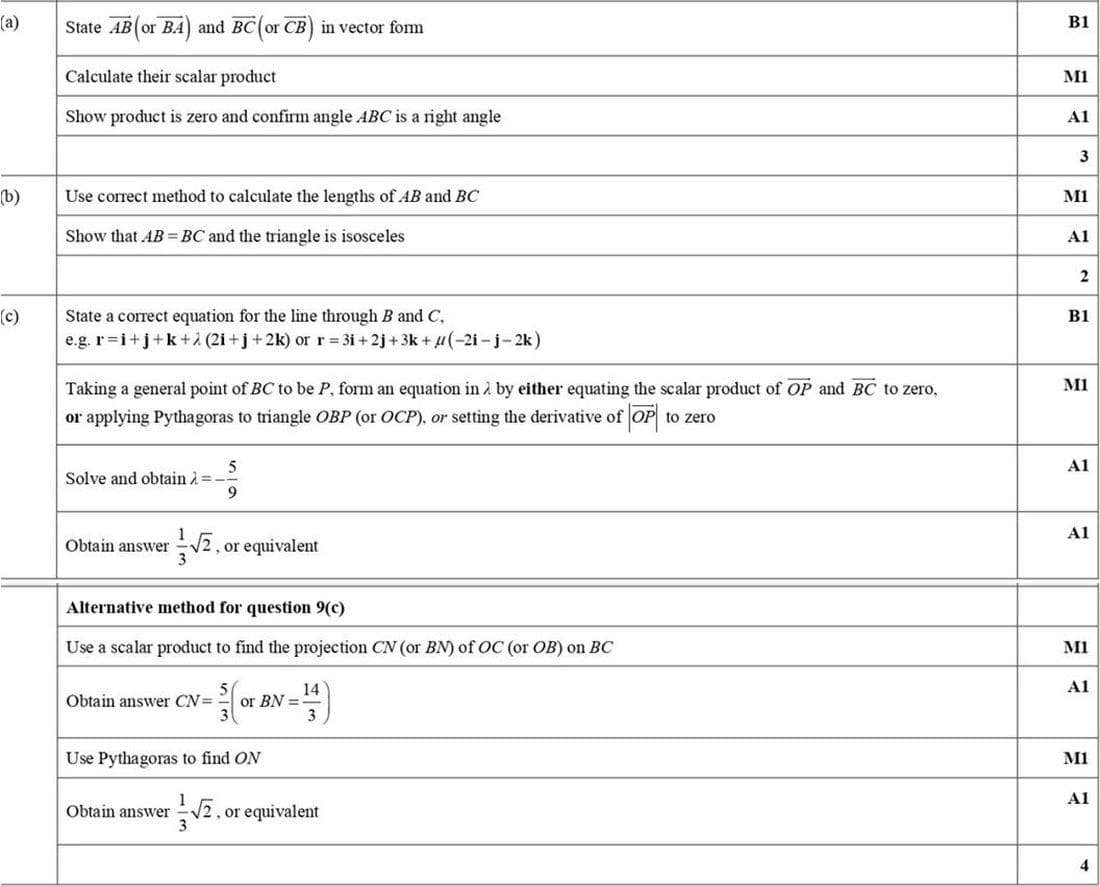
With respect to the origin O, the vertices of a triangle ABC have position vectors \(\overrightarrow{OA} = 2\mathbf{i} + 5\mathbf{k}\), \(\overrightarrow{OB} = 3\mathbf{i} + 2\mathbf{j} + 3\mathbf{k}\) and \(\overrightarrow{OC} = \mathbf{i} + \mathbf{j} + \mathbf{k}\).
(a) Using a scalar product, show that angle ABC is a right angle. [3]
(b) Show that triangle ABC is isosceles. [2]
(c) Find the exact length of the perpendicular from O to the line through B and C. [4]
Problem 2139
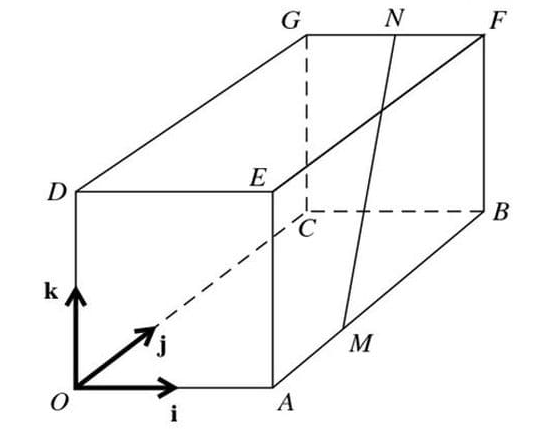
In the diagram, OABCDEFG is a cuboid in which OA = 2 units, OC = 3 units and OD = 2 units. Unit vectors i, j and k are parallel to OA, OC and OD respectively. The point M on AB is such that MB = 2AM. The midpoint of FG is N.
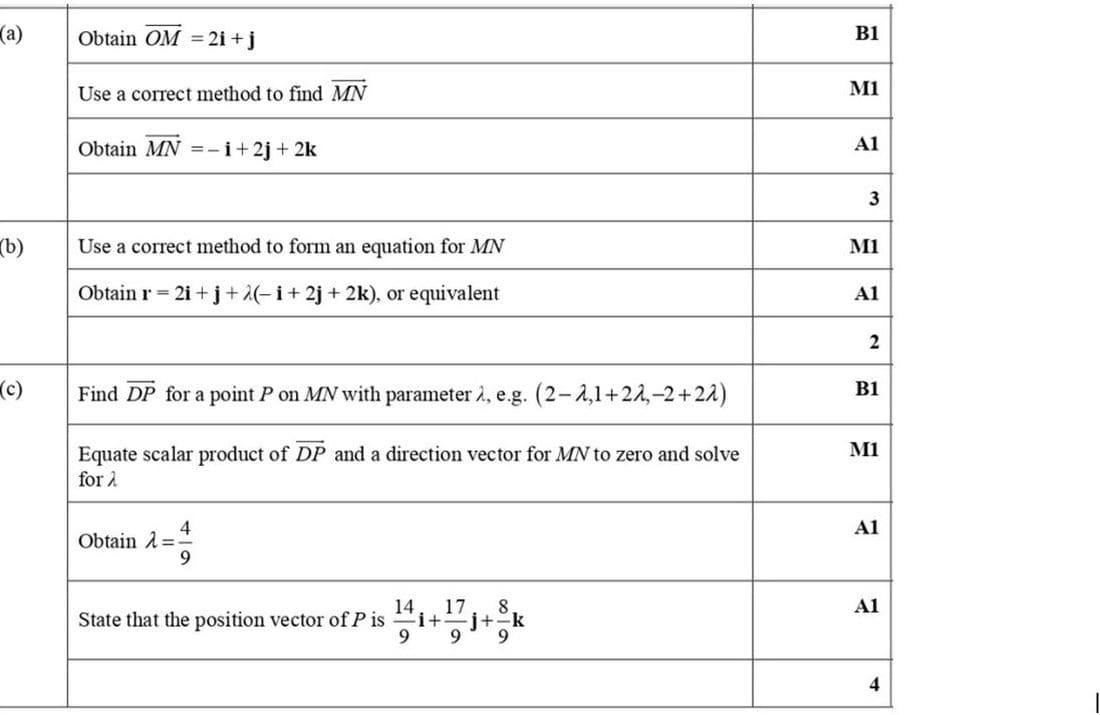
(a) Express the vectors \(\overrightarrow{OM}\) and \(\overrightarrow{MN}\) in terms of i, j and k.
(b) Find a vector equation for the line through M and N.
(c) Find the position vector of P, the foot of the perpendicular from D to the line through M and N.
Problem 2140
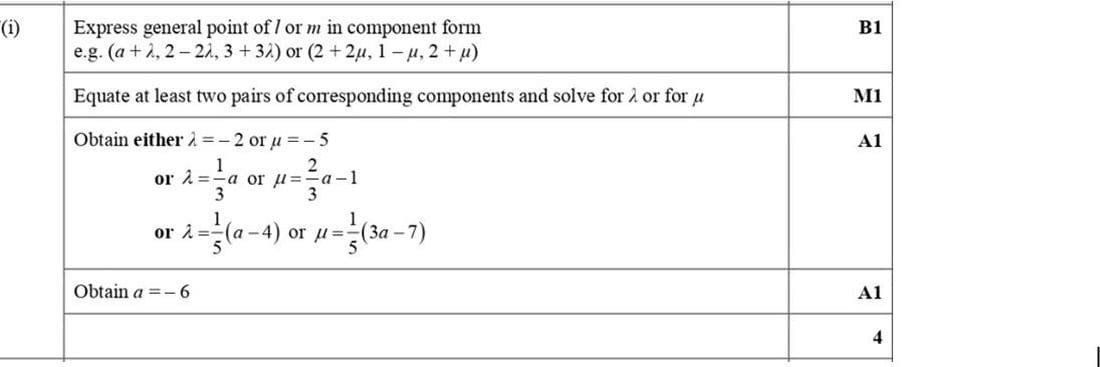
Two lines l and m have equations r = ai + 2j + 3k + λ(i − 2j + 3k) and r = 2i + j + 2k + μ(2i − j + k) respectively, where a is a constant. It is given that the lines intersect.
Find the value of a.