Exam-Style Problems
⬅ Back to SubchapterNov 2012 p31 q4
2026
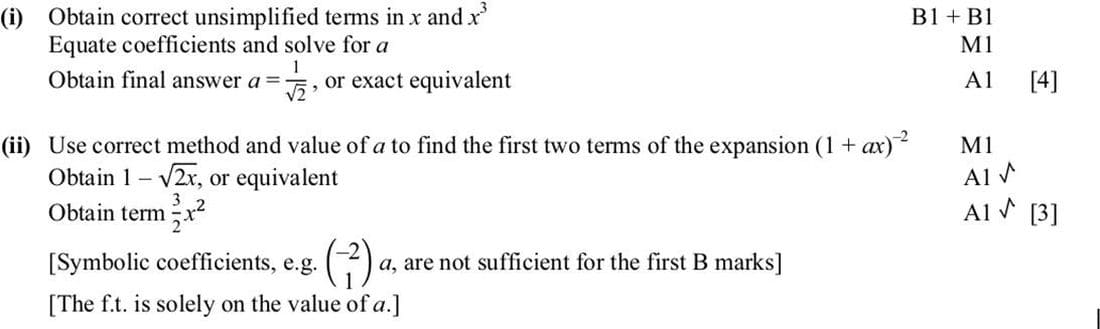
When \((1 + ax)^{-2}\), where \(a\) is a positive constant, is expanded in ascending powers of \(x\), the coefficients of \(x\) and \(x^3\) are equal.
(i) Find the exact value of \(a\). [4]
(ii) When \(a\) has this value, obtain the expansion up to and including the term in \(x^2\), simplifying the coefficients. [3]
Nov 2022 p33 q2
2027
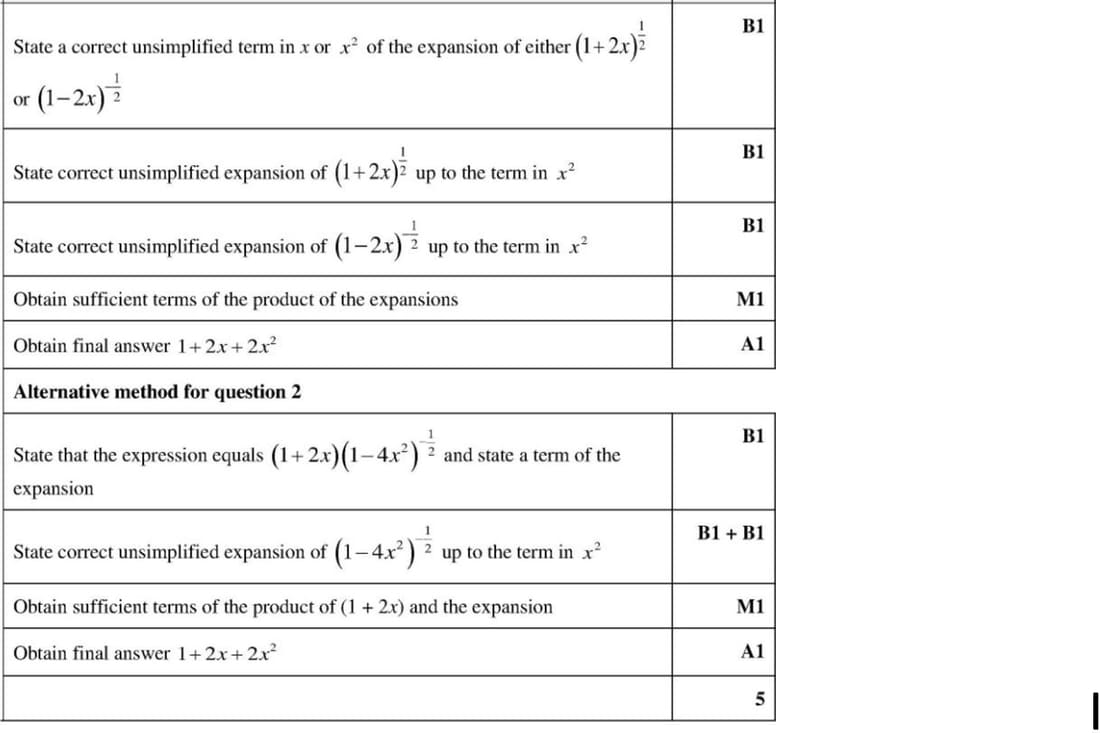
Expand \(\sqrt{\frac{1+2x}{1-2x}}\) in ascending powers of \(x\), up to and including the term in \(x^2\), simplifying the coefficients.
June 2012 p33 q1
2028
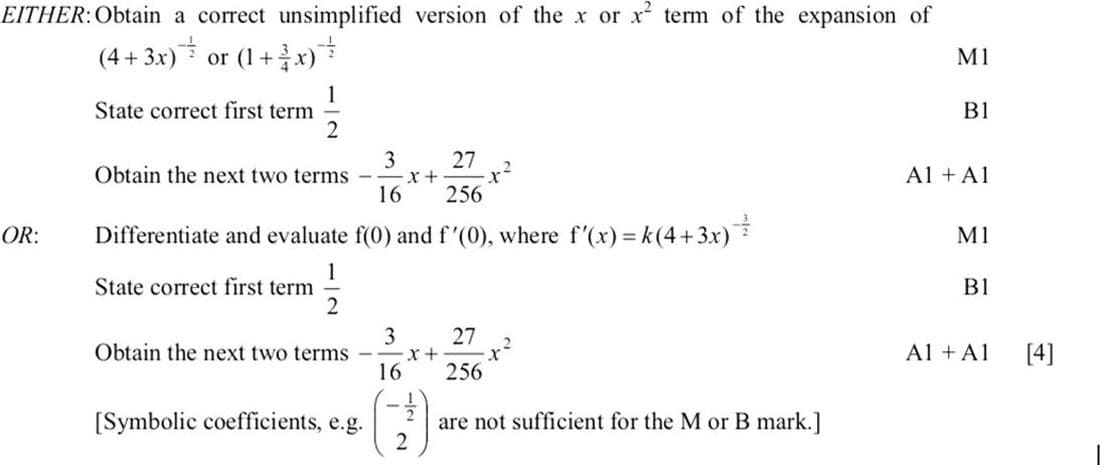
Expand \(\frac{1}{\sqrt{4 + 3x}}\) in ascending powers of \(x\), up to and including the term in \(x^2\), simplifying the coefficients.
June 2012 p32 q3
2029
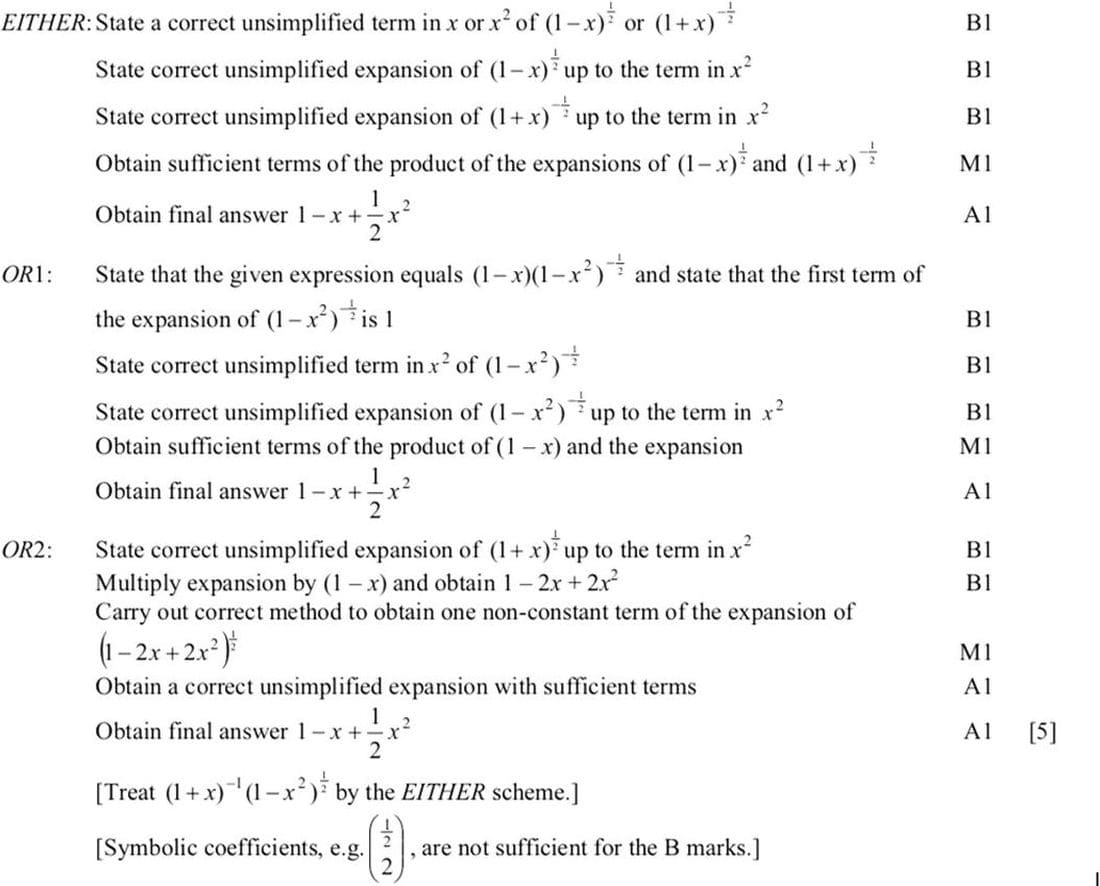
Expand \(\sqrt{\left( \frac{1-x}{1+x} \right)}\) in ascending powers of \(x\), up to and including the term in \(x^2\), simplifying the coefficients.
June 2012 p31 q2
2030
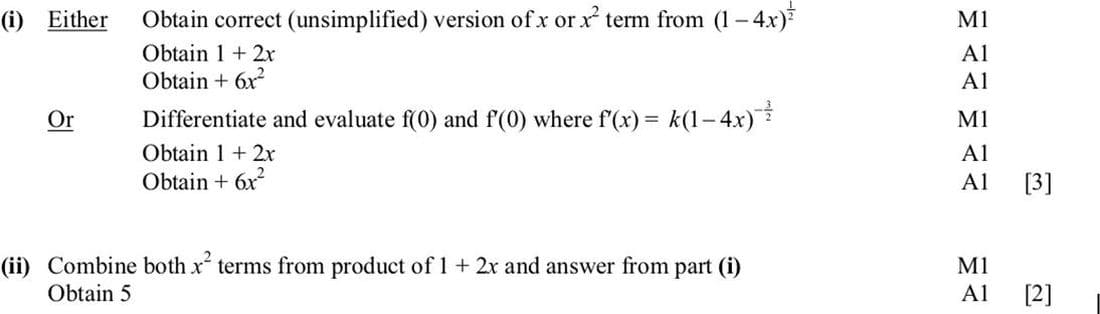
(i) Expand \(\frac{1}{\sqrt{1-4x}}\) in ascending powers of \(x\), up to and including the term in \(x^2\), simplifying the coefficients.
(ii) Hence find the coefficient of \(x^2\) in the expansion of \(\frac{1+2x}{\sqrt{4-16x}}\).