Exam-Style Problems
⬅ Back to SubchapterNov 2022 p32 q8
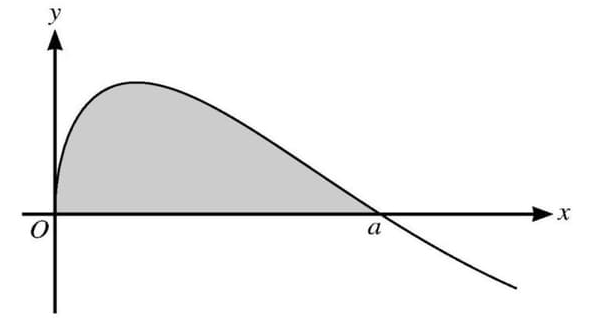
The diagram shows part of the curve \(y = \\sin \\sqrt{x}\). This part of the curve intersects the x-axis at the point where \(x = a\).
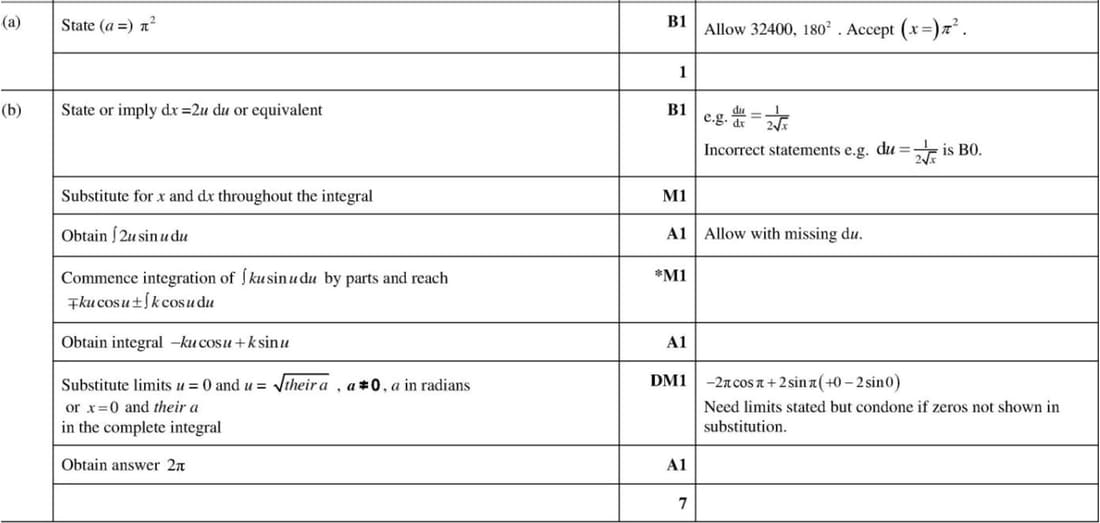
(a) State the exact value of \(a\).
(b) Using the substitution \(u = \\sqrt{x}\), find the exact area of the shaded region in the first quadrant bounded by this part of the curve and the x-axis.
Feb/Mar 2022 p32 q11
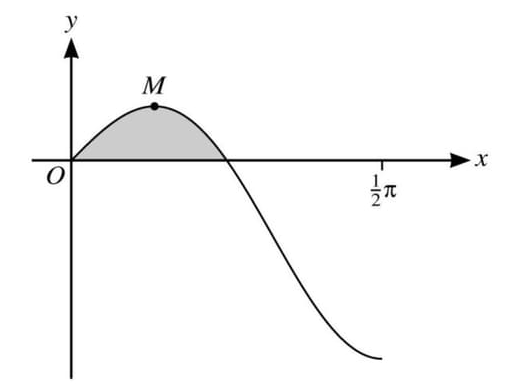
The diagram shows the curve \(y = \sin x \cos 2x\) for \(0 \leq x \leq \frac{1}{2}\pi\), and its maximum point \(M\).
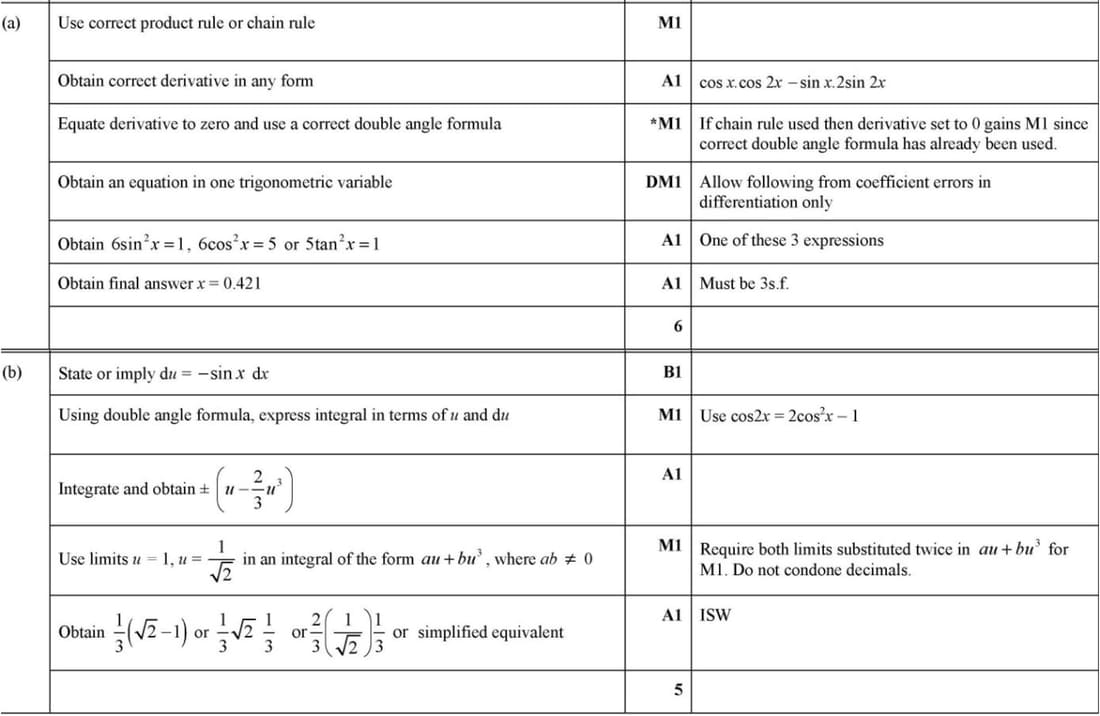
(a) Find the \(x\)-coordinate of \(M\), giving your answer correct to 3 significant figures.
(b) Using the substitution \(u = \cos x\), find the area of the shaded region enclosed by the curve and the \(x\)-axis in the first quadrant, giving your answer in a simplified exact form.
June 2020 p32 q6
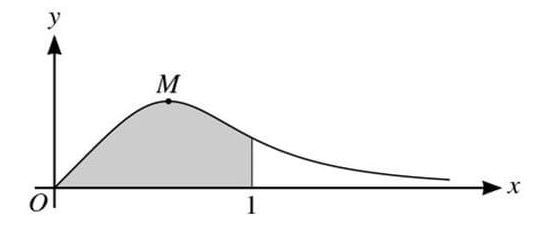
The diagram shows the curve \(y = \frac{x}{1 + 3x^4}\), for \(x \geq 0\), and its maximum point \(M\).
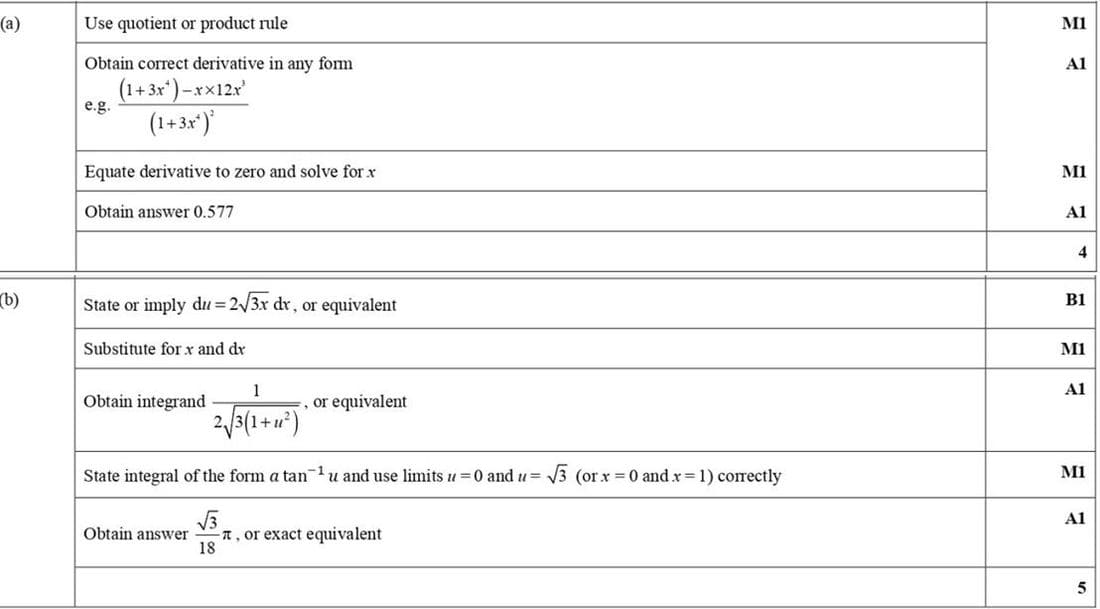
(a) Find the \(x\)-coordinate of \(M\), giving your answer correct to 3 decimal places.
(b) Using the substitution \(u = \sqrt{3}x^2\), find by integration the exact area of the shaded region bounded by the curve, the \(x\)-axis and the line \(x = 1\).
Feb/Mar 2019 p32 q10
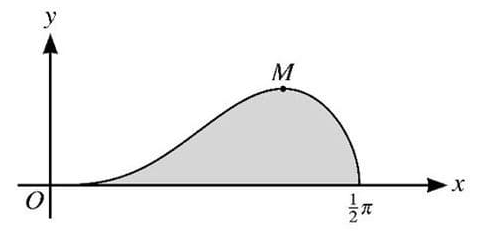
The diagram shows the curve \(y = \\sin^3 x \\sqrt{\\cos x}\) for \(0 \leq x \leq \frac{1}{2} \pi\), and its maximum point \(M\).
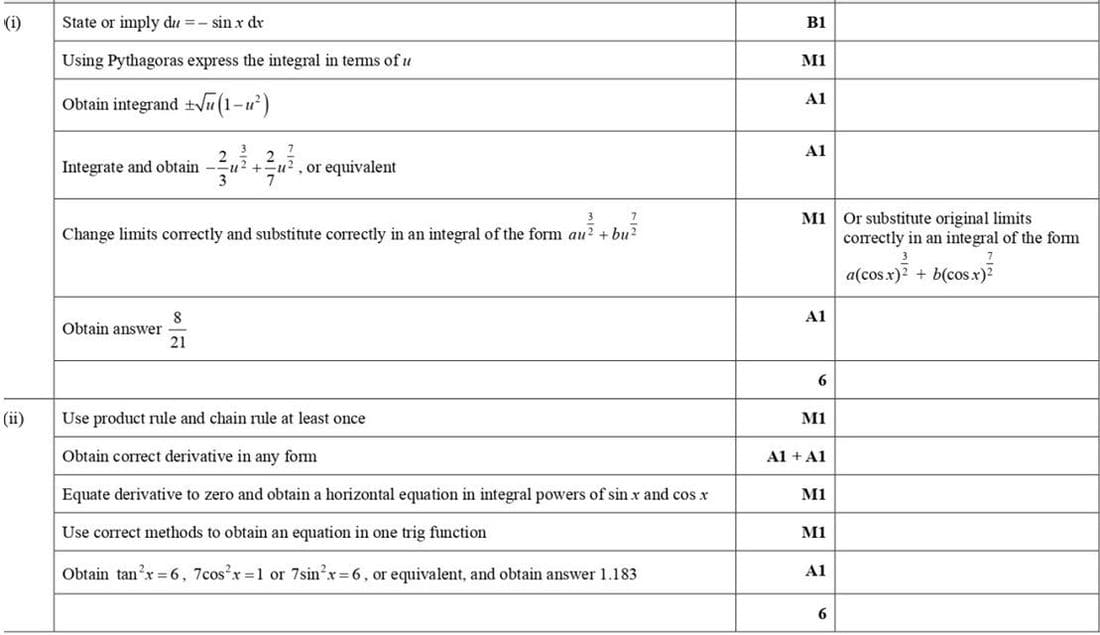
(i) Using the substitution \(u = \\cos x\), find by integration the exact area of the shaded region bounded by the curve and the \(x\)-axis.
(ii) Showing all your working, find the \(x\)-coordinate of \(M\), giving your answer correct to 3 decimal places.
Nov 2018 p31 q7
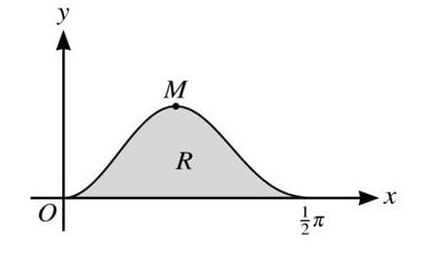
The diagram shows the curve \(y = 5 \sin^2 x \cos^3 x\) for \(0 \leq x \leq \frac{1}{2} \pi\), and its maximum point \(M\). The shaded region \(R\) is bounded by the curve and the \(x\)-axis.
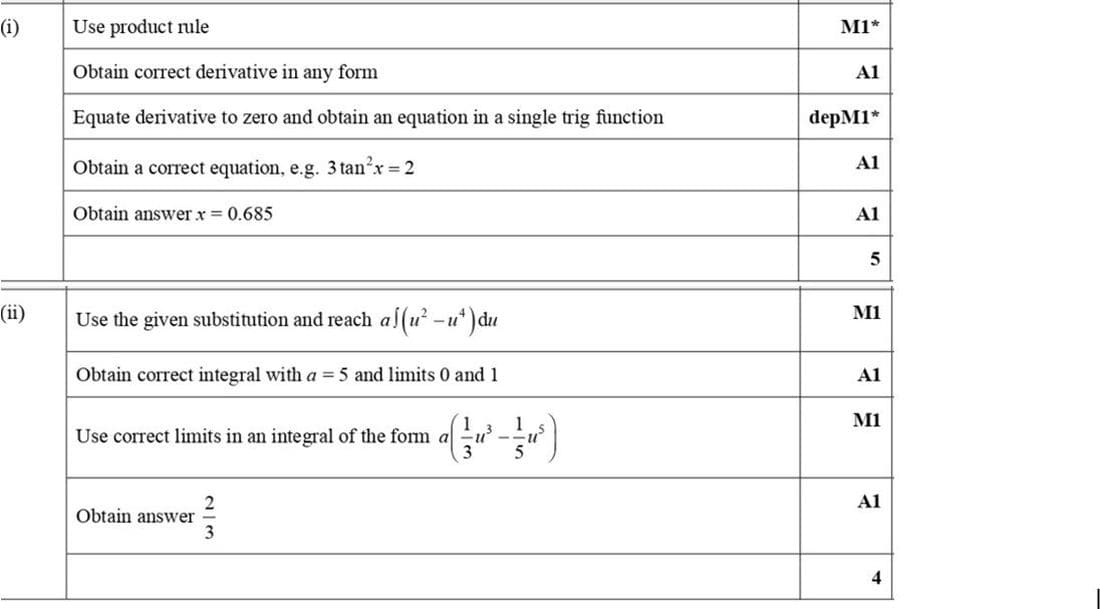
(i) Find the \(x\)-coordinate of \(M\), giving your answer correct to 3 decimal places.
(ii) Using the substitution \(u = \sin x\) and showing all necessary working, find the exact area of \(R\).