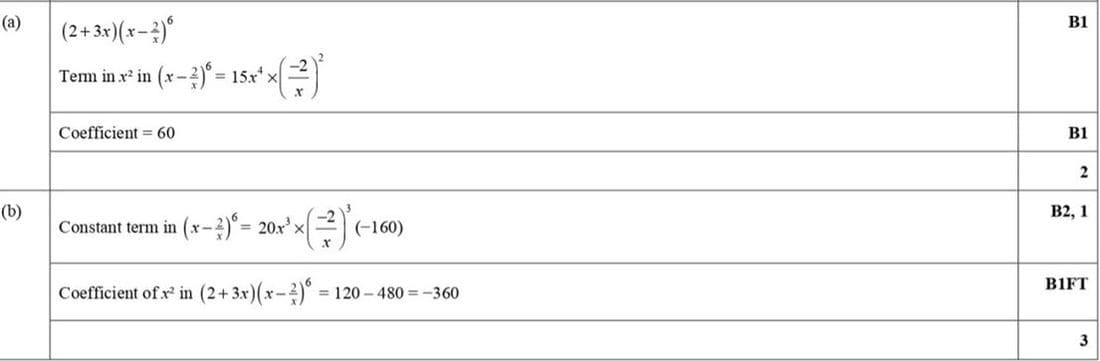
(a) To find the coefficient of \(x^2\) in \(\left(x - \frac{2}{x}\right)^6\), we use the binomial expansion. The general term is given by:
\(T_k = \binom{6}{k} x^{6-k} \left(-\frac{2}{x}\right)^k\).
We need the term where the power of \(x\) is 2:
\(6-k-k = 2 \Rightarrow k = 2\).
Substitute \(k = 2\) into the general term:
\(T_2 = \binom{6}{2} x^{6-2} \left(-\frac{2}{x}\right)^2 = 15x^4 \left(\frac{4}{x^2}\right) = 60x^2\).
Thus, the coefficient of \(x^2\) is 60.
(b) To find the coefficient of \(x^2\) in \((2 + 3x^2)\left(x - \frac{2}{x}\right)^6\), we first find the constant term in \(\left(x - \frac{2}{x}\right)^6\):
The constant term is when the power of \(x\) is 0:
\(6-k-k = 0 \Rightarrow k = 3\).
Substitute \(k = 3\) into the general term:
\(T_3 = \binom{6}{3} x^{6-3} \left(-\frac{2}{x}\right)^3 = 20x^3 \left(-\frac{8}{x^3}\right) = -160\).
Now, consider the expansion \((2 + 3x^2)(-160)\):
The coefficient of \(x^2\) is:
\(3x^2(-160) = -480\).
Adding the contribution from \(2\) times the \(x^2\) term from part (a):
\(2 \times 60 = 120\).
Thus, the total coefficient of \(x^2\) is:
\(120 - 480 = -360\).