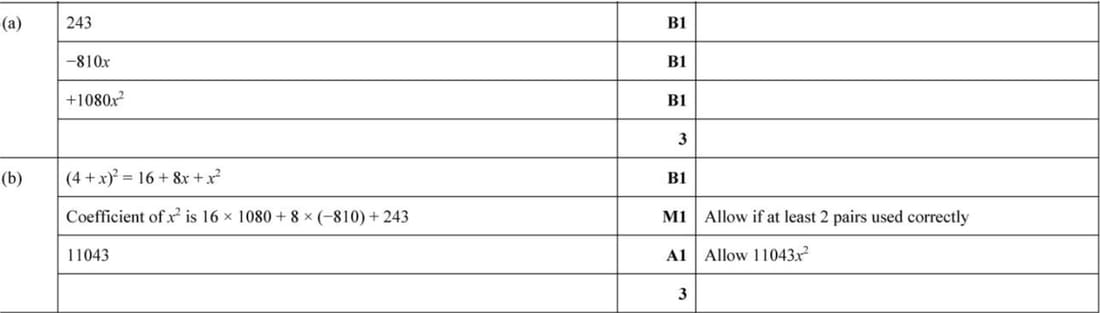
(a) To expand \((3 - 2x)^5\), use the binomial theorem:
\((3 - 2x)^5 = \sum_{k=0}^{5} \binom{5}{k} (3)^{5-k} (-2x)^k\).
The first three terms are:
\(\binom{5}{0} (3)^5 (-2x)^0 = 243\)
\(\binom{5}{1} (3)^4 (-2x)^1 = -810x\)
\(\binom{5}{2} (3)^3 (-2x)^2 = 1080x^2\)
Thus, the first three terms are \(243 - 810x + 1080x^2\).
(b) Expand \((4 + x)^2\):
\((4 + x)^2 = 16 + 8x + x^2\).
To find the coefficient of \(x^2\) in \((4 + x)^2(3 - 2x)^5\), consider:
\(16 \times 1080 + 8 \times (-810) + 243\).
Calculate:
\(16 \times 1080 = 17280\)
\(8 \times (-810) = -6480\)
\(17280 - 6480 + 243 = 11043\)
Thus, the coefficient of \(x^2\) is 11043.