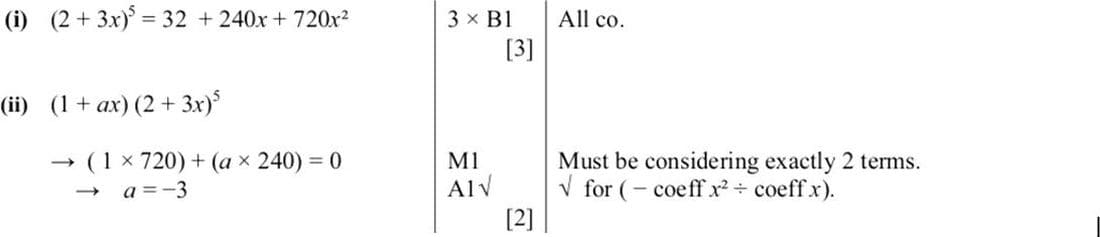
(i) To find the first three terms of \((2 + 3x)^5\), we use the binomial expansion formula:
\((2 + 3x)^5 = \sum_{k=0}^{5} \binom{5}{k} (2)^{5-k} (3x)^k\).
The first three terms are:
\(\binom{5}{0} (2)^5 (3x)^0 = 32\)
\(\binom{5}{1} (2)^4 (3x)^1 = 5 \times 16 \times 3x = 240x\)
\(\binom{5}{2} (2)^3 (3x)^2 = 10 \times 8 \times 9x^2 = 720x^2\)
Thus, the first three terms are \(32 + 240x + 720x^2\).
(ii) To find \(a\) such that there is no \(x^2\) term in \((1 + ax)(2 + 3x)^5\), we consider the expansion:
\((1 + ax)(32 + 240x + 720x^2)\).
The \(x^2\) term comes from:
\(1 \times 720x^2 + ax \times 240x = 720 + 240ax^2\).
Setting the coefficient of \(x^2\) to zero:
\(720 + 240a = 0\)
\(a = -3\)