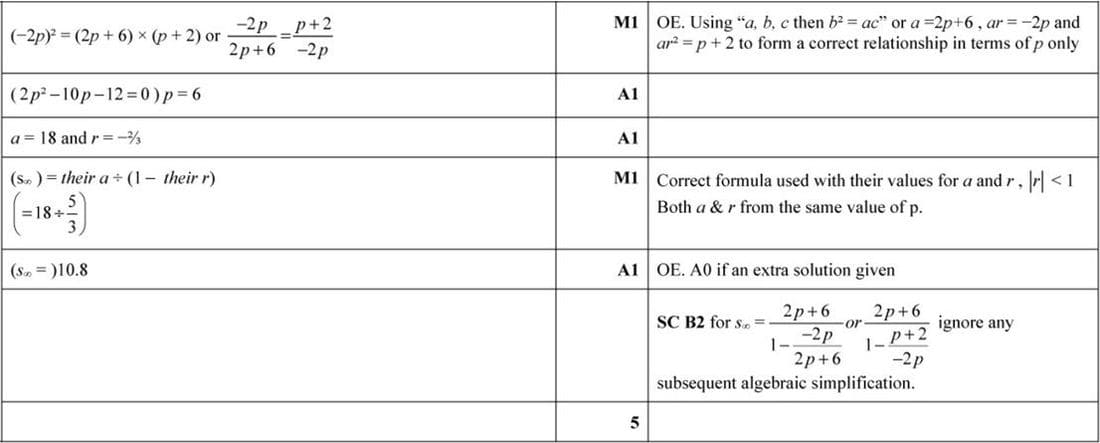
Given the terms of the geometric progression: \(a = 2p + 6\), \(ar = -2p\), and \(ar^2 = p + 2\).
Using the relationship \(b^2 = ac\), we have:
\((-2p)^2 = (2p + 6) \times (p + 2)\)
\(4p^2 = (2p + 6)(p + 2)\)
Expanding and simplifying:
\(4p^2 = 2p^2 + 4p + 12p + 12\)
\(4p^2 = 2p^2 + 16p + 12\)
\(2p^2 - 16p - 12 = 0\)
Solving this quadratic equation for \(p\):
\(p^2 - 8p - 6 = 0\)
Using the quadratic formula \(p = \frac{-b \pm \sqrt{b^2 - 4ac}}{2a}\):
\(p = \frac{8 \pm \sqrt{64 + 24}}{2}\)
\(p = \frac{8 \pm \sqrt{88}}{2}\)
\(p = \frac{8 \pm 2\sqrt{22}}{2}\)
\(p = 4 \pm \sqrt{22}\)
Since \(p\) is positive, we take \(p = 6\).
Substituting \(p = 6\) back into the expressions for \(a\) and \(r\):
\(a = 2(6) + 6 = 18\)
\(r = \frac{-2(6)}{18} = -\frac{2}{3}\)
The sum to infinity of a geometric progression is given by:
\(S_\infty = \frac{a}{1 - r}\)
\(S_\infty = \frac{18}{1 - (-\frac{2}{3})}\)
\(S_\infty = \frac{18}{1 + \frac{2}{3}}\)
\(S_\infty = \frac{18}{\frac{5}{3}}\)
\(S_\infty = 18 \times \frac{3}{5}\)
\(S_\infty = 10.8\)