0606 P23 - Nov 2017 - Q1 - 5 marks
8672
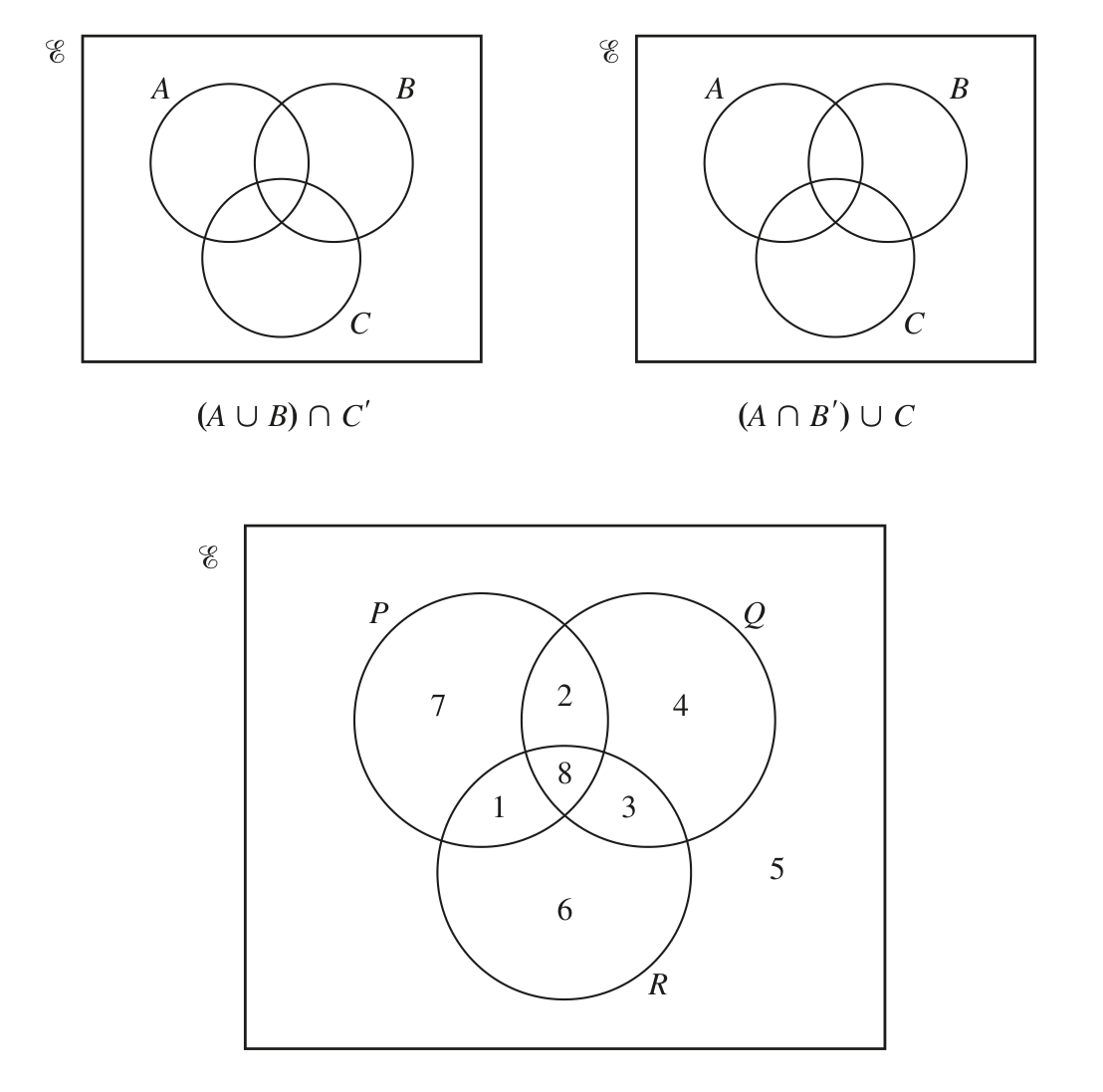
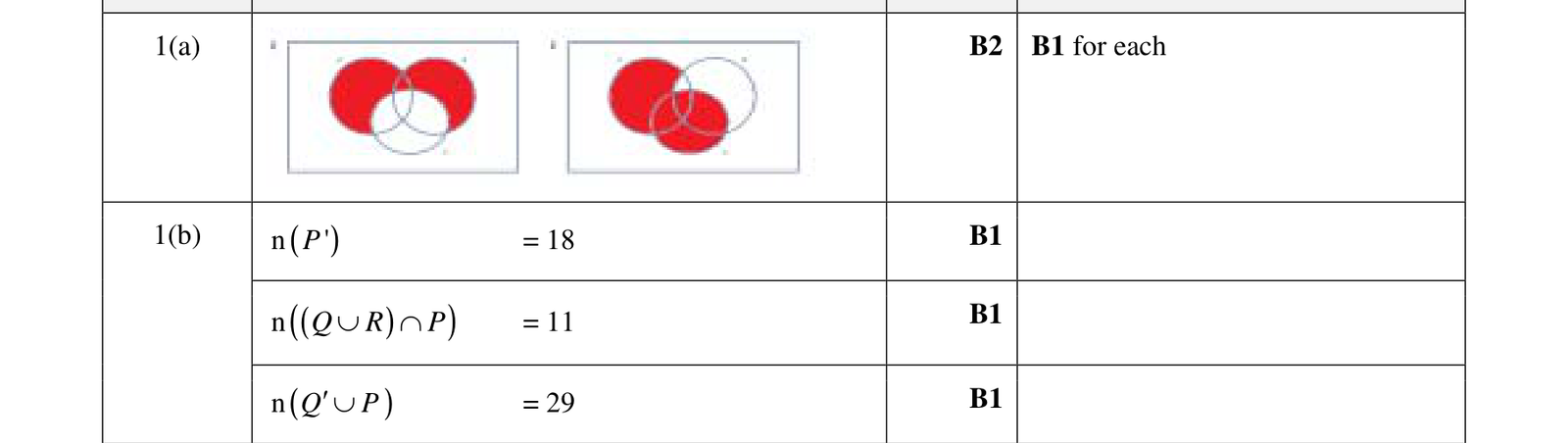
(a) On each diagram, shade the required set:
\((A\cup B)\cap C'\) and \((A\cap B')\cup C\).
(b) The Venn diagram shows the number of elements in each subset. Complete:
\(n(P')\), \(n((Q\cup R)\cap P)\), and \(n(Q'\cup P)\).
Solution
Answer: \(n(P')=18\), \(n((Q\cup R)\cap P)=11\), \(n(Q'\cup P)=29\).
For \(n(P')\), count all regions outside \(P\):
\(4+3+6+5=18.\)
So \(n(P')=18\).
For \(n((Q\cup R)\cap P)\), we need the elements that are in \(P\) and also in either \(Q\) or \(R\).
Those regions contain \(2\), \(1\), and \(8\), so
\(n((Q\cup R)\cap P)=2+1+8=11.\)
For \(n(Q'\cup P)\), it is easier to count the complement. The only elements not in \(Q'\cup P\) are those in \(Q\) but not in \(P\).
These regions contain \(4\) and \(3\), so there are \(7\) elements outside \(Q'\cup P\).
The total number of elements is
\(7+2+4+1+8+3+6+5=36.\)
Therefore
\(n(Q'\cup P)=36-7=29.\)