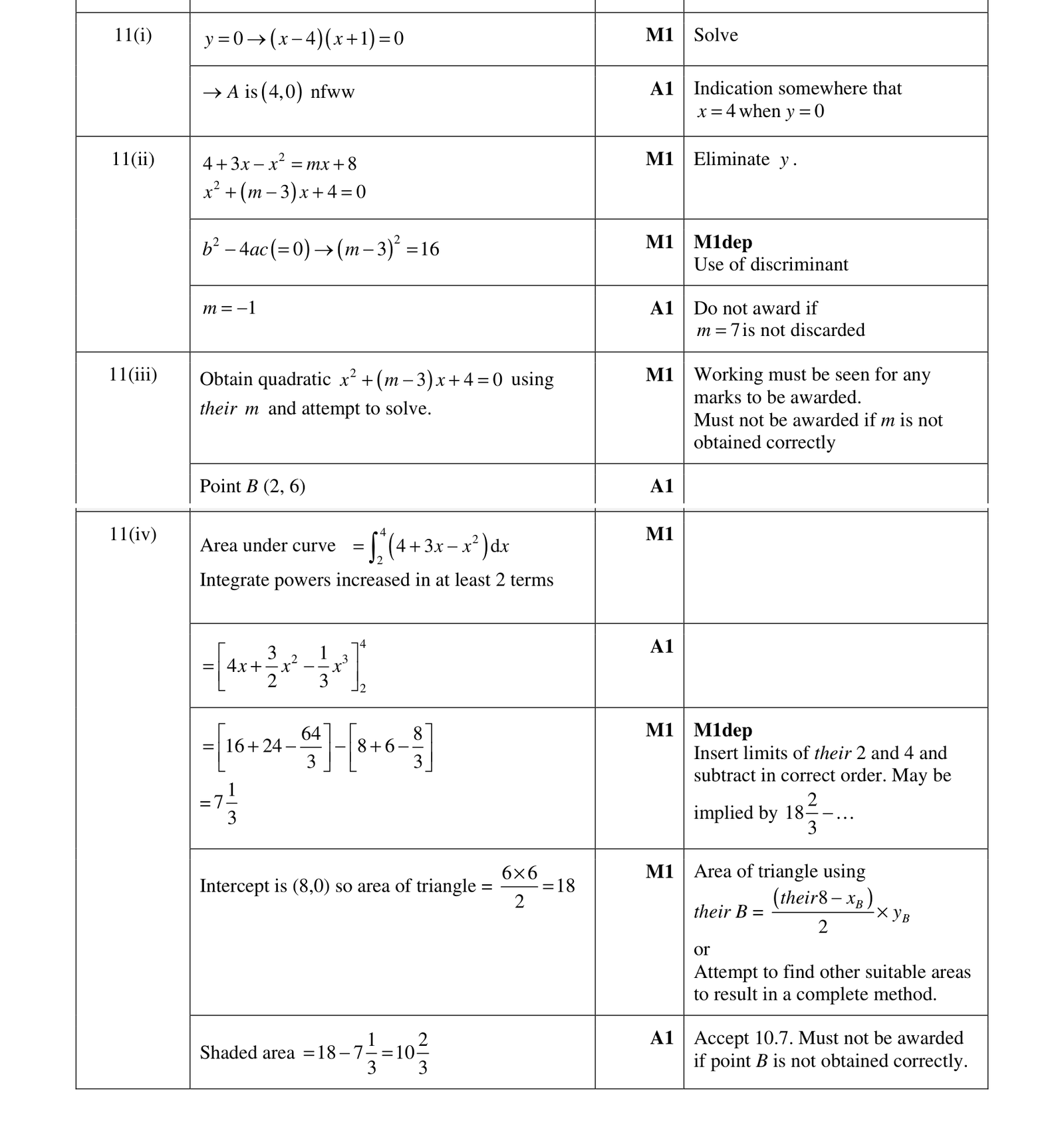
Answer: \(A=(4,0)\), \(m=-1\), \(B=(2,6)\), shaded area \(=10\dfrac23\).
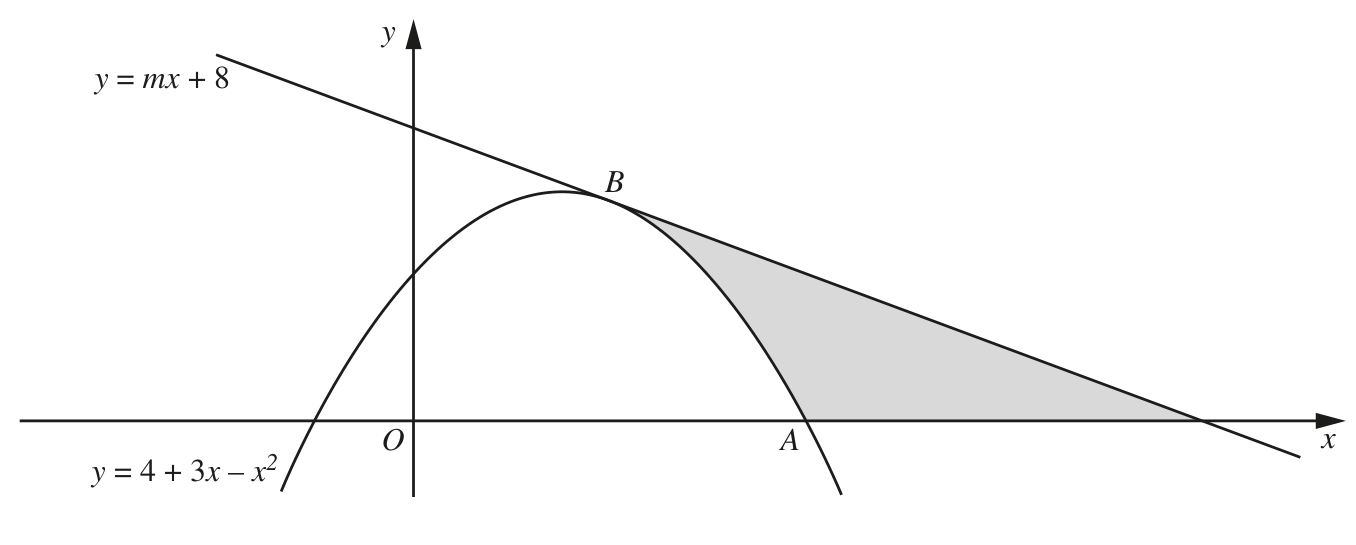
At \(A\), the curve intersects the \(x\)-axis, so \(y=0\):
\(4+3x-x^2=0.\)
Rearrange:
\(x^2-3x-4=0.\)
Factor:
\((x-4)(x+1)=0.\)
The positive \(x\)-intercept is \(x=4\), so
\(A=(4,0).\)
For the tangent, set the curve equal to the line:
\(4+3x-x^2=mx+8.\)
This gives
\(x^2+(m-3)x+4=0.\)
Since the line is a tangent, the discriminant is zero:
\((m-3)^2-16=0.\)
So
\(m-3=\pm4.\)
From the diagram, the tangent has negative gradient, so
\(m=-1.\)
Now use \(m=-1\). The line is
\(y=-x+8.\)
Substitute into the intersection equation:
\(x^2+(-1-3)x+4=0,\)
so
\(x^2-4x+4=0.\)
Thus
\((x-2)^2=0,\)
so \(x=2\). Then
\(y=-2+8=6.\)
Therefore
\(B=(2,6).\)
The line \(y=-x+8\) meets the \(x\)-axis at \(x=8\). The triangle under the tangent line from \(x=2\) to \(x=8\) has base \(6\) and height \(6\), so its area is
\(\dfrac12(6)(6)=18.\)
The area under the curve from \(x=2\) to \(x=4\) is
\(\int_2^4(4+3x-x^2)\,dx.\)
This is
\(\left[4x+\dfrac32x^2-\dfrac13x^3\right]_2^4.\)
Evaluating gives
\(\dfrac{22}{3}=7\dfrac13.\)
The shaded area is the triangle area minus this area under the curve:
\(18-\dfrac{22}{3}=\dfrac{32}{3}.\)
Therefore
\(\boxed{\text{area}=10\dfrac23}.\)