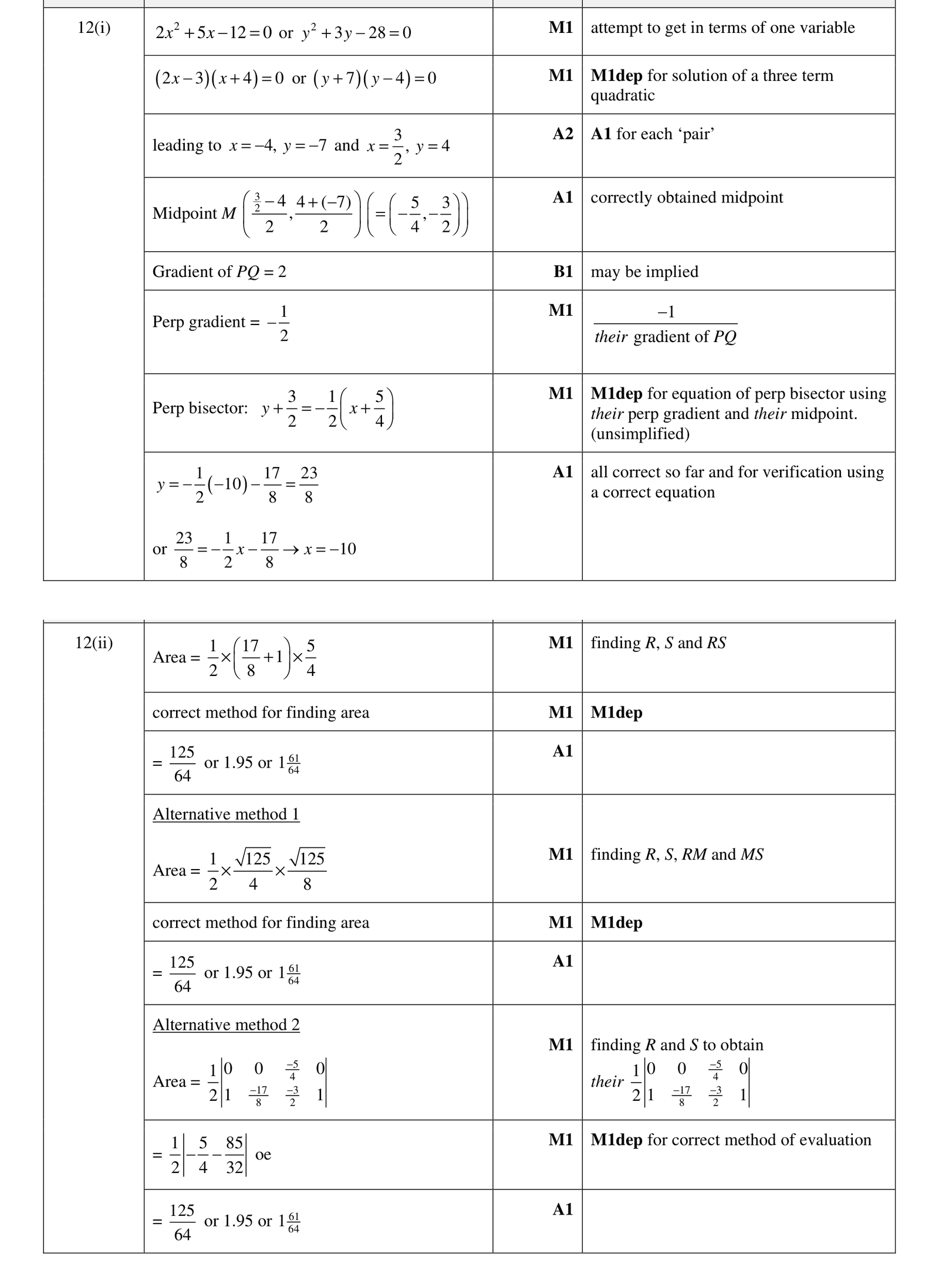
Answer: \(\left(-10,\dfrac{23}{8}\right)\) lies on the perpendicular bisector; area \(=\dfrac{125}{64}\).
Substitute \(y=2x+1\) into \(xy=14-2y\):
\(x(2x+1)=14-2(2x+1).\)
So
\(2x^2+x=12-4x.\)
Hence
\(2x^2+5x-12=0.\)
Factor:
\((2x-3)(x+4)=0.\)
So
\(x=\dfrac32\quad\text{or}\quad x=-4.\)
Using \(y=2x+1\), the corresponding points are
\(\left(\dfrac32,4\right)\quad\text{and}\quad(-4,-7).\)
The midpoint \(M\) is
\(M=\left(\dfrac{\frac32-4}{2},\dfrac{4-7}{2}\right)=\left(-\dfrac54,-\dfrac32\right).\)
The gradient of \(PQ\) is
\(\dfrac{4-(-7)}{\frac32-(-4)}=\dfrac{11}{\frac{11}{2}}=2.\)
Therefore the perpendicular bisector has gradient
\(-\dfrac12.\)
Its equation through \(M\) is
\(y+\dfrac32=-\dfrac12\left(x+\dfrac54\right).\)
Simplifying gives
\(y=-\dfrac12x-\dfrac{17}{8}.\)
When \(x=-10\),
\(y=5-\dfrac{17}{8}=\dfrac{23}{8}.\)
Therefore \(\left(-10,\dfrac{23}{8}\right)\) lies on the perpendicular bisector of \(PQ\).
The line \(PQ\) is \(y=2x+1\), so it meets the \(y\)-axis at
\(R=(0,1).\)
The perpendicular bisector \(y=-\dfrac12x-\dfrac{17}{8}\) meets the \(y\)-axis at
\(S=\left(0,-\dfrac{17}{8}\right).\)
Thus
\(RS=1-\left(-\dfrac{17}{8}\right)=\dfrac{25}{8}.\)
The perpendicular distance from \(M\) to the \(y\)-axis is
\(\dfrac54.\)
Therefore
\(\text{area of triangle }RSM=\dfrac12\cdot\dfrac{25}{8}\cdot\dfrac54.\)
So
\(\boxed{\text{area}=\dfrac{125}{64}}.\)