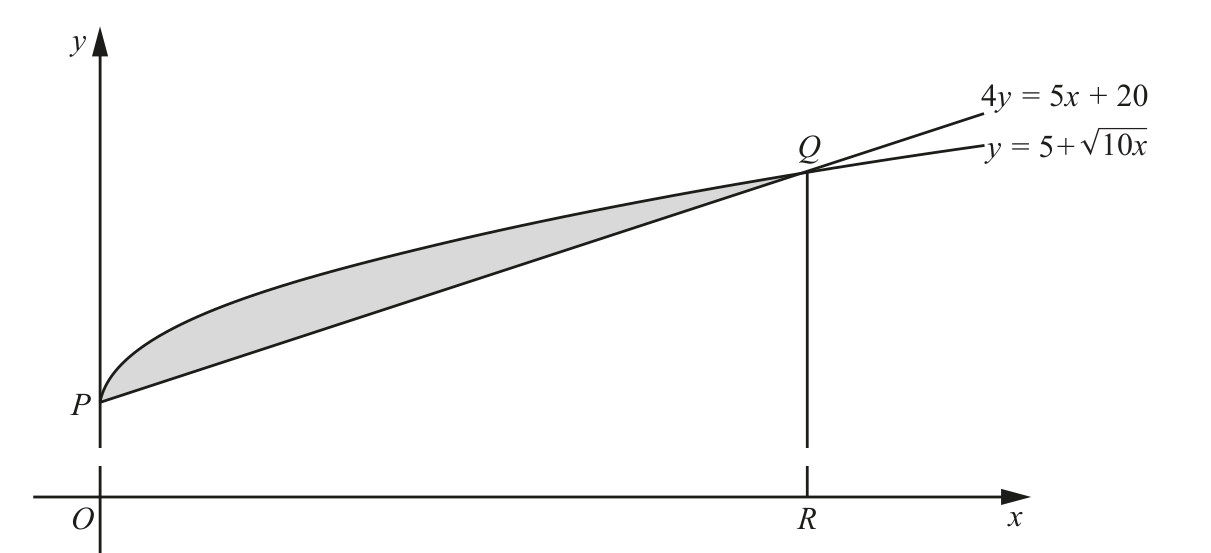
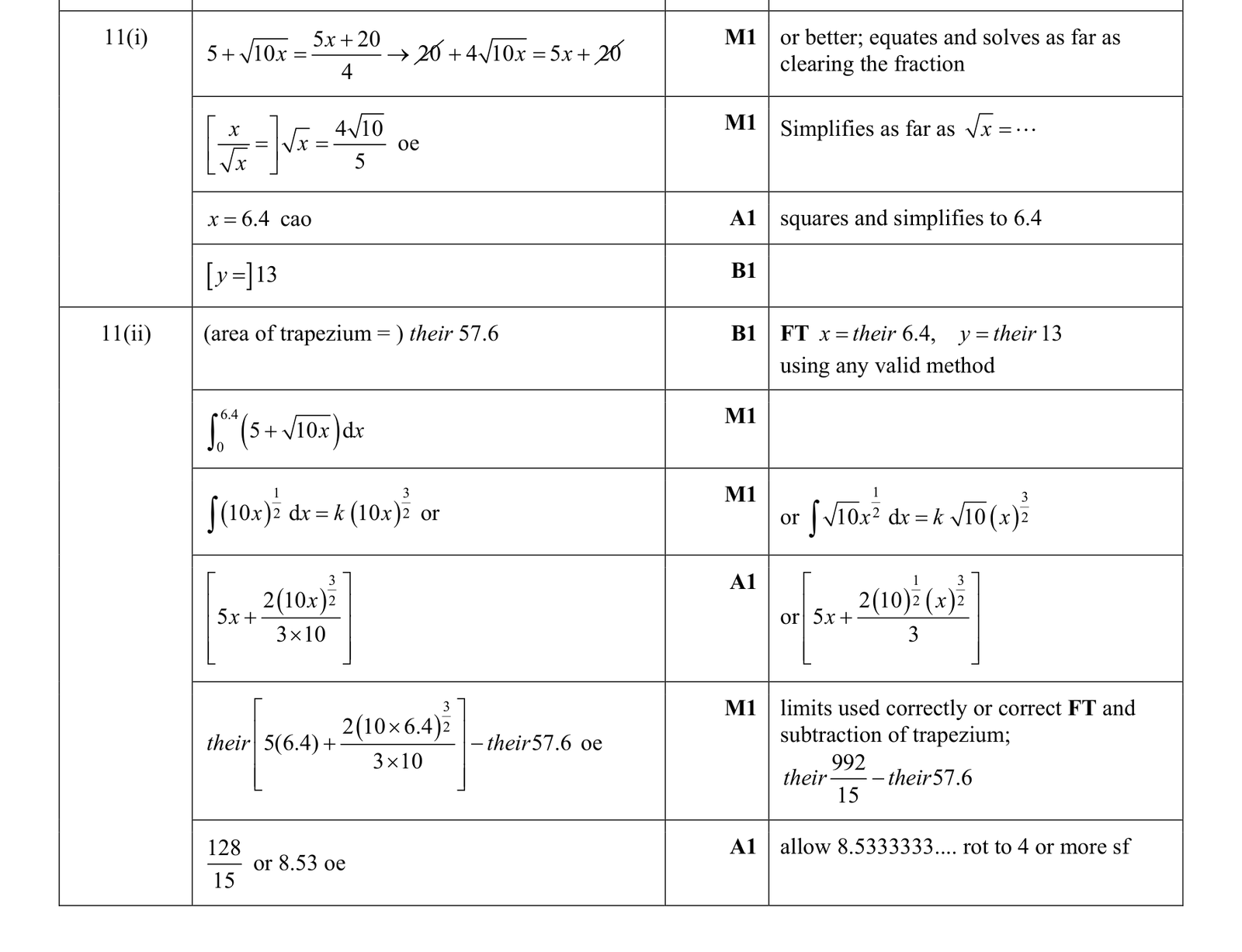
Answer: \(Q=\left(\dfrac{32}{5},13\right)\). The shaded area is \(\dfrac{128}{15}\).
(i) The line is
\(4y=5x+20 \quad\Rightarrow\quad y=\frac54x+5.\)
At the intersection point \(Q\),
\(5+\sqrt{10x}=\frac54x+5.\)
So
\(\sqrt{10x}=\frac54x.\)
For \(x\gt 0\), divide by \(\sqrt x\):
\(\sqrt{10}=\frac54\sqrt x.\)
Hence
\(\sqrt x=\frac{4\sqrt{10}}{5}.\)
Squaring gives
\(x=\frac{16\cdot 10}{25}=\frac{32}{5}.\)
Then
\(y=5+\sqrt{10\cdot \frac{32}{5}}=5+\sqrt{64}=13.\)
Therefore
\(\boxed{Q=\left(\frac{32}{5},13\right)}.\)
(ii) The shaded area is the area between the curve and the line from \(x=0\) to \(x=\dfrac{32}{5}\).
So
\(\text{Area} = \int_0^{32/5}\left[\left(5+\sqrt{10x}\right)-\left(\frac54x+5\right)\right]\,dx.\)
This simplifies to
\(\text{Area} = \int_0^{32/5}\left(\sqrt{10x}-\frac54x\right)\,dx.\)
Integrate term by term:
\(\int \sqrt{10x}\,dx = \sqrt{10}\int x^{1/2}\,dx = \frac{2\sqrt{10}}{3}x^{3/2},\)
and
\(\int \frac54x\,dx=\frac58x^2.\)
Therefore
\(\text{Area} = \left[\frac{2\sqrt{10}}{3}x^{3/2}-\frac58x^2\right]_0^{32/5}.\)
Now from part (i),
\(\sqrt{\frac{32}{5}}=\frac{4\sqrt{10}}{5}.\)
So
\(\sqrt{10}\left(\frac{32}{5}\right)^{3/2} = \sqrt{10}\cdot \frac{32}{5}\cdot \frac{4\sqrt{10}}{5} = \frac{256}{5}.\)
Hence
\(\frac{2\sqrt{10}}{3}\left(\frac{32}{5}\right)^{3/2} = \frac{2}{3}\cdot \frac{256}{5} = \frac{512}{15}.\)
Also,
\(\frac58\left(\frac{32}{5}\right)^2 = \frac58\cdot \frac{1024}{25} = \frac{128}{5} = \frac{384}{15}.\)
So the shaded area is
\(\frac{512}{15}-\frac{384}{15}=\frac{128}{15}.\)
Therefore
\(\boxed{\text{Area}=\frac{128}{15}}.\)