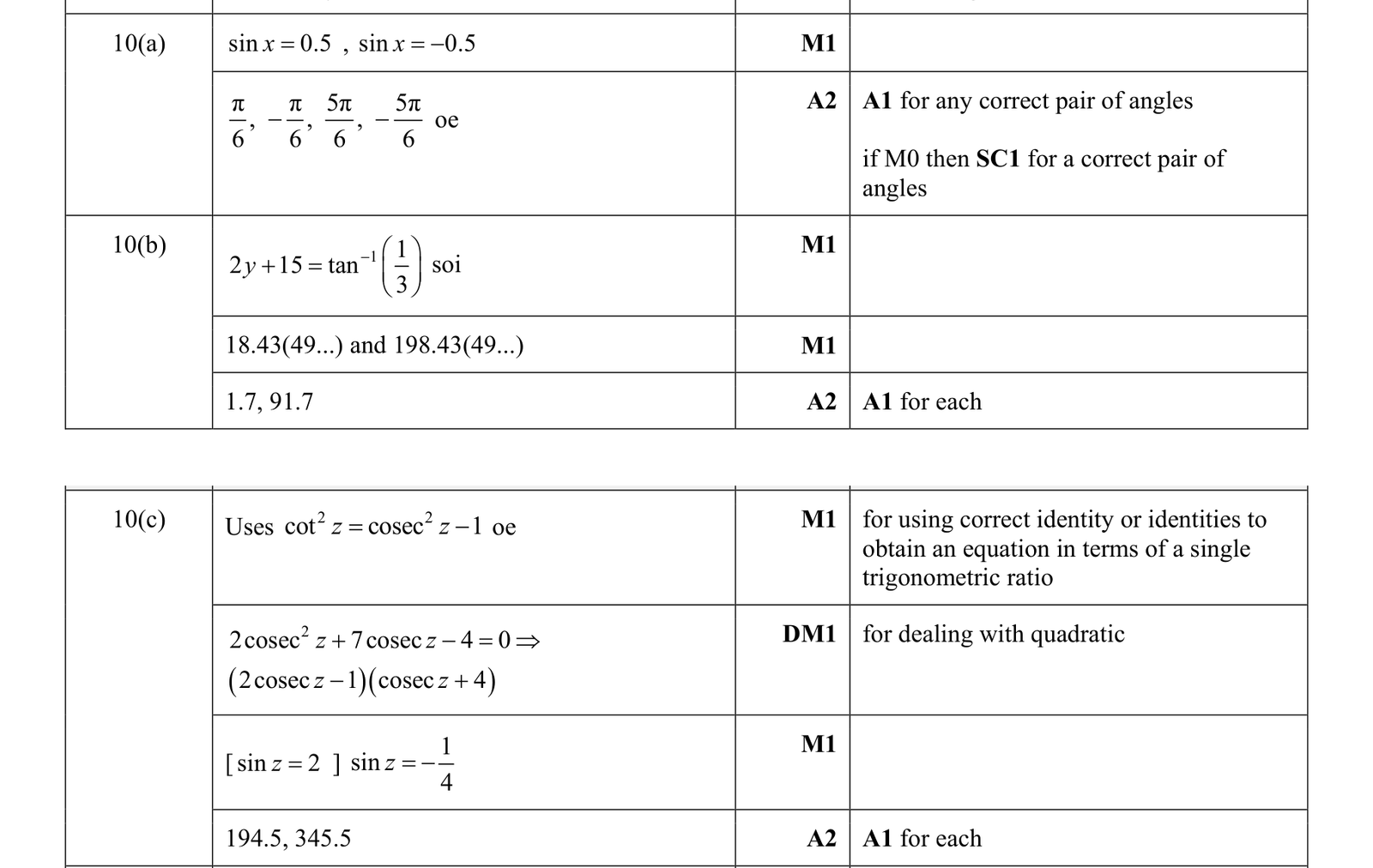
Answer: (a) \(x=\pm\dfrac{\pi}{6}, \pm\dfrac{5\pi}{6}\). (b) \(y=1.7^\circ, 91.7^\circ\). (c) \(z=194.5^\circ, 345.5^\circ\).
(a) The equation
\(2\lvert \sin x\rvert=1\)
gives
\(\lvert \sin x\rvert=\frac12.\)
So either \(\sin x=\frac12\) or \(\sin x=-\frac12\).
For \(-\pi\le x\le \pi\), the solutions are
\(x=\frac{\pi}{6},\ \frac{5\pi}{6},\ -\frac{\pi}{6},\ -\frac{5\pi}{6}.\)
(b) Rearrange first:
\(\tan(2y+15^\circ)=\frac13.\)
So
\(2y+15^\circ=\tan^{-1}\left(\frac13\right) \quad\text{or}\quad 2y+15^\circ=\tan^{-1}\left(\frac13\right)+180^\circ.\)
Now
\(\tan^{-1}\left(\frac13\right)\approx 18.4349^\circ.\)
Hence
\(2y+15^\circ\approx 18.4349^\circ \quad\Rightarrow\quad y\approx 1.717^\circ,\)
or
\(2y+15^\circ\approx 198.4349^\circ \quad\Rightarrow\quad y\approx 91.717^\circ.\)
So, to \(1\) decimal place,
\(\boxed{y=1.7^\circ,\ 91.7^\circ}.\)
(c) Use the identity
\(\operatorname{cot}^2 z=\operatorname{cosec}^2 z-1.\)
Then
\(3(\operatorname{cosec}^2 z-1)=\operatorname{cosec}^2 z-7\operatorname{cosec} z+1.\)
Simplify:
\(2\operatorname{cosec}^2 z+7\operatorname{cosec} z-4=0.\)
Factorise:
\((2\operatorname{cosec} z-1)(\operatorname{cosec} z+4)=0.\)
So either \(\operatorname{cosec} z=\dfrac12\), which would give \(\sin z=2\) and is impossible, or
\(\operatorname{cosec} z=-4.\)
Hence
\(\sin z=-\frac14.\)
The reference angle is
\(\sin^{-1}\left(\frac14\right)\approx 14.5^\circ.\)
Since sine is negative in quadrants III and IV,
\(z\approx 180^\circ+14.5^\circ=194.5^\circ,\)
or
\(z\approx 360^\circ-14.5^\circ=345.5^\circ.\)