Answer: (i) \(\dfrac{x^4}{4}+\dfrac{4x^3}{3}-\dfrac{5x^2}{2}+5x+c\). (ii) \(OEAB=25\), \(OBCD=5\). (iii) Total shaded area \(=\dfrac{443}{6}=73\dfrac{5}{6}\).
(i) Integrate term by term:
\(\int(x^3+4x^2-5x+5)\,dx = \frac{x^4}{4}+\frac{4x^3}{3}-\frac{5x^2}{2}+5x+c.\)
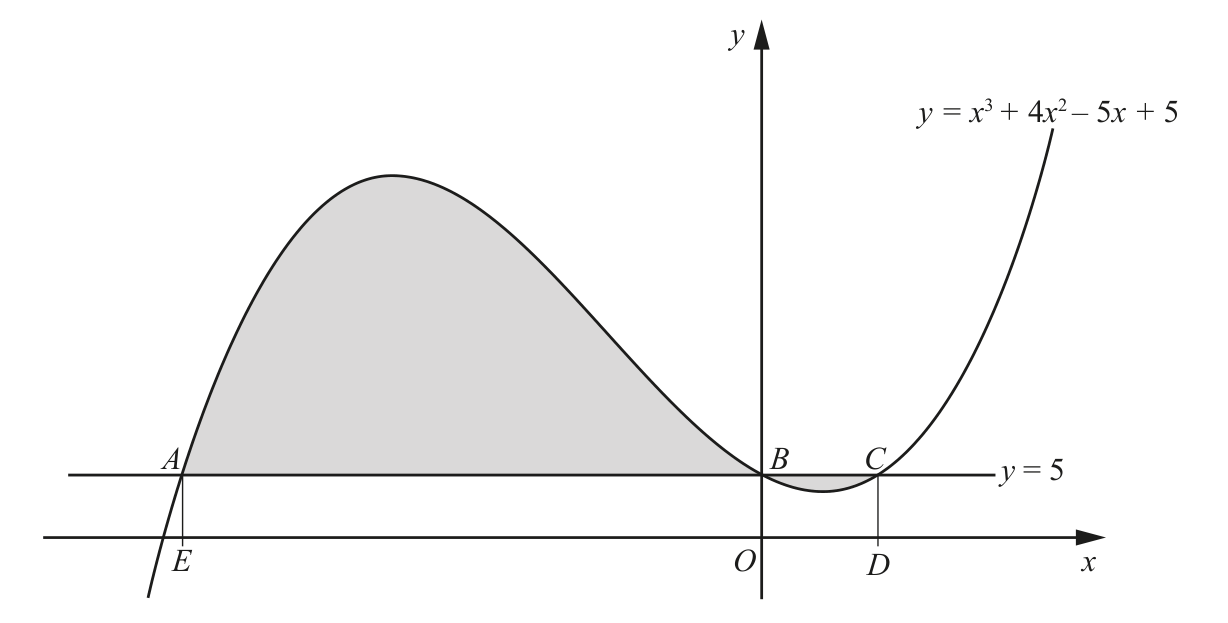
(ii) The intersection points with \(y=5\) satisfy
\(x^3+4x^2-5x+5=5.\)
So
\(x^3+4x^2-5x=0 \quad\Rightarrow\quad x(x^2+4x-5)=0.\)
Hence
\(x=0,\quad x=\frac{-4\pm\sqrt{16+20}}{2} =\frac{-4\pm6}{2},\)
so the three roots are \(x=-5,0,1\).
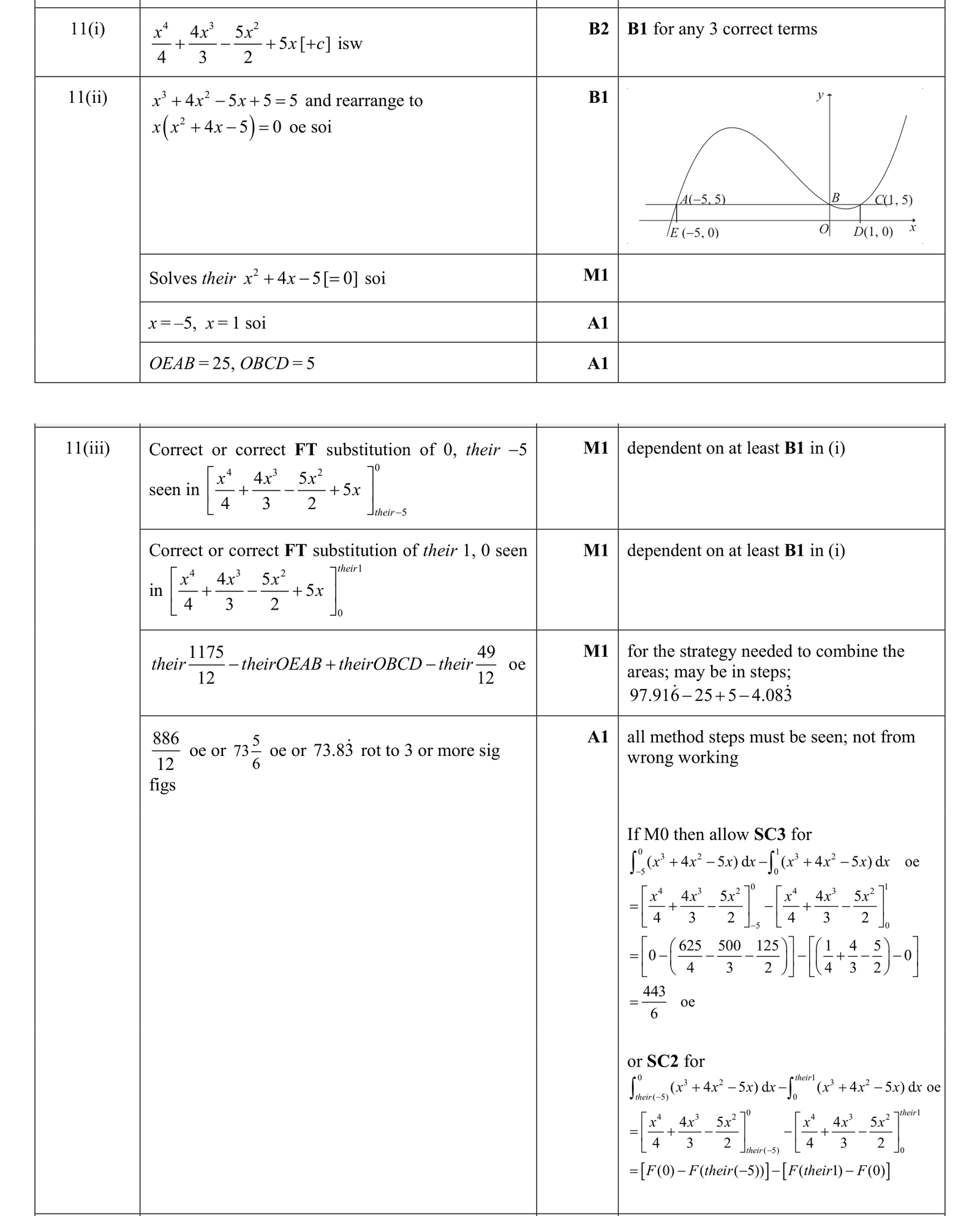
Therefore \(A=(-5,5)\), \(B=(0,5)\), \(C=(1,5)\), \(E=(-5,0)\) and \(D=(1,0)\).
The rectangle \(OEAB\) has width \(5\) and height \(5\), so
\(OEAB=5\times5=25.\)
The rectangle \(OBCD\) has width \(1\) and height \(5\), so
\(OBCD=1\times5=5.\)
(iii) Let
\(F(x)=\frac{x^4}{4}+\frac{4x^3}{3}-\frac{5x^2}{2}+5x.\)
Then the area under the curve from \(x=-5\) to \(x=0\) is
\(F(0)-F(-5) = 0-\left(\frac{625}{4}-\frac{500}{3}-\frac{125}{2}-25\right) = \frac{1175}{12}.\)
So the shaded area on the left is
\(\frac{1175}{12}-25 = \frac{1175}{12}-\frac{300}{12} = \frac{875}{12}.\)
From \(x=0\) to \(x=1\), the line lies above the curve. The area under the curve there is
\(F(1)-F(0) = \left(\frac14+\frac43-\frac52+5\right)-0 = \frac{49}{12}.\)
So the shaded area on the right is
\(5-\frac{49}{12} = \frac{60}{12}-\frac{49}{12} = \frac{11}{12}.\)
Hence the total shaded area is
\(\frac{875}{12}+\frac{11}{12} = \frac{886}{12} = \frac{443}{6} = 73\frac56.\)
Therefore the total shaded area is
\(\boxed{\frac{443}{6}}.\)