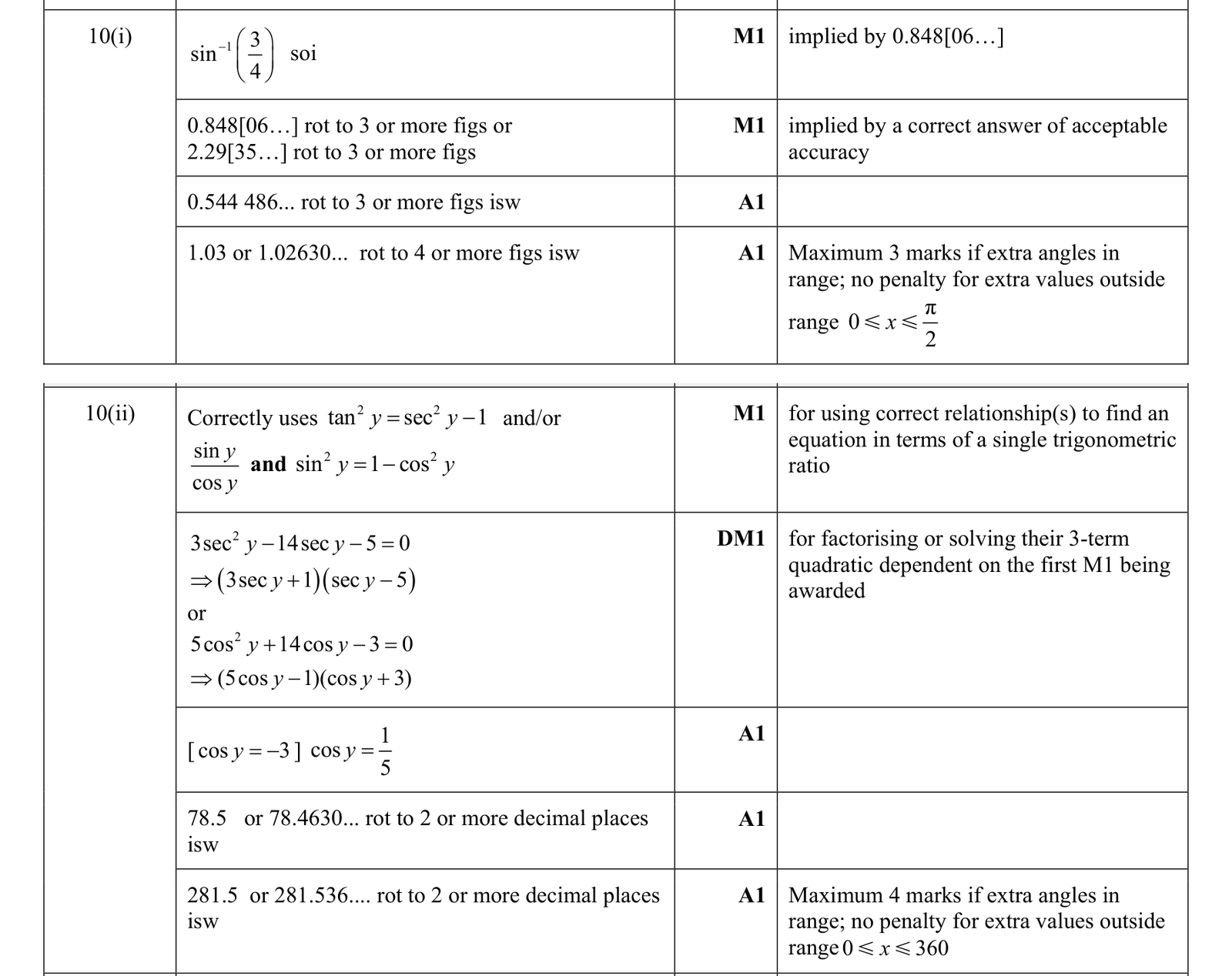
Answer: (i) \(x\approx0.544\) and \(x\approx1.026\) radians. (ii) \(y\approx78.46^\circ\) and \(y\approx281.54^\circ\).
(i) Rearrange first:
\(\sin\left(3x-\frac{\pi}{4}\right)=\frac34.\)
Let
\(\theta=3x-\frac{\pi}{4}.\)
Then \(\sin\theta=\frac34\), so
\(\theta=\sin^{-1}\left(\frac34\right)\approx0.8481\) or \(\theta=\pi-\sin^{-1}\left(\frac34\right)\approx2.2935.\)
Thus
\(3x-\frac{\pi}{4}=0.8481 \quad\Rightarrow\quad x=\frac{0.8481+\frac{\pi}{4}}{3}\approx0.544.\)
And
\(3x-\frac{\pi}{4}=2.2935 \quad\Rightarrow\quad x=\frac{2.2935+\frac{\pi}{4}}{3}\approx1.026.\)
Both lie in \(0\leqslant x\leqslant \frac{\pi}{2}\).
(ii) Use the identity \(\tan^2 y=\operatorname{sec}^2 y-1\):
\(2(\operatorname{sec}^2 y-1)+\operatorname{sec}^2 y=14\operatorname{sec} y+3.\)
So
\(3\operatorname{sec}^2 y-14\operatorname{sec} y-5=0.\)
Factorise:
\((3\operatorname{sec} y+1)(\operatorname{sec} y-5)=0.\)
Hence either \(\operatorname{sec} y=-\frac13\), which is impossible because it would give \(\cos y=-3\), or
\(\operatorname{sec} y=5.\)
So
\(\cos y=\frac15.\)
Therefore
\(y=\cos^{-1}\left(\frac15\right)\approx78.46^\circ\) or \(y=360^\circ-\cos^{-1}\left(\frac15\right)\approx281.54^\circ.\)