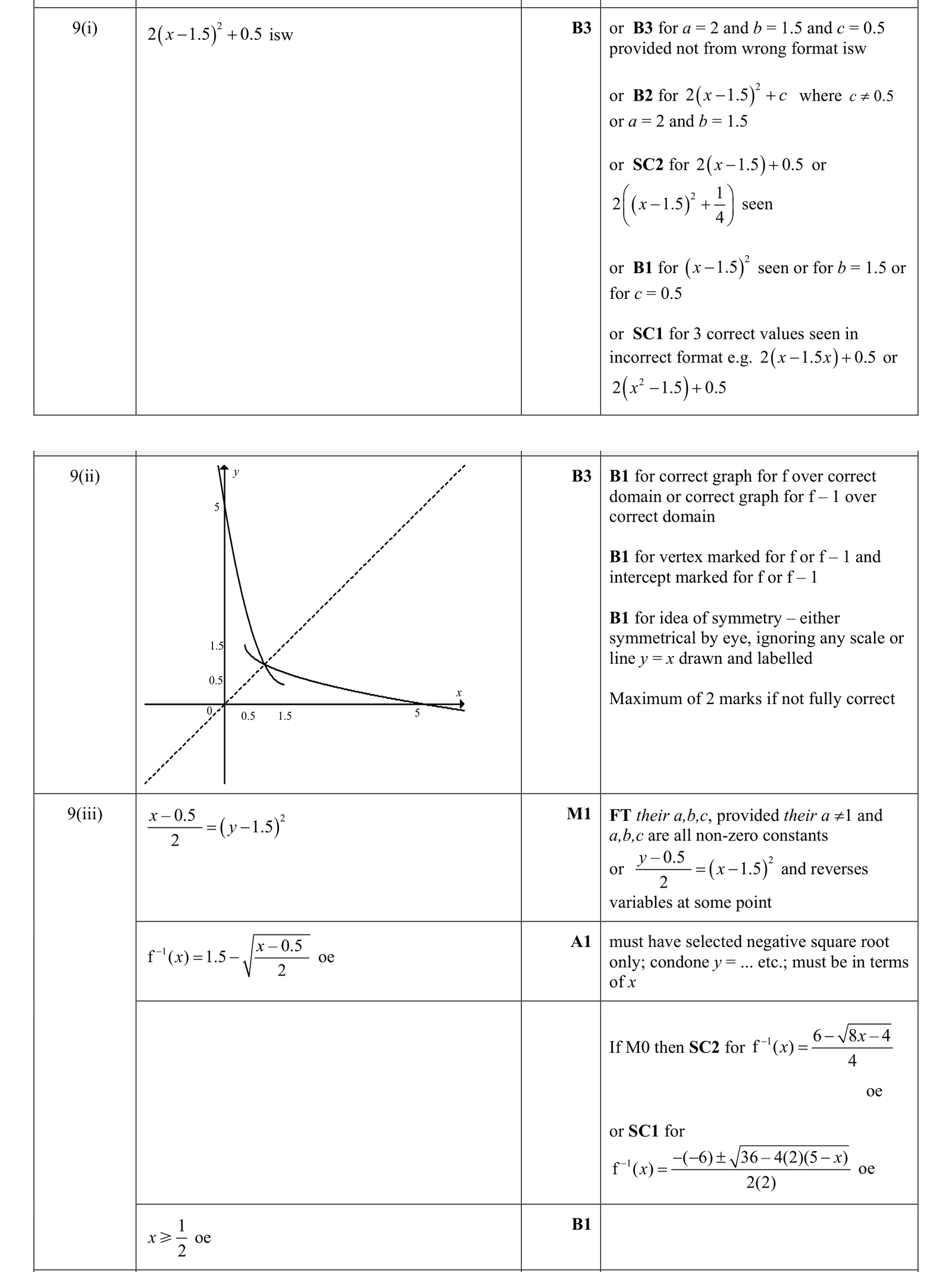
Answer: (i) \(f(x)=2\left(x-\dfrac32\right)^2+\dfrac12\). (ii) The graphs are reflections in the line \(y=x\). (iii) \(f^{-1}(x)=\dfrac32-\sqrt{\dfrac{x-\frac12}{2}}\), with domain \(x\geqslant \dfrac12\).
(i) Complete the square:
\(f(x)=2x^2-6x+5 =2(x^2-3x)+5.\)
Now
\(x^2-3x=\left(x-\frac32\right)^2-\frac94,\)
so
\(f(x)=2\left[\left(x-\frac32\right)^2-\frac94\right]+5 =2\left(x-\frac32\right)^2-\frac92+5 =2\left(x-\frac32\right)^2+\frac12.\)
(ii) The graph of \(y=f(x)\) is the left-hand branch of the parabola with vertex \(\left(\frac32,\frac12\right)\), because the domain is \(x\leqslant\frac32\).
The graph of \(y=f^{-1}(x)\) is the reflection of \(y=f(x)\) in the line \(y=x\). In particular, the vertex \(\left(\frac32,\frac12\right)\) reflects to \(\left(\frac12,\frac32\right)\).
(iii) Start from
\(y=2\left(x-\frac32\right)^2+\frac12.\)
Swap \(x\) and \(y\):
\(x=2\left(y-\frac32\right)^2+\frac12.\)
Then
\(\frac{x-\frac12}{2}=\left(y-\frac32\right)^2.\)
Taking square roots gives
\(y-\frac32=\pm\sqrt{\frac{x-\frac12}{2}}.\)
Because the original domain is \(x\leqslant\frac32\), the inverse must use the branch with \(y\leqslant\frac32\). So we take the negative root:
\(f^{-1}(x)=\frac32-\sqrt{\frac{x-\frac12}{2}}.\)
The domain of \(f^{-1}\) is the range of \(f\), which is
\(x\geqslant\frac12.\)