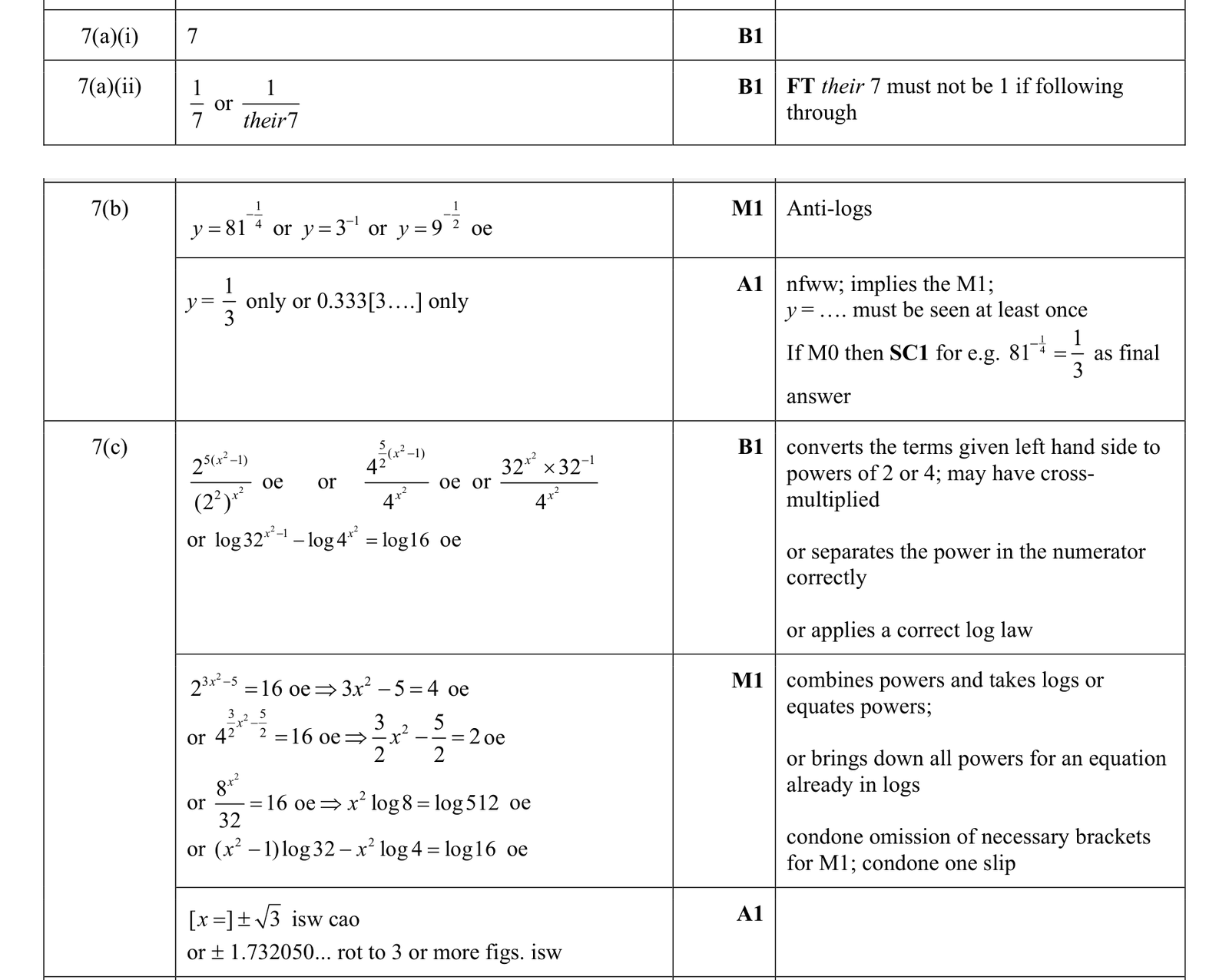
0606 P22 - Jun 2017 - Q7 - 7 marks
8599
(a) Given that \(a^7=b\), where \(a\) and \(b\) are positive constants, find
(i) \(\log_a b\),
(ii) \(\log_b a\).
(b) Solve the equation \(\log_{81} y=-\dfrac14\).
(c) Solve the equation
\(\frac{32^{x^2-1}}{4^{x^2}}=16.\)
Solution
Answer: (a)(i) \(7\), (ii) \(\dfrac17\). (b) \(y=\dfrac13\). (c) \(x=\pm\sqrt3\).
(a)(i) Since \(a^7=b\), the power to which \(a\) must be raised to give \(b\) is \(7\). Therefore
\(\log_a b=7.\)
(a)(ii) Using the reciprocal rule for logarithms,
\(\log_b a=\frac{1}{\log_a b}=\frac17.\)
(b) Convert from logarithmic to exponential form:
\(y=81^{-1/4}.\)
Since \(81=3^4\),
\(y=(3^4)^{-1/4}=3^{-1}=\frac13.\)
(c) Write everything as powers of \(2\):
\(\frac{32^{x^2-1}}{4^{x^2}} = \frac{(2^5)^{x^2-1}}{(2^2)^{x^2}} = 2^{5(x^2-1)-2x^2} = 2^{3x^2-5}.\)
Also \(16=2^4\), so
\(2^{3x^2-5}=2^4.\)
Hence the exponents are equal:
\(3x^2-5=4.\)
So
\(3x^2=9 \quad\Rightarrow\quad x^2=3.\)
Therefore
\(\boxed{x=\pm\sqrt3}.\)