Browsing as Guest. Progress, bookmarks and attempts are disabled.
Log in to track your work.
0606 P13 - Jun 2017 - Q1 - 2 marks
8569
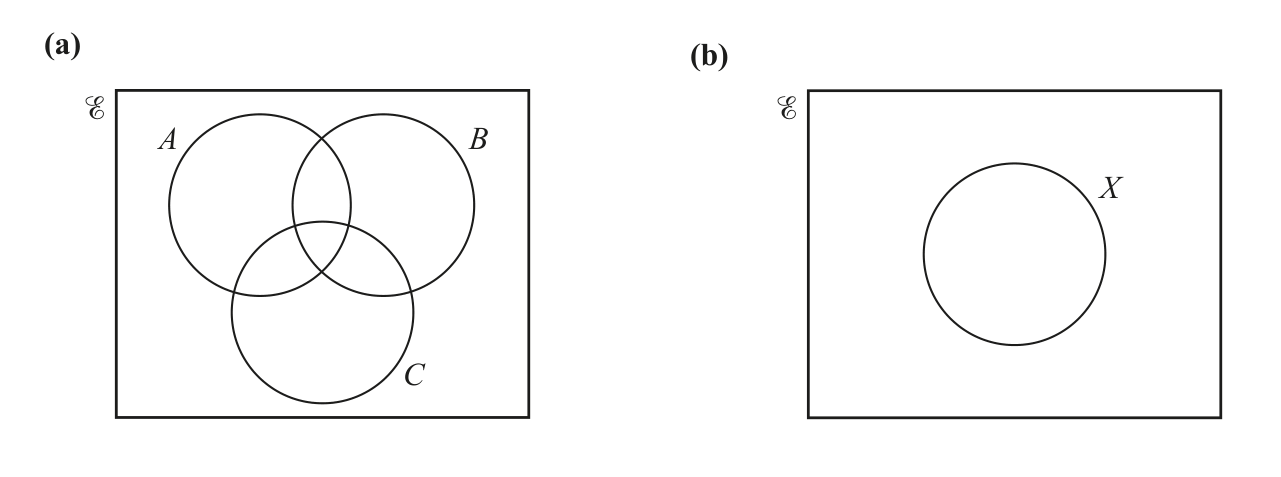
(a) On the Venn diagram below, shade the region which represents
\((A\cap B')\cup(C\cap B').\)
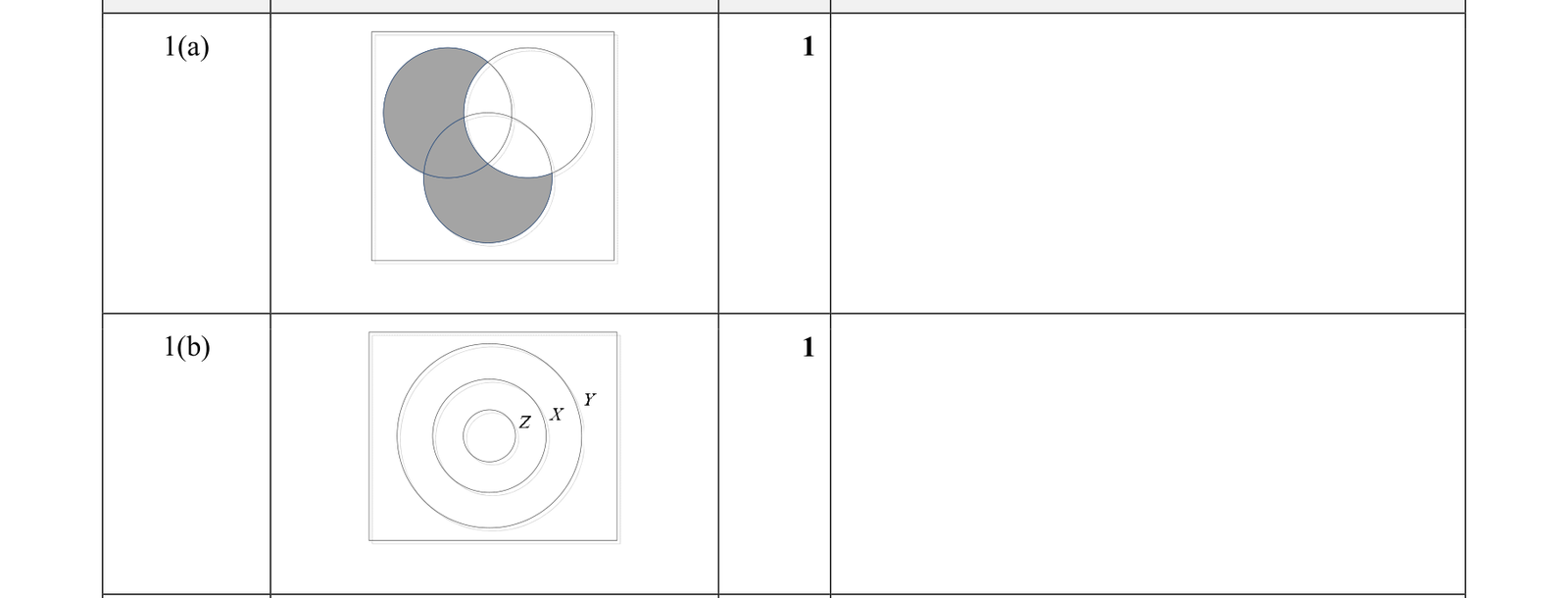
(b) Complete the Venn diagram below to show the sets \(Y\) and \(Z\) such that
\(Z\subset X\subset Y.\)
Solution
Answer: (a) Shade the parts of \(A\) and \(C\) that lie outside \(B\). (b) Draw a larger set \(Y\) around \(X\), and a smaller set \(Z\) entirely inside \(X\).
(a) The set \(A\cap B'\) means the part of \(A\) which is not in \(B\). The set \(C\cap B'\) means the part of \(C\) which is not in \(B\). Taking the union means shading both of these regions.
So shade all points that are in \(A\) but not \(B\), together with all points that are in \(C\) but not \(B\).
(b) The notation \(Z\subset X\subset Y\) means every element of \(Z\) lies in \(X\), and every element of \(X\) lies in \(Y\).
Therefore \(Y\) must be a larger set containing the whole of \(X\), and \(Z\) must be a smaller set drawn entirely inside \(X\).