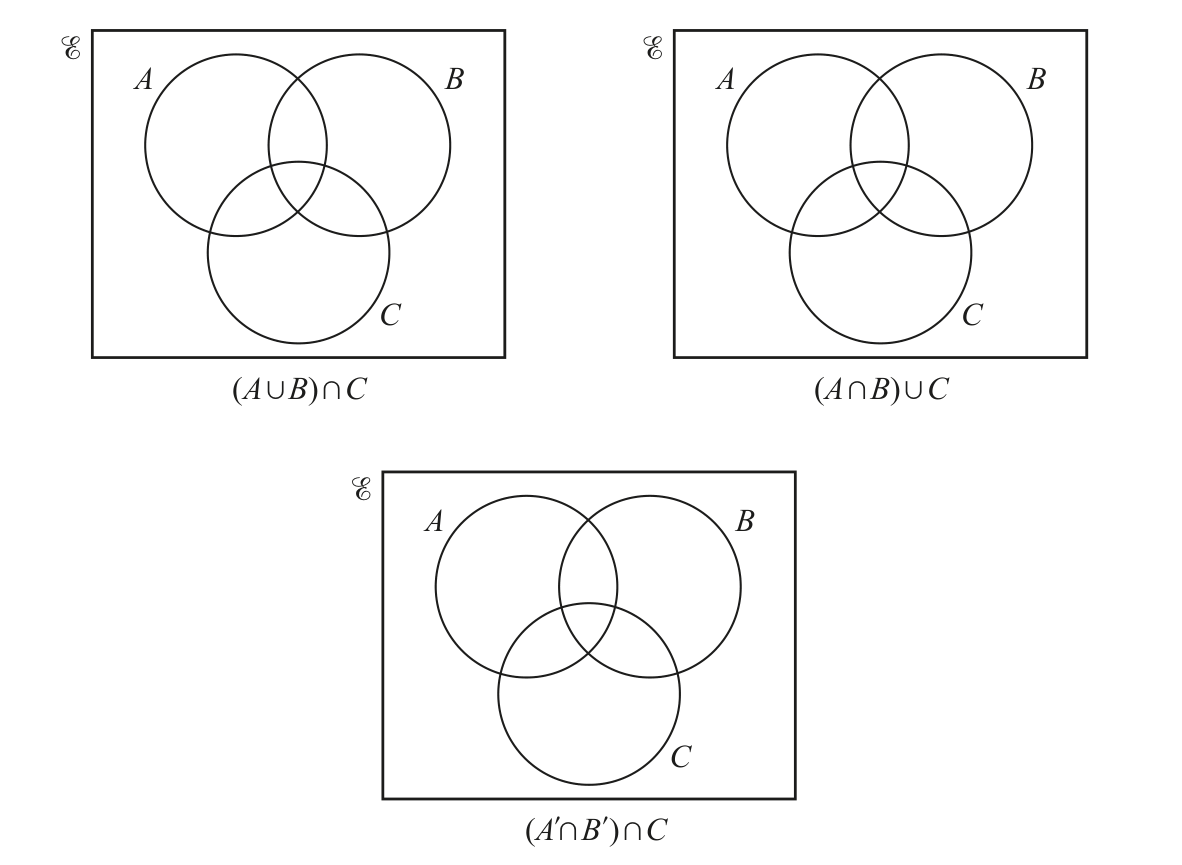
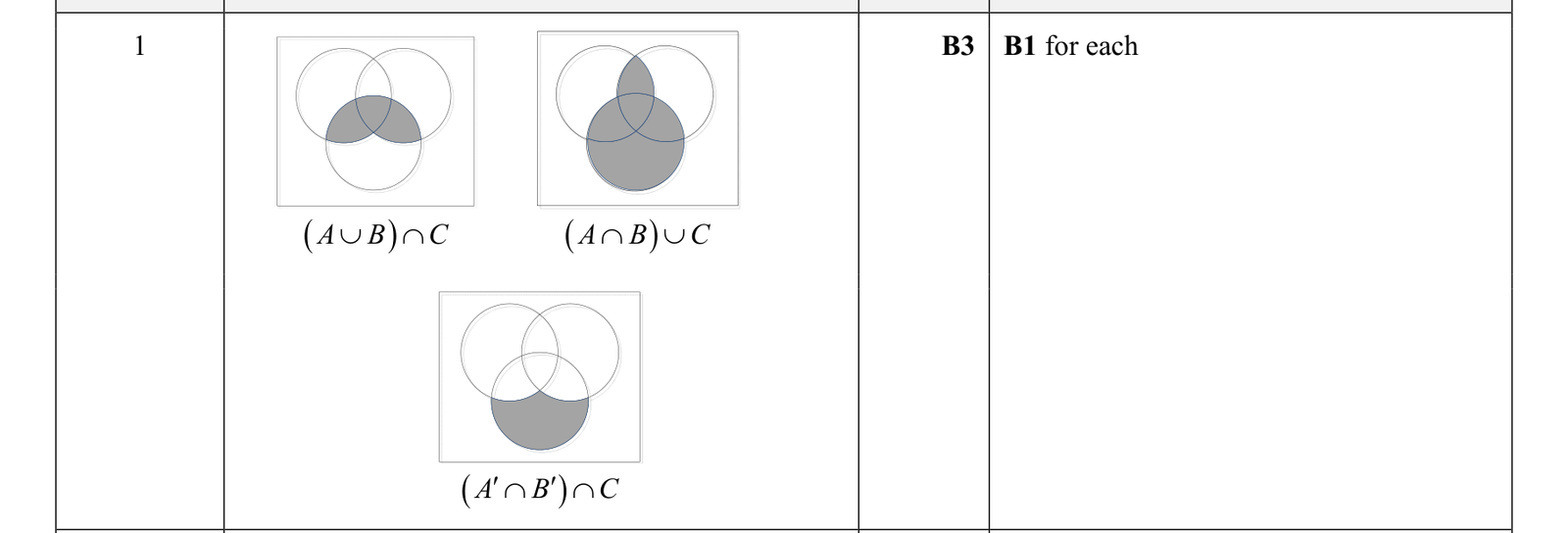
Answer: Shade the part of \(C\) that lies in \(A\) or \(B\); shade all of \(C\) together with the overlap \(A\cap B\); shade the part of \(C\) outside both \(A\) and \(B\).
For \((A\cup B)\cap C\), first take everything in \(A\) or \(B\), then keep only the part that is also in \(C\). So shade the two lens-shaped parts of \(C\) inside \(A\) or \(B\), including the central triple intersection.
For \((A\cap B)\cup C\), first take the overlap of \(A\) and \(B\), then combine it with all of \(C\). So shade the whole circle \(C\), and also shade the part where \(A\) and \(B\) overlap outside \(C\).
For \((A'\cap B')\cap C\), take the elements outside both \(A\) and \(B\), then keep only the part in \(C\). So shade only the part of \(C\) that is not inside \(A\) and not inside \(B\).