0606 P11 - Jun 2017 - Q5 - 11 marks
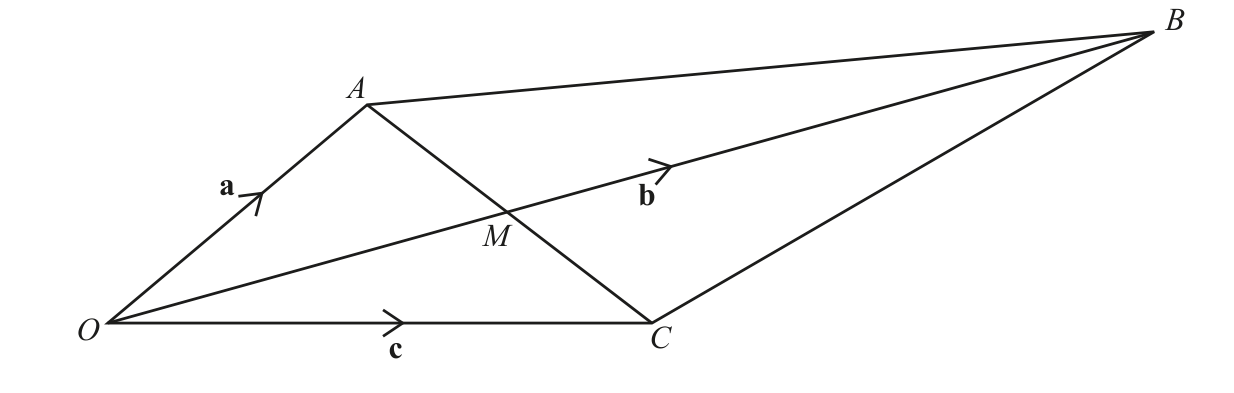
(a) The diagram shows a figure \(OABC\), where \(\overrightarrow{OA}=\mathbf a\), \(\overrightarrow{OB}=\mathbf b\), and \(\overrightarrow{OC}=\mathbf c\). The lines \(AC\) and \(OB\) intersect at \(M\), where \(M\) is the midpoint of \(AC\).
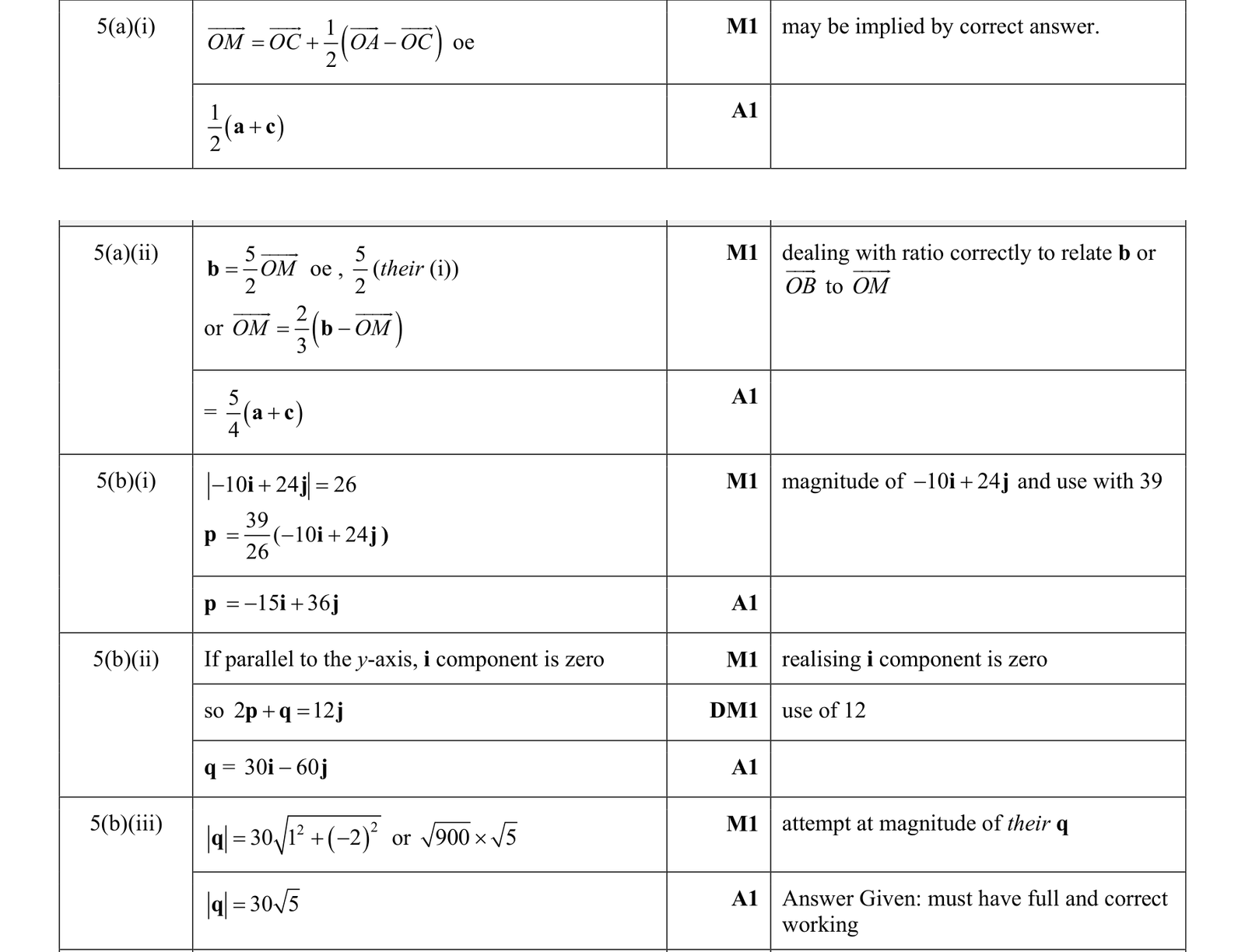
(i) Find \(\overrightarrow{OM}\) in terms of \(\mathbf a\) and \(\mathbf c\).
(ii) Given that \(OM:MB=2:3\), find \(\mathbf b\) in terms of \(\mathbf a\) and \(\mathbf c\).
(b) Vectors \(\mathbf i\) and \(\mathbf j\) are unit vectors parallel to the \(x\)-axis and \(y\)-axis respectively. The vector \(\mathbf p\) has magnitude \(39\) units and has the same direction as \(-10\mathbf i+24\mathbf j\).
(i) Find \(\mathbf p\) in terms of \(\mathbf i\) and \(\mathbf j\).
(ii) Find \(\mathbf q\) such that \(2\mathbf p+\mathbf q\) is parallel to the positive \(y\)-axis and has magnitude \(12\) units.
(iii) Hence show that \(|\mathbf q|=k\sqrt5\), where \(k\) is an integer to be found.