0606 P11 - Jun 2017 - Q4 - 8 marks
8551
(a) It is given that \(f(x)=3e^{-4x}+5\), for \(x\in\mathbb R\).
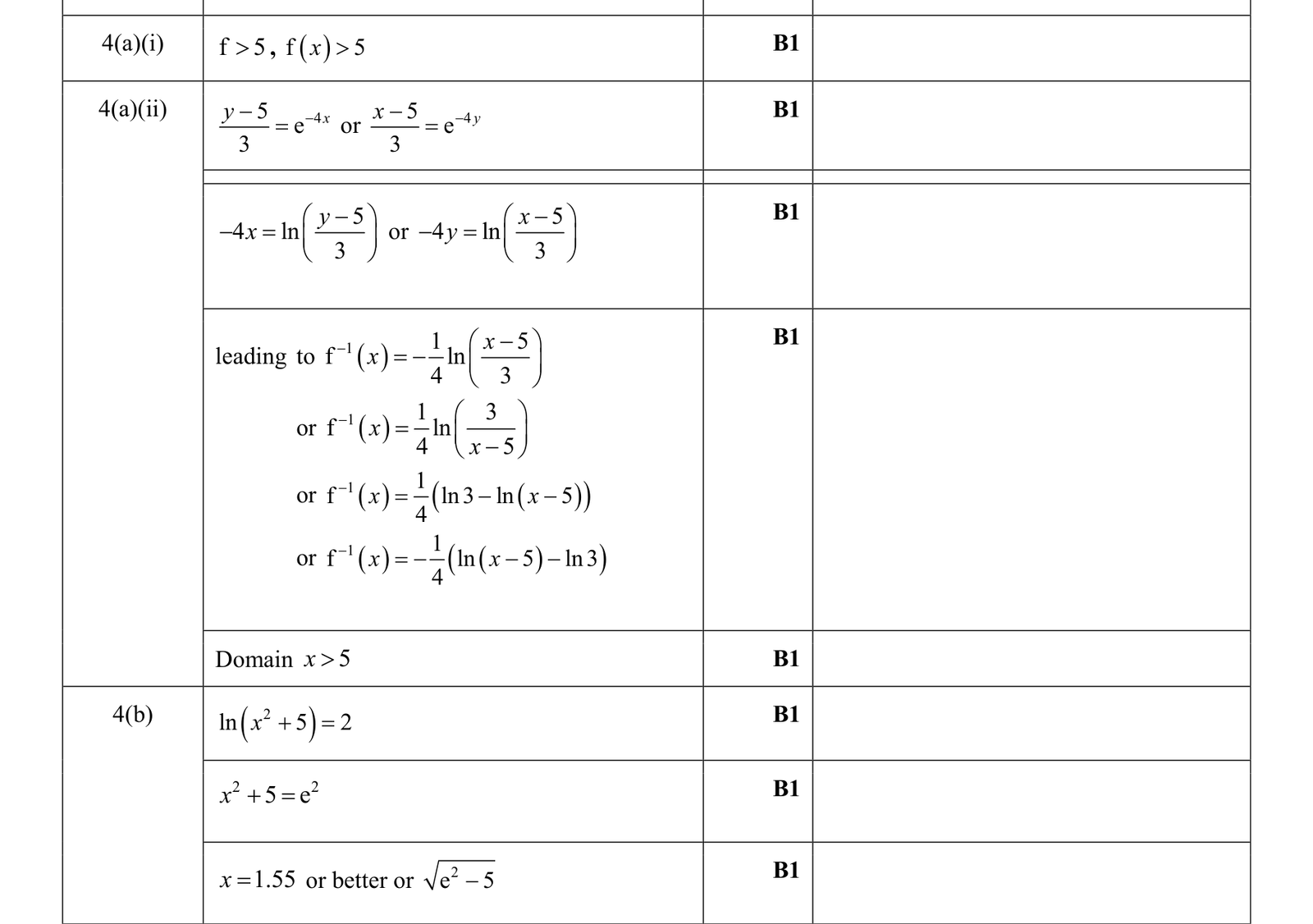
(i) State the range of \(f\).
(ii) Find \(f^{-1}\) and state its domain.
(b) It is given that \(g(x)=x^2+5\) and \(h(x)=\ln x\), for \(x\gt 0\). Solve \(hg(x)=2\).
Solution
Answer: range \(f(x)\gt 5\); \(f^{-1}(x)=-\dfrac14\ln\!\left(\dfrac{x-5}{3}\right)\), domain \(x\gt 5\); \(x=\sqrt{e^2-5}\approx1.55\).
Since \(e^{-4x}\gt 0\) for all real \(x\),
\(3e^{-4x}+5\gt 5.\)
Therefore the range is
\(f(x)\gt 5.\)
To find the inverse, let
\(y=3e^{-4x}+5.\)
Then
\(y-5=3e^{-4x}.\)
So
\(\frac{y-5}{3}=e^{-4x}.\)
Take natural logarithms:
\(\ln\left(\frac{y-5}{3}\right)=-4x.\)
Hence
\(x=-\frac14\ln\left(\frac{y-5}{3}\right).\)
Therefore
\(f^{-1}(x)=-\frac14\ln\left(\frac{x-5}{3}\right).\)
The domain of \(f^{-1}\) is the range of \(f\), so
\(x\gt 5.\)
For part (b),
\(hg(x)=h(g(x))=\ln(x^2+5).\)
So
\(\ln(x^2+5)=2.\)
Therefore
\(x^2+5=e^2.\)
Thus
\(x=\sqrt{e^2-5}\approx1.55.\)