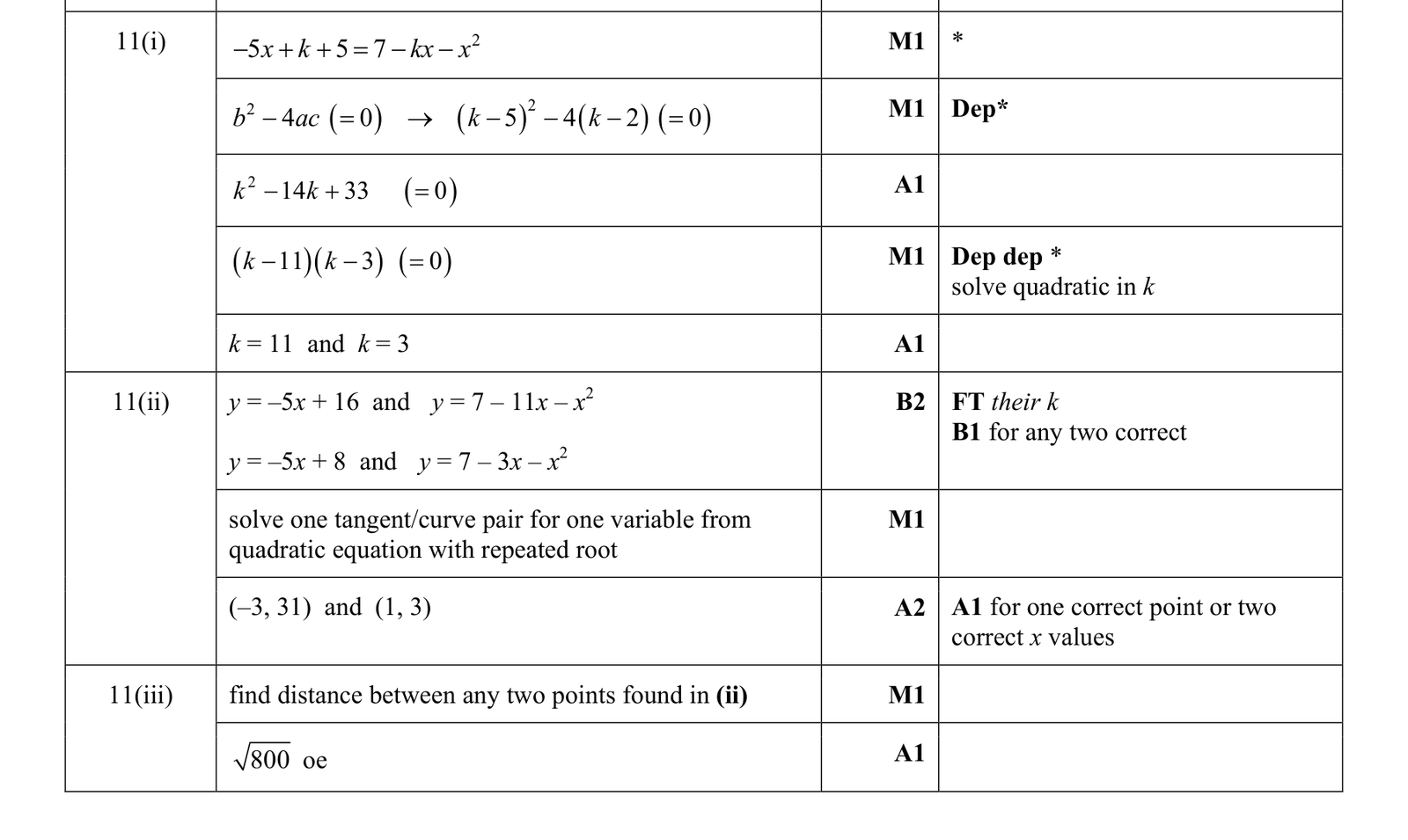
Answer: (i) \(k=11\) or \(k=3\). (ii) For \(k=11\): tangent \(y=-5x+16\), curve \(y=7-11x-x^2\), point \((-3,31)\). For \(k=3\): tangent \(y=-5x+8\), curve \(y=7-3x-x^2\), point \((1,3)\). (iii) Distance \(=\sqrt{800}=20\sqrt2\).
(i) At a point of contact, the line and curve meet in one repeated root. Equate the two expressions for \(y\):
\(-5x+k+5=7-kx-x^2.\)
Bring all terms to one side:
\(x^2+(k-5)x+(k-2)=0.\)
For tangency, the discriminant is zero:
\((k-5)^2-4(k-2)=0.\)
Expand and simplify:
\(k^2-10k+25-4k+8=0.\)
So
\(k^2-14k+33=0.\)
Factorise:
\((k-11)(k-3)=0.\)
Hence
\(k=11 \quad\text{or}\quad k=3.\)
(ii) If \(k=11\), the tangent is
\(y=-5x+16\)
and the curve is
\(y=7-11x-x^2.\)
Equate them:
\(-5x+16=7-11x-x^2.\)
This gives
\(x^2+6x+9=0,\)
so
\((x+3)^2=0, \qquad x=-3.\)
Then
\(y=-5(-3)+16=31.\)
So the point of contact is \((-3,31)\).
If \(k=3\), the tangent is
\(y=-5x+8\)
and the curve is
\(y=7-3x-x^2.\)
Equate them:
\(-5x+8=7-3x-x^2.\)
This gives
\(x^2-2x+1=0.\)
So
\((x-1)^2=0, \qquad x=1.\)
Then
\(y=-5(1)+8=3.\)
So the point of contact is \((1,3)\).
(iii) The two points are \((-3,31)\) and \((1,3)\). Their distance is
\(\sqrt{(1-(-3))^2+(3-31)^2}.\)
So
\(d=\sqrt{4^2+(-28)^2} = \sqrt{16+784} = \sqrt{800} = 20\sqrt2.\)