0606 P22 - Nov 2018 - Q10 - 9 marks
8534
Two lines are tangents to the curve
\(y=12-4x-x^2.\)
The equation of each tangent is of the form
\(y=2k+1-kx,\)
where \(k\) is a constant.
(i) Find the two possible values of \(k\).
(ii) Find the coordinates of the point of intersection of the two tangents.
Solution
Answer: (i) \(k=6\) or \(k=10\). (ii) \((2,1)\).
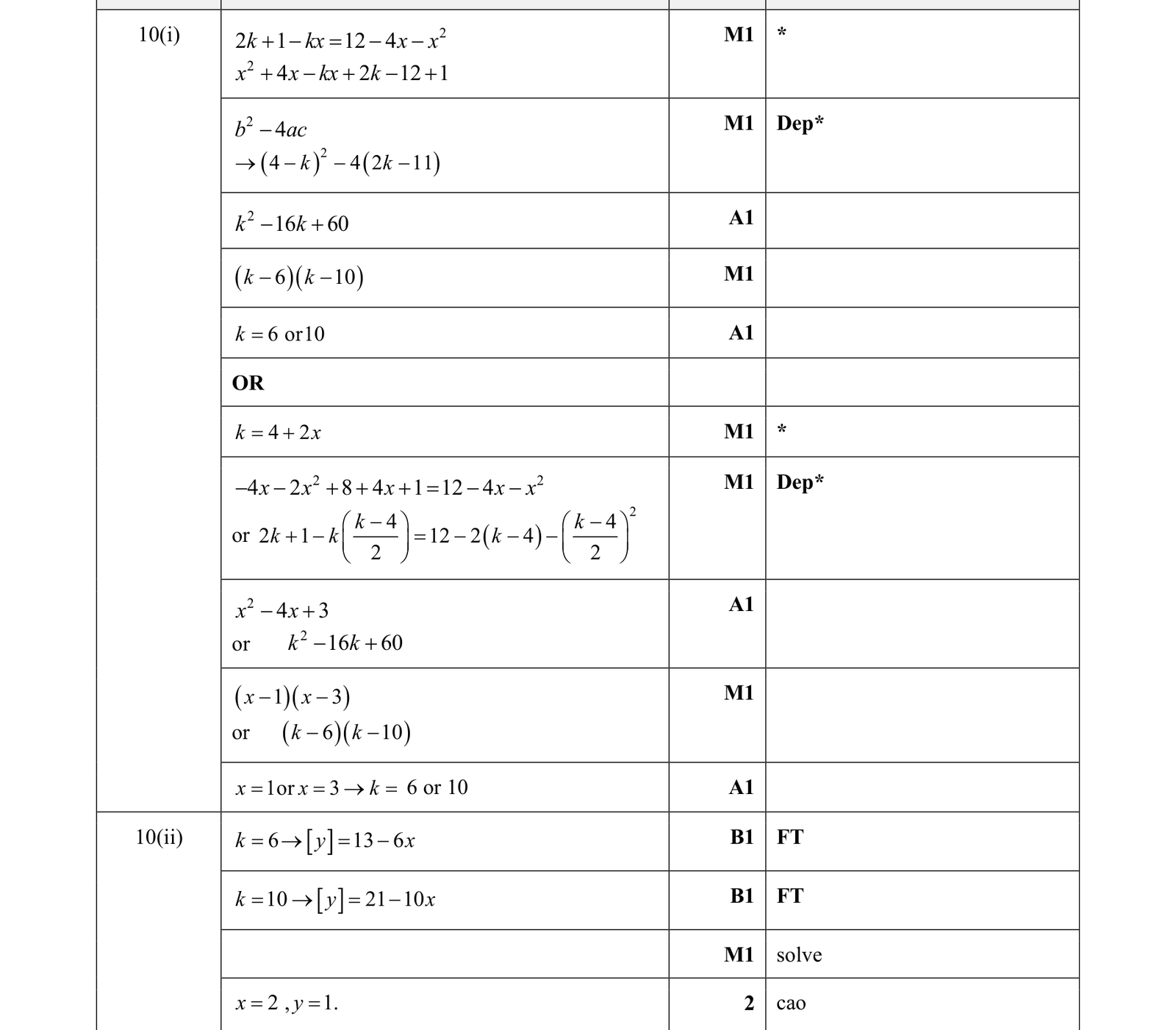
(i) At a point of contact, the tangent and curve have exactly one common point. Equate the line and curve:
\(2k+1-kx=12-4x-x^2.\)
Bring all terms to one side:
\(x^2+(4-k)x+(2k-11)=0.\)
For tangency, this quadratic has a repeated root, so its discriminant is zero:
\((4-k)^2-4(2k-11)=0.\)
Expand and simplify:
\(k^2-8k+16-8k+44=0,\)
so
\(k^2-16k+60=0.\)
Factorise:
\((k-6)(k-10)=0.\)
Thus
\(k=6\quad\text{or}\quad k=10.\)
(ii) If \(k=6\), the tangent is
\(y=13-6x.\)
If \(k=10\), the tangent is
\(y=21-10x.\)
At their intersection,
\(13-6x=21-10x.\)
So
\(4x=8, \qquad x=2.\)
Substitute into \(y=13-6x\):
\(y=13-12=1.\)
Therefore the point of intersection is
\(\boxed{(2,1)}.\)