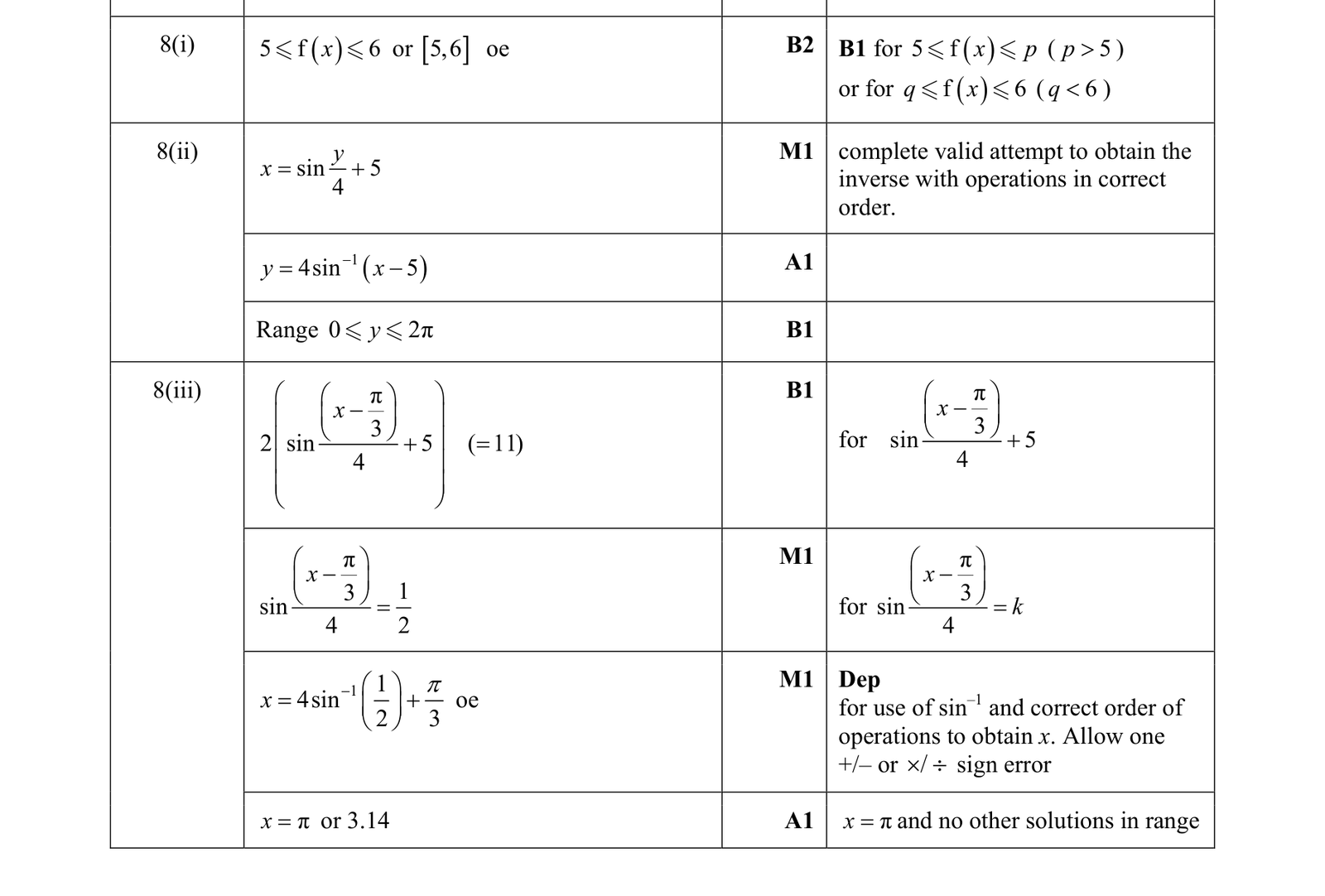
Answer: (i) \(5\leq f(x)\leq6\). (ii) \(f^{-1}(x)=4\sin^{-1}(x-5)\), range \(0\leq f^{-1}(x)\leq2\pi\). (iii) \(x=\pi\).
(i) Since \(0\leq x\leq2\pi\),
\(0\leq \frac{x}{4}\leq \frac{\pi}{2}.\)
On this interval, \(\sin\dfrac{x}{4}\) ranges from \(0\) to \(1\). Therefore
\(5\leq f(x)\leq6.\)
(ii) Let \(y=f(x)\). Then
\(y=5+\sin\frac{x}{4}.\)
So
\(y-5=\sin\frac{x}{4}.\)
Taking inverse sine,
\(\frac{x}{4}=\sin^{-1}(y-5),\)
and hence
\(x=4\sin^{-1}(y-5).\)
Therefore
\(f^{-1}(x)=4\sin^{-1}(x-5).\)
The range of \(f^{-1}\) is the original domain of \(f\), so
\(0\leq f^{-1}(x)\leq2\pi.\)
(iii) Here \(fg(x)\) means \(f(g(x))\). Thus
\(2f(g(x))=11.\)
So
\(f(g(x))=\frac{11}{2}.\)
Since \(g(x)=x-\dfrac{\pi}{3}\),
\(f(g(x))=5+\sin\left(\frac{x-\frac{\pi}{3}}{4}\right).\)
Therefore
\(5+\sin\left(\frac{x-\frac{\pi}{3}}{4}\right)=\frac{11}{2}.\)
Hence
\(\sin\left(\frac{x-\frac{\pi}{3}}{4}\right)=\frac12.\)
The input of \(f\) must lie in \(0\leq g(x)\leq2\pi\), so
\(0\leq x-\frac{\pi}{3}\leq2\pi.\)
Thus
\(0\leq \frac{x-\frac{\pi}{3}}{4}\leq\frac{\pi}{2}.\)
On this interval, the only solution to \(\sin u=\dfrac12\) is \(u=\dfrac{\pi}{6}\). Therefore
\(\frac{x-\frac{\pi}{3}}{4}=\frac{\pi}{6}.\)
So
\(x=\frac{4\pi}{6}+\frac{\pi}{3} =\frac{2\pi}{3}+\frac{\pi}{3} =\pi.\)