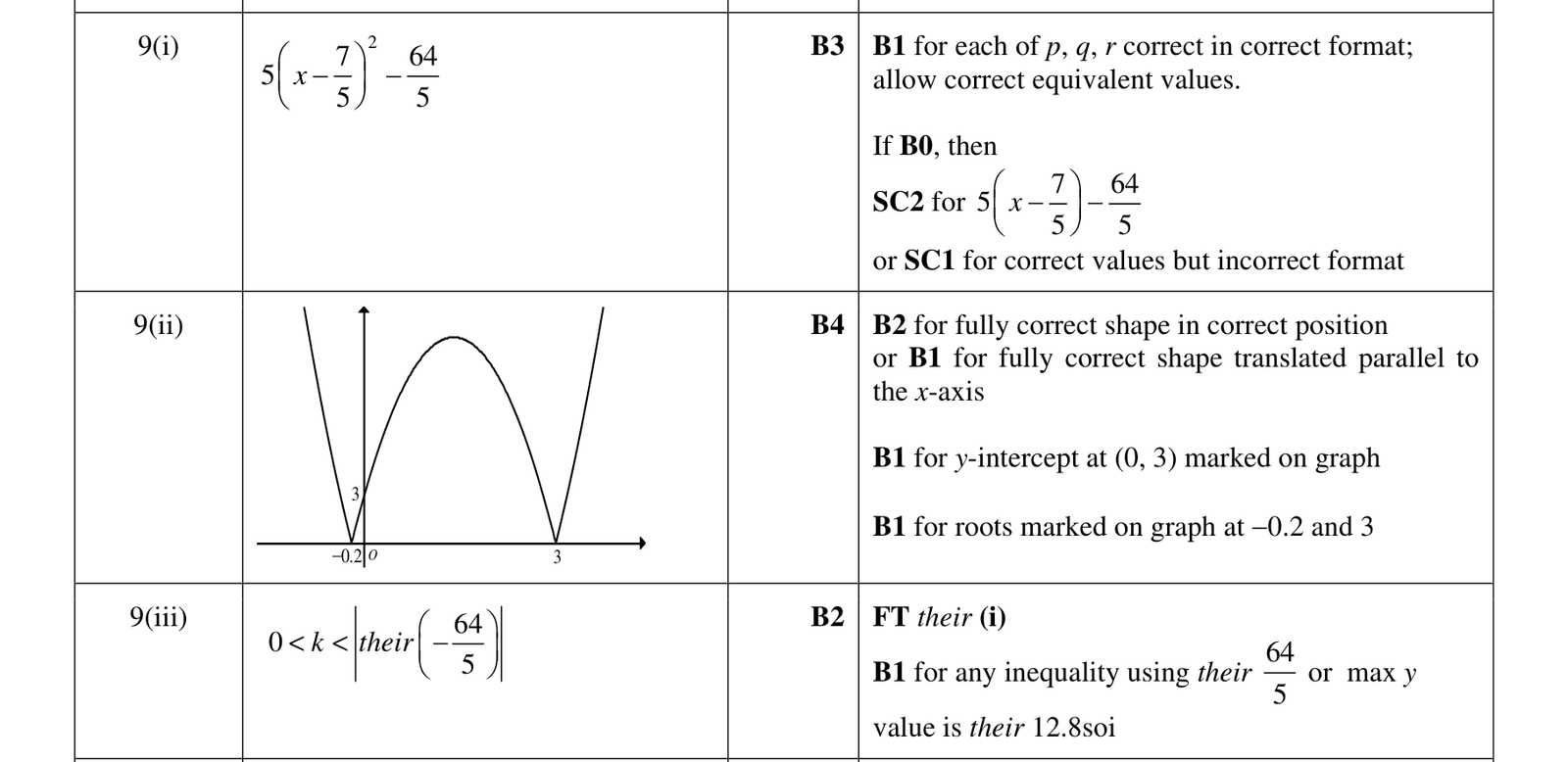
Answer: (i) \(5\left(x-\dfrac75\right)^2-\dfrac{64}{5}\). (ii) Intercepts: \((-0.2,0)\), \((3,0)\), \((0,3)\); reflected vertex \(\left(\dfrac75,\dfrac{64}{5}\right)\). (iii) \(0\lt k\lt\dfrac{64}{5}\).
(i) Complete the square:
\(5x^2-14x-3 =5\left(x^2-\frac{14}{5}x\right)-3.\)
Now
\(x^2-\frac{14}{5}x =\left(x-\frac75\right)^2-\left(\frac75\right)^2.\)
Therefore
\(5x^2-14x-3 = 5\left(x-\frac75\right)^2 -5\left(\frac{49}{25}\right)-3.\)
So
\(5x^2-14x-3 = 5\left(x-\frac75\right)^2-\frac{64}{5}.\)
(ii) The \(x\)-intercepts are found from
\(5x^2-14x-3=0.\)
Using the quadratic formula,
\(x=\frac{14\pm\sqrt{196+60}}{10} =\frac{14\pm16}{10}.\)
So
\(x=3\quad\text{or}\quad x=-0.2.\)
The \(y\)-intercept is
\(y=|-3|=3.\)
The original quadratic has minimum value \(-\frac{64}{5}\) at \(x=\frac75\). For \(y=\left|5x^2-14x-3\right|\), the part below the \(x\)-axis is reflected above it, giving a highest point on the reflected middle section at
\(\left(\frac75,\frac{64}{5}\right).\)
(iii) A horizontal line \(y=k\) cuts the modulus graph in exactly four points only when it lies above the \(x\)-axis and below the reflected maximum \(\frac{64}{5}\). Therefore
\(0\lt k\lt\frac{64}{5}.\)