Browsing as Guest. Progress, bookmarks and attempts are disabled.
Log in to track your work.
0606 P13 - Jun 2018 - Q3 - 4 marks
8434
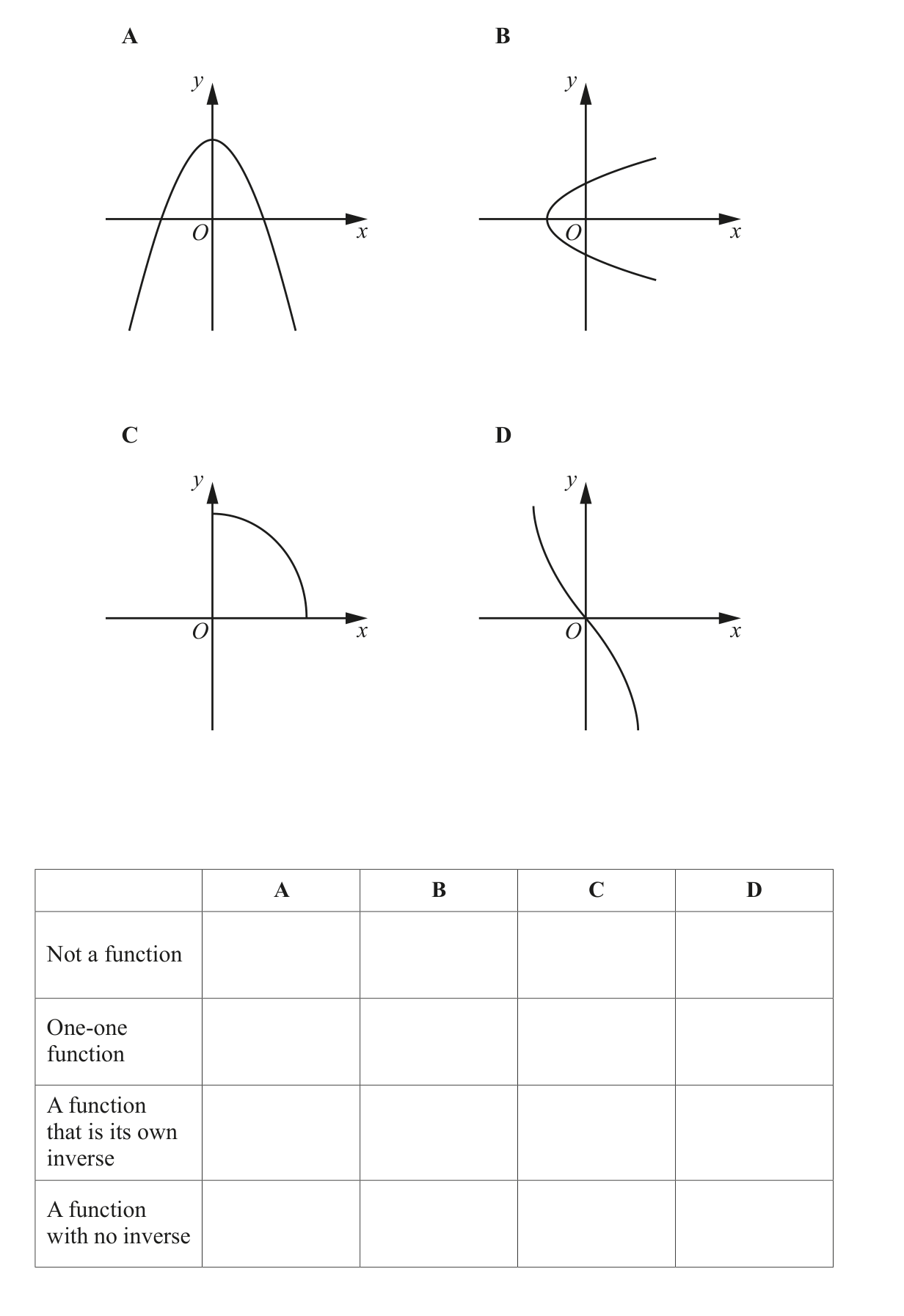
Diagrams \(A\) to \(D\) show four different graphs. In each case the whole graph is shown and the scales on the two axes are the same.
Place ticks in the boxes in the table to indicate which descriptions, if any, apply to each graph. There may be more than one tick in any row or column of the table.
Solution
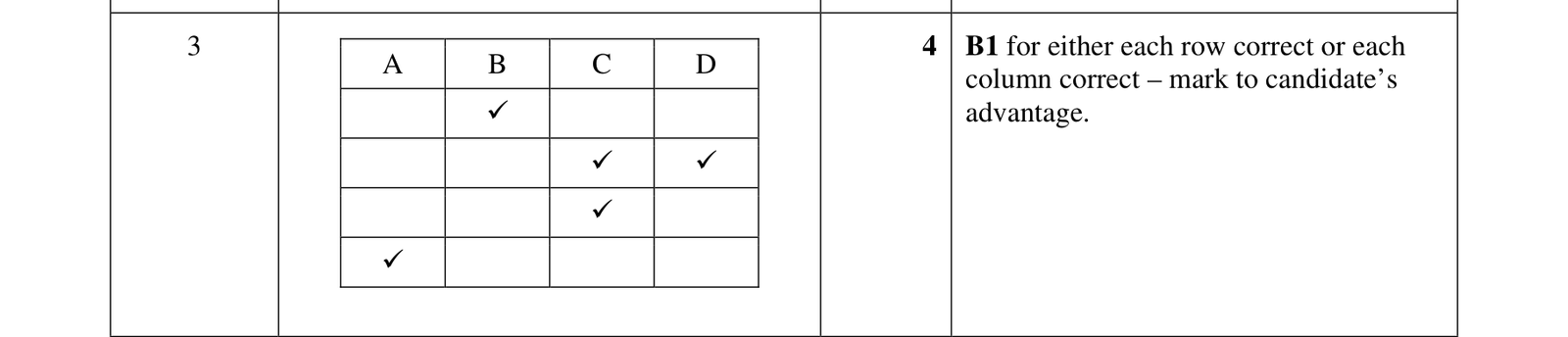
Answer: \(A\): a function with no inverse. \(B\): not a function. \(C\): one-one function and its own inverse. \(D\): one-one function.
Use the vertical line test to decide whether a graph represents a function. A vertical line cuts graph \(B\) more than once, so \(B\) is not a function.
Graph \(A\) is a function, but it is not one-one because horizontal lines can cut it twice. Therefore \(A\) is a function with no inverse.
Graph \(C\) is one-one, and because it is symmetric in the line \(y=x\), it is its own inverse.
Graph \(D\) is one-one, since each horizontal line cuts it at most once.