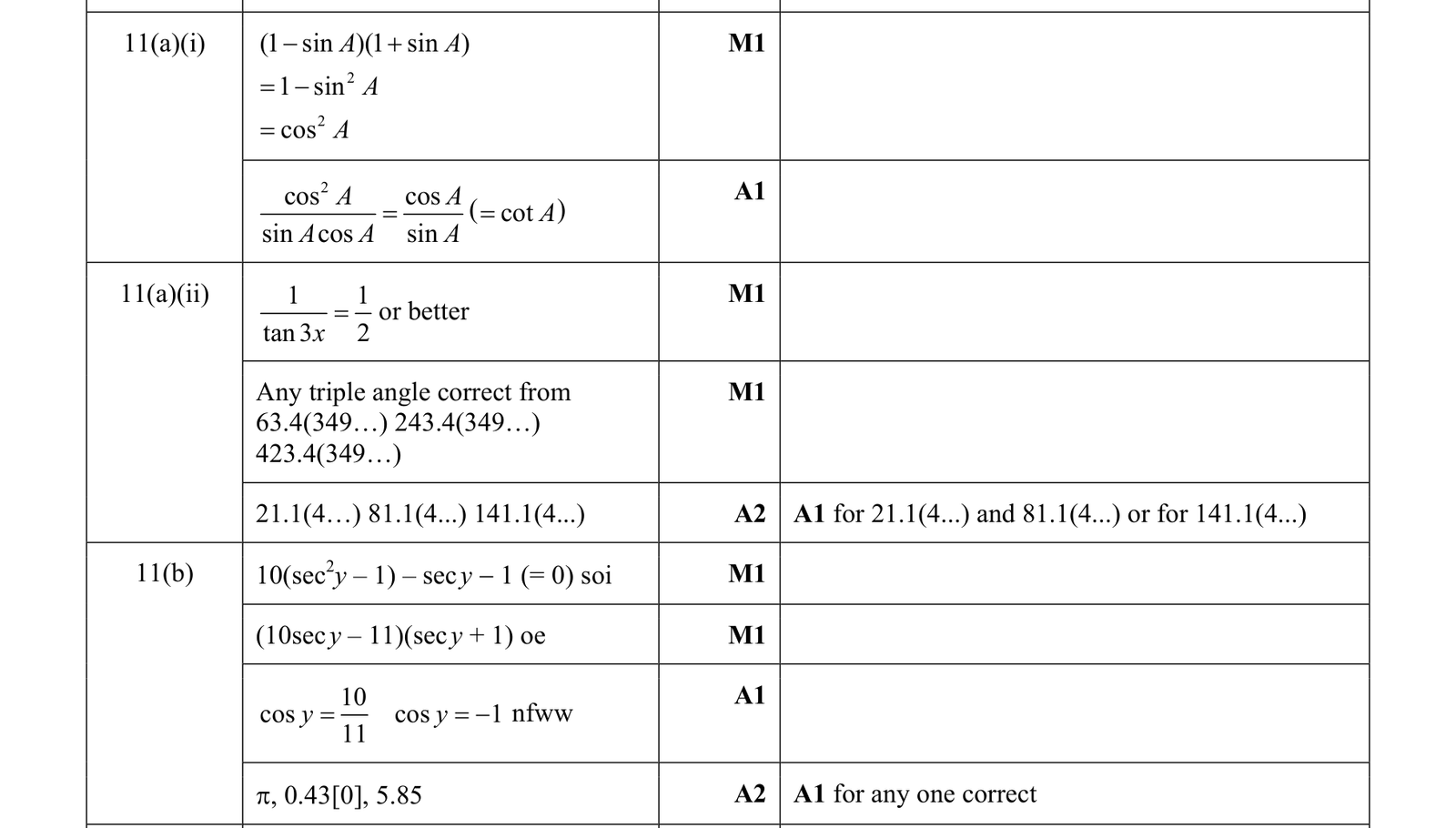
Answer: \(x=21.1^\circ,\ 81.1^\circ,\ 141.1^\circ\); \(y=0.430,\ \pi,\ 5.85\) radians.
For part (a)(i),
\((1-\sin A)(1+\sin A)=1-\sin^2A=\cos^2A.\)
Therefore
\(\dfrac{(1-\sin A)(1+\sin A)}{\sin A\cos A}=\dfrac{\cos^2A}{\sin A\cos A}=\dfrac{\cos A}{\sin A}=\operatorname{cot}A.\)
Using this identity with angle \(3x\), the equation becomes
\(\operatorname{cot}3x=\dfrac12.\)
So
\(\tan3x=2.\)
Since \(0^\circ\leq x\leq180^\circ\), we have \(0^\circ\leq3x\leq540^\circ\).
The solutions for \(3x\) in this interval are
\(3x=63.434^\circ,\ 243.434^\circ,\ 423.434^\circ.\)
Divide by \(3\):
\(x=21.145^\circ,\ 81.145^\circ,\ 141.145^\circ.\)
So
\(\boxed{x=21.1^\circ,\ 81.1^\circ,\ 141.1^\circ}.\)
For part (b), use \(\tan^2y=\operatorname{sec}^2y-1\):
\(10(\operatorname{sec}^2y-1)-\operatorname{sec}y-1=0.\)
So
\(10\operatorname{sec}^2y-\operatorname{sec}y-11=0.\)
Factorise:
\((10\operatorname{sec}y-11)(\operatorname{sec}y+1)=0.\)
Hence
\(\operatorname{sec}y=\dfrac{11}{10}\quad\text{or}\quad \operatorname{sec}y=-1.\)
So
\(\cos y=\dfrac{10}{11}\quad\text{or}\quad \cos y=-1.\)
For \(0\leq y\leq2\pi\), this gives
\(y=0.4297\ldots,\quad y=\pi,\quad y=2\pi-0.4297\ldots.\)
Therefore
\(\boxed{y=0.430,\ \pi,\ 5.85}\) radians.