0606 P23 - Nov 2019 - Q7 - 10 marks
8382
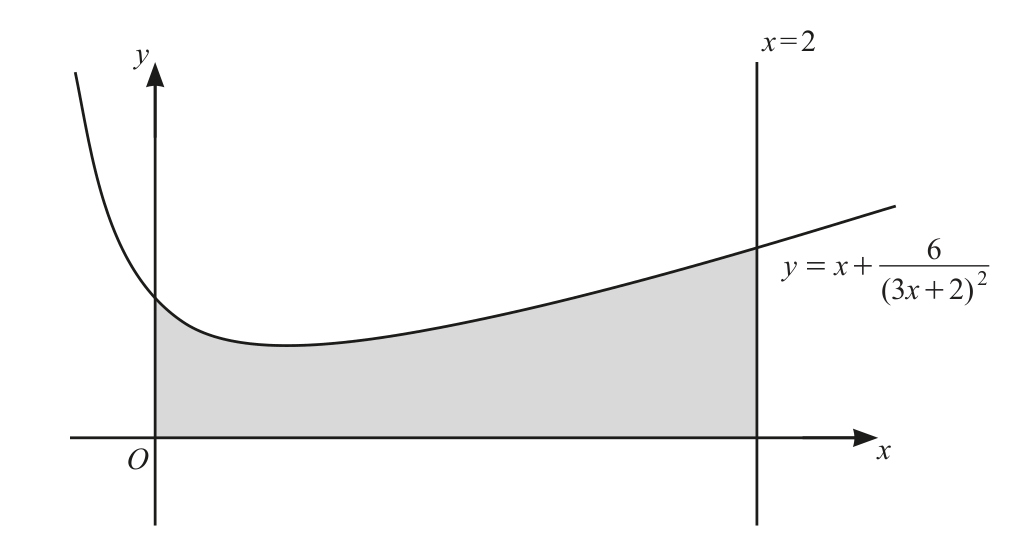
The diagram shows part of the curve
\(y=x+\frac{6}{(3x+2)^2}\)
and the line \(x=2\).
(i) Find, correct to 2 decimal places, the coordinates of the stationary point.
(ii) Find the area of the shaded region, showing all your working.
Solution
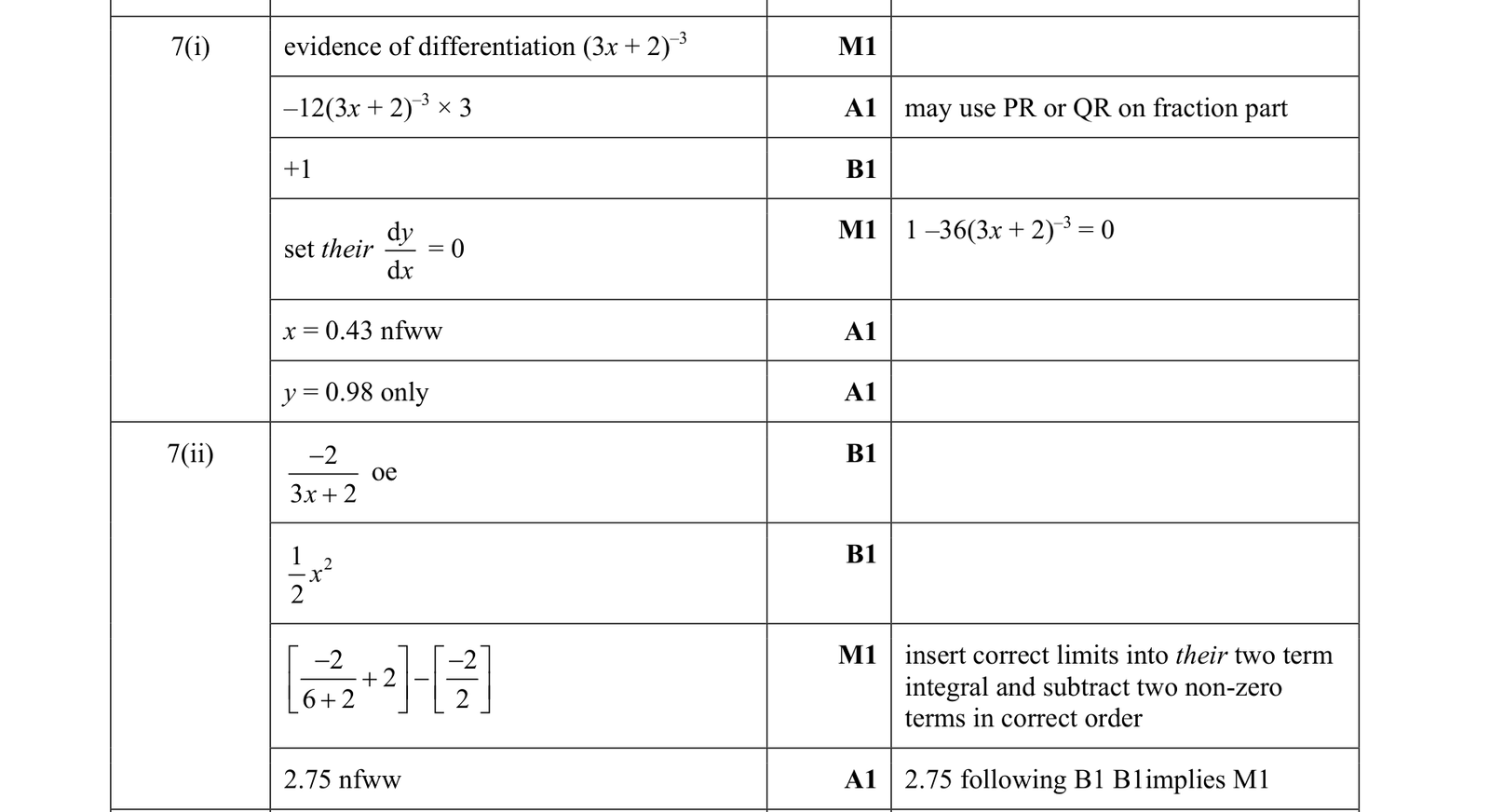
Answer: stationary point \((0.43,0.98)\); area \(2.75\).
Differentiate
\(y=x+6(3x+2)^{-2}.\)
This gives
\(\frac{dy}{dx}=1-36(3x+2)^{-3}.\)
At a stationary point,
\(1-\frac{36}{(3x+2)^3}=0.\)
So
\((3x+2)^3=36.\)
Hence
\(x=\frac{\sqrt[3]{36}-2}{3}=0.4339\ldots.\)
Substitute this into the curve:
\(y=x+\frac{6}{(3x+2)^2}=0.9845\ldots.\)
Therefore the stationary point is
\(\boxed{(0.43,0.98)}.\)
The shaded area is
\(\int_0^2\left(x+\frac{6}{(3x+2)^2}\right)\,dx.\)
An antiderivative is
\(\frac{x^2}{2}-\frac{2}{3x+2}.\)
Therefore the area is
\(\left[\frac{x^2}{2}-\frac{2}{3x+2}\right]_0^2.\)
This equals
\(\left(2-\frac14\right)-\left(0-1\right)=\frac74+1=\frac{11}{4}.\)
So the area is
\(\boxed{2.75}.\)