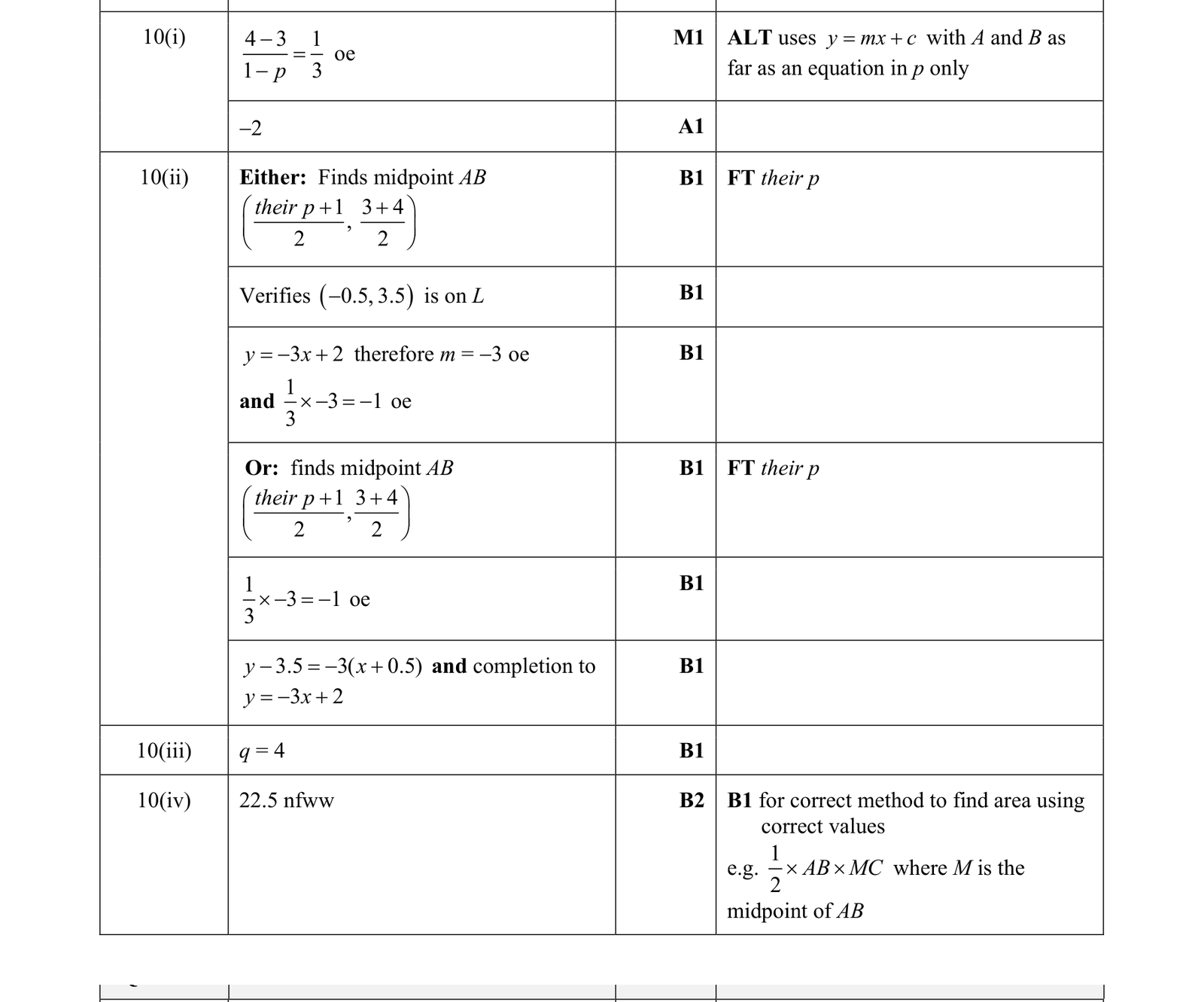
Answer: \(p=-2\), \(q=4\), area \(=22.5\).
The gradient of \(AB\) is
\(\frac{4-3}{1-p}.\)
Given that this is \(\frac13\),
\(\frac{1}{1-p}=\frac13.\)
Therefore \(1-p=3\), so
\(\boxed{p=-2}.\)
Now \(A=(-2,3)\) and \(B=(1,4)\). The midpoint of \(AB\) is
\(\left(\frac{-2+1}{2},\frac{3+4}{2}\right) =\left(-\frac12,\frac72\right).\)
Substitute this point into \(3x+y=2\):
\(3\left(-\frac12\right)+\frac72=-\frac32+\frac72=2.\)
So the midpoint lies on \(L\).
The line \(L\) can be written as
\(y=-3x+2,\)
so its gradient is \(-3\). Since
\(\frac13\times(-3)=-1,\)
\(L\) is perpendicular to \(AB\). Hence \(L\) is the perpendicular bisector of \(AB\).
Since \(C(q,-10)\) lies on \(L\),
\(3q-10=2.\)
Thus \(3q=12\), so
\(\boxed{q=4}.\)
Let \(M\) be the midpoint of \(AB\). Since \(L\) is perpendicular to \(AB\), \(CM\) is the perpendicular height of triangle \(ABC\) when \(AB\) is used as the base.
The length of \(AB\) is
\(\sqrt{(1-(-2))^2+(4-3)^2}=\sqrt{10}.\)
The length of \(CM\), where \(C=(4,-10)\) and \(M=\left(-\frac12,\frac72\right)\), is
\(\sqrt{\left(4+\frac12\right)^2+\left(-10-\frac72\right)^2} =\sqrt{\left(\frac92\right)^2+\left(-\frac{27}{2}\right)^2} =\frac{9\sqrt{10}}{2}.\)
Therefore the area is
\(\frac12\times\sqrt{10}\times\frac{9\sqrt{10}}{2} =\boxed{22.5}.\)