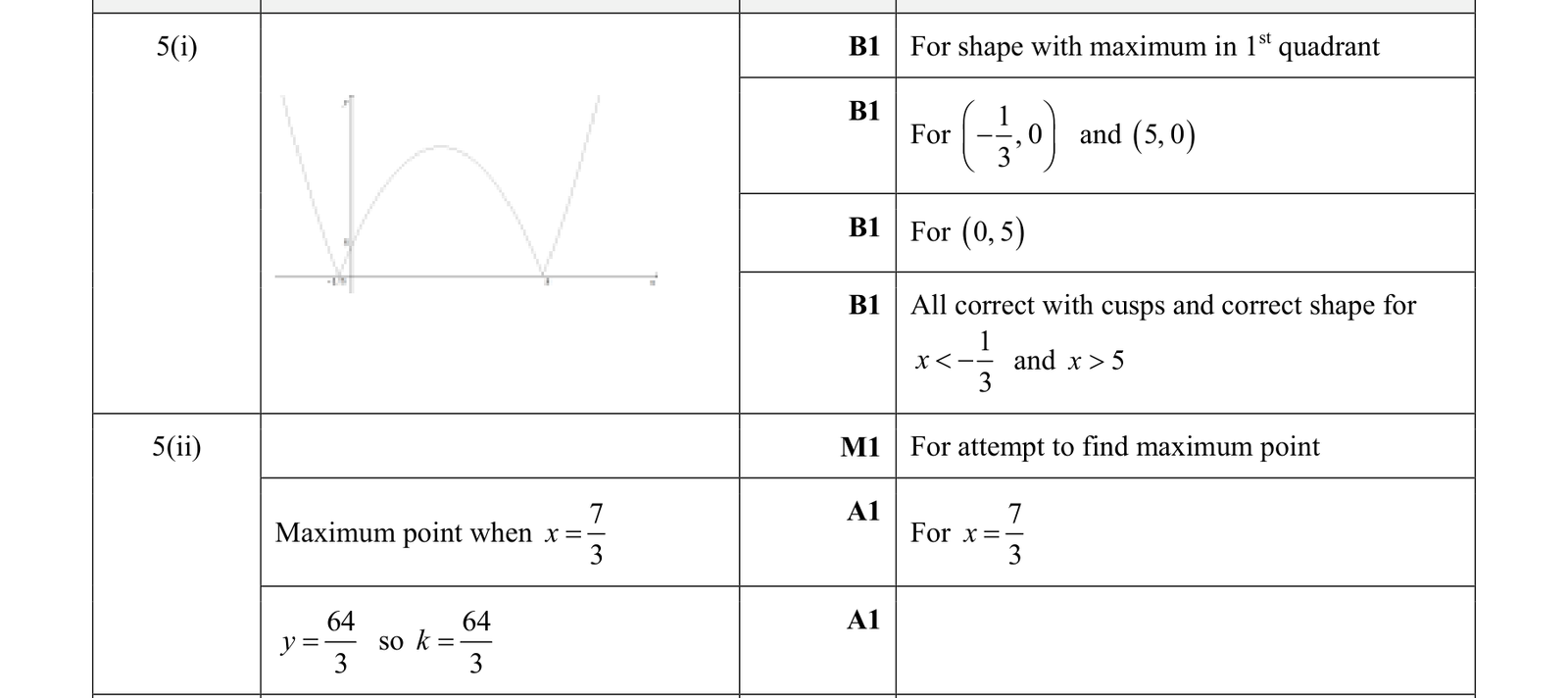
Answer: Intercepts \(\left(-\frac13,0\right)\), \((5,0)\), \((0,5)\); \(k=\frac{64}{3}\).
First find the zeros of \(3x^2-14x-5\):
\(3x^2-14x-5=0.\)
Using the quadratic formula,
\(x=\frac{14\pm\sqrt{196+60}}{6} =\frac{14\pm16}{6}.\)
So
\(x=-\frac13\quad\text{or}\quad x=5.\)
Therefore the graph meets the \(x\)-axis at
\(\left(-\frac13,0\right)\quad\text{and}\quad (5,0).\)
When \(x=0\),
\(y=|-5|=5,\)
so the graph meets the \(y\)-axis at \((0,5)\).
The quadratic \(3x^2-14x-5\) is negative between its roots, so the modulus reflects that part above the \(x\)-axis.
The turning point of \(3x^2-14x-5\) occurs at
\(x=\frac{-(-14)}{2(3)}=\frac73.\)
At this value,
\(3\left(\frac73\right)^2-14\left(\frac73\right)-5 =-\frac{64}{3}.\)
After reflection by the modulus, the maximum point of the middle section has height \(\frac{64}{3}\).
The equation \(\left|3x^2-14x-5\right|=k\) has exactly 3 solutions when the horizontal line touches this maximum point and also intersects the two outer branches. Hence
\(\boxed{k=\frac{64}{3}}.\)