9709 P1 - Nov 2007 - Q4
810
The 1st term of an arithmetic progression is \(a\) and the common difference is \(d\), where \(d \neq 0\).
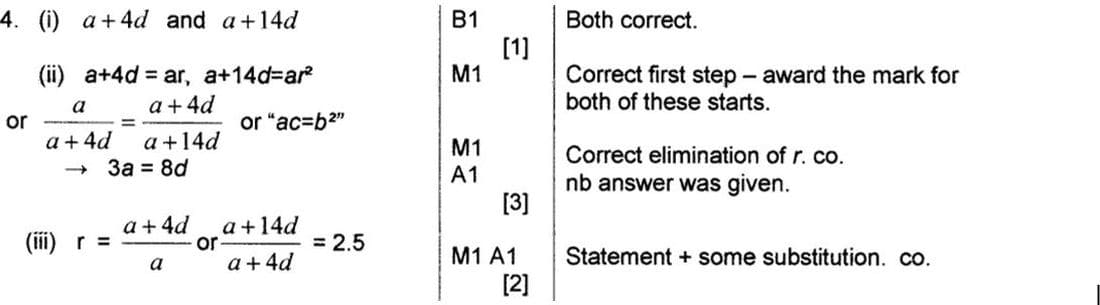
(i) Write down expressions, in terms of \(a\) and \(d\), for the 5th term and the 15th term.
The 1st term, the 5th term and the 15th term of the arithmetic progression are the first three terms of a geometric progression.
(ii) Show that \(3a = 8d\).
(iii) Find the common ratio of the geometric progression.