Answer: \(BC=2\sqrt3\); \(\sin ACB=\frac{\sqrt6+\sqrt2}{4}\); distance \(1\).
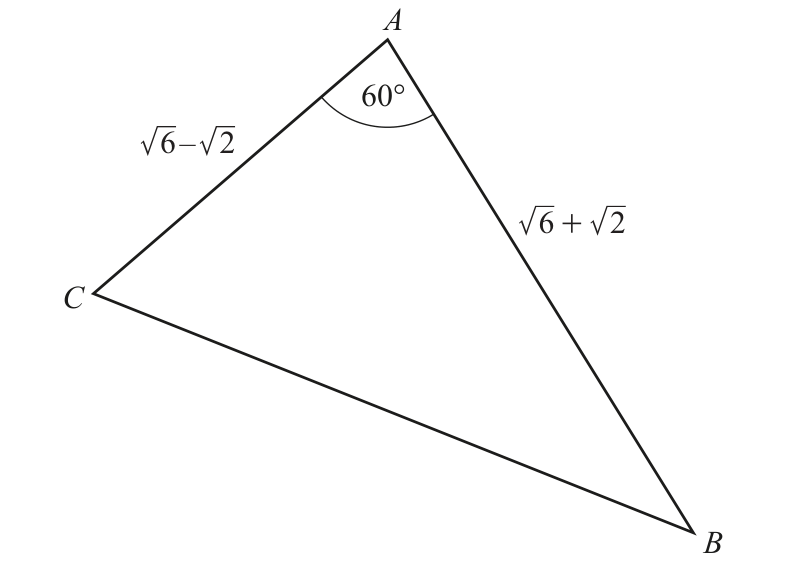
(a) Use the cosine rule with angle \(CAB=60^\circ\):
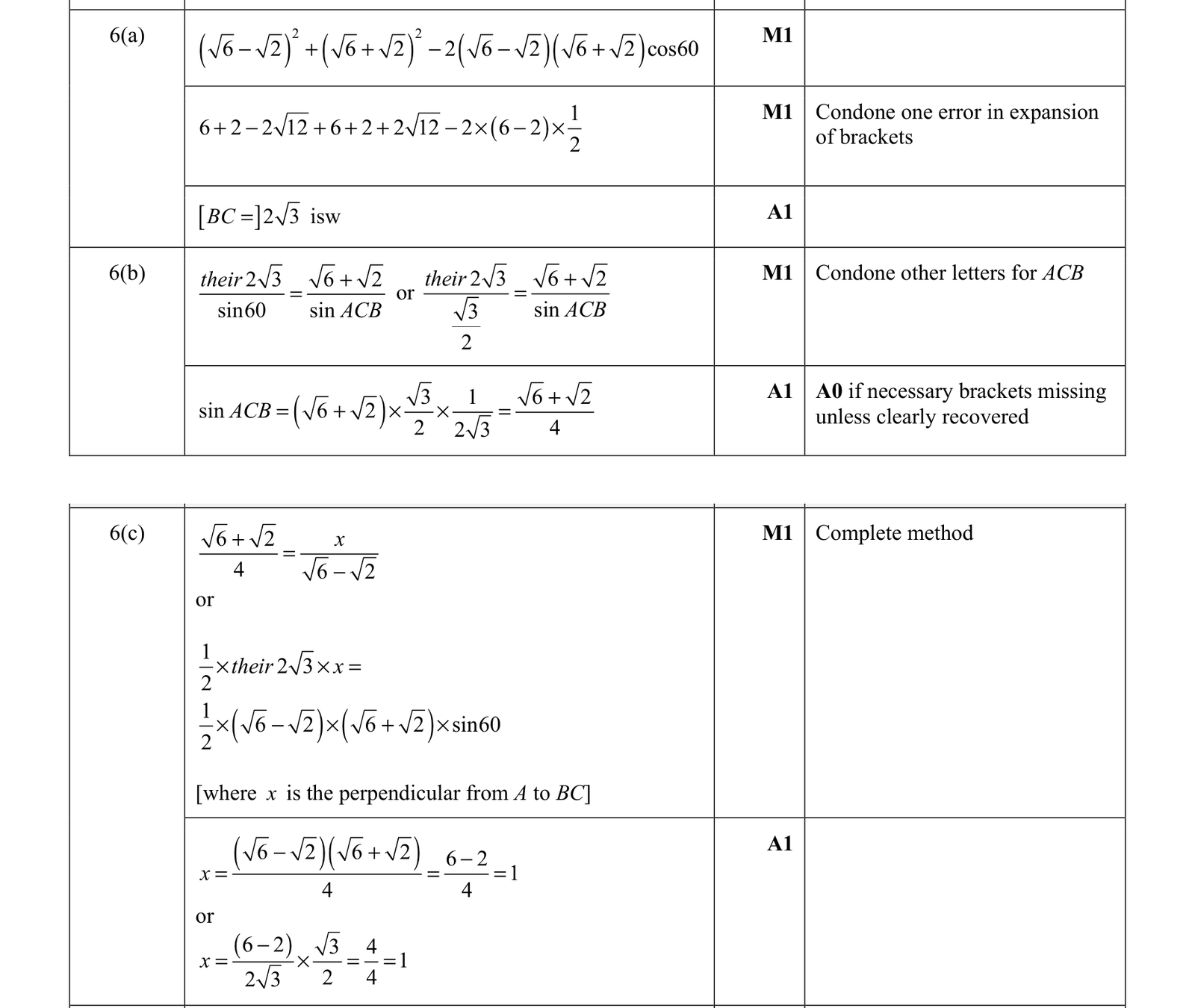
\(BC^2=AC^2+AB^2-2(AC)(AB)\cos60^\circ.\)
Now
\(AC=\sqrt6-\sqrt2,\qquad AB=\sqrt6+\sqrt2.\)
So
\(AC^2=(\sqrt6-\sqrt2)^2=8-4\sqrt3\)
and
\(AB^2=(\sqrt6+\sqrt2)^2=8+4\sqrt3.\)
Also,
\(AC\cdot AB=(\sqrt6-\sqrt2)(\sqrt6+\sqrt2)=6-2=4.\)
Therefore
\(BC^2=(8-4\sqrt3)+(8+4\sqrt3)-2(4)\left(\frac12\right).\)
Hence
\(BC^2=16-4=12,\)
so
\(BC=2\sqrt3.\)
(b) By the sine rule,
\(\frac{BC}{\sin60^\circ}=\frac{AB}{\sin ACB}.\)
So
\(\sin ACB=\frac{AB\sin60^\circ}{BC}.\)
Substitute \(AB=\sqrt6+\sqrt2\), \(\sin60^\circ=\frac{\sqrt3}{2}\) and \(BC=2\sqrt3\):
\(\sin ACB =\frac{(\sqrt6+\sqrt2)\left(\frac{\sqrt3}{2}\right)}{2\sqrt3} =\frac{\sqrt6+\sqrt2}{4}.\)
(c) Let the perpendicular distance from \(A\) to \(BC\) be \(h\).
The area of triangle \(ABC\), using sides \(AC\) and \(AB\), is
\(\frac12(AC)(AB)\sin60^\circ.\)
So
\(\text{area} =\frac12(\sqrt6-\sqrt2)(\sqrt6+\sqrt2)\cdot\frac{\sqrt3}{2} =\frac12(4)\cdot\frac{\sqrt3}{2} =\sqrt3.\)
The same area is also
\(\frac12(BC)h=\frac12(2\sqrt3)h=\sqrt3h.\)
Therefore
\(\sqrt3h=\sqrt3,\)
so
\(h=1.\)