0606 P21 - Nov 2021 - Q11 - 11 marks
8052
The volume \(V\) of a cone with base radius \(r\) and vertical height \(h\) is given by
\(V=\frac13\pi r^2h.\)
The curved surface area of a cone with base radius \(r\) and slant height \(l\) is given by \(\pi rl\).
A cone has base radius \(r\text{ cm}\), vertical height \(h\text{ cm}\) and volume \(V\text{ cm}^3\). The curved surface area of the cone is \(4\pi\text{ cm}^2\).
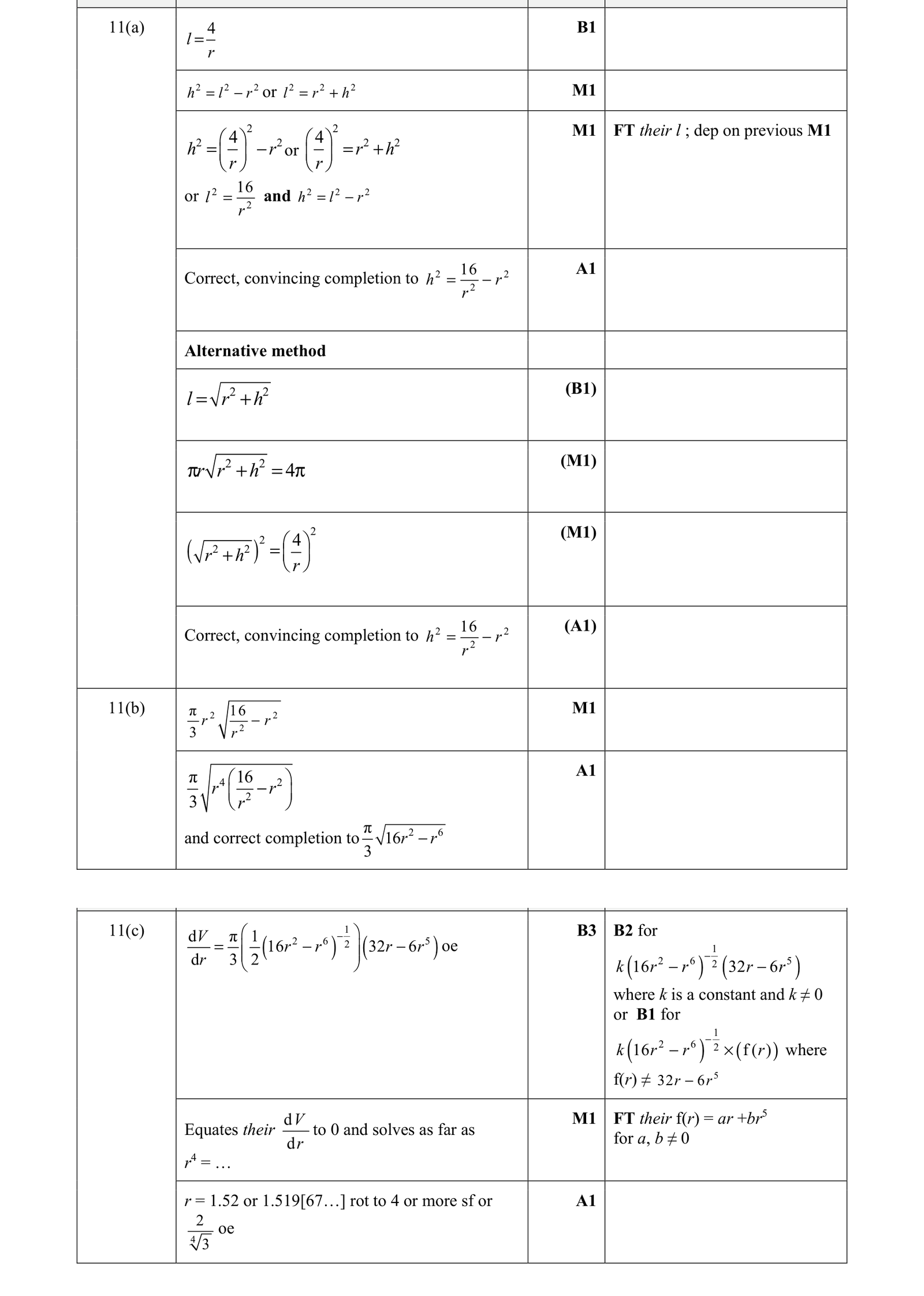
(a) Show that
\(h^2=\frac{16}{r^2}-r^2.\)
(b) Show that
\(V=\frac{\pi}{3}\sqrt{16r^2-r^6}.\)
(c) Given that \(r\) can vary and that \(V\) has a maximum value, find the value of \(r\) that gives the maximum volume.