0606 P21 - Nov 2021 - Q10 - 9 marks
8051
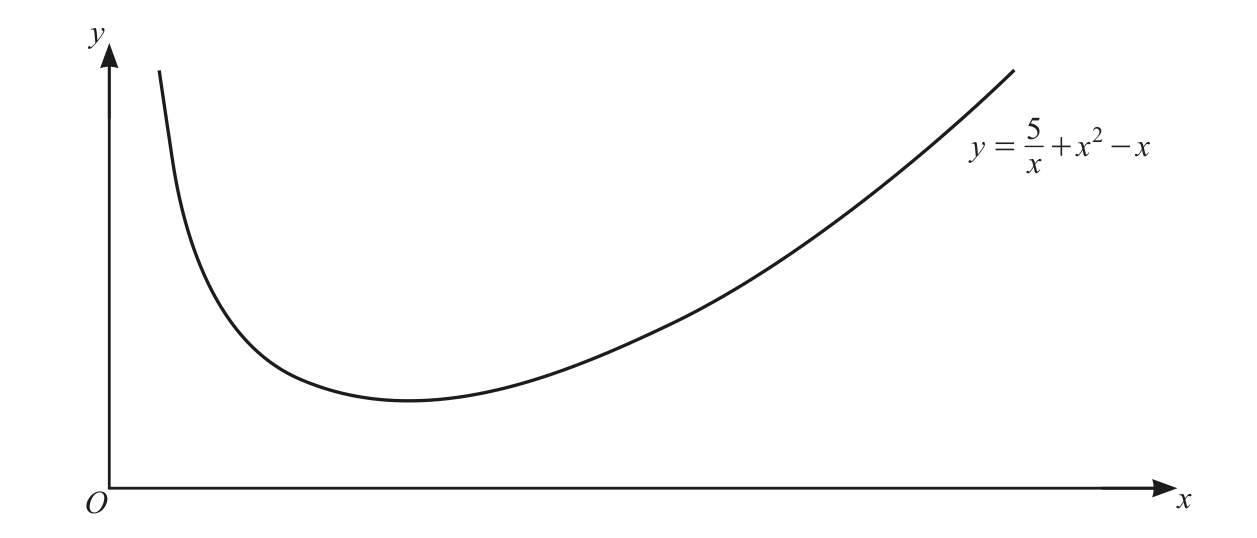
The diagram shows part of the curve
\(y=\frac5x+x^2-x.\)
(a) Find, in the form \(y=mx+c\), the equation of the tangent to the curve at the point where \(x=1\).
(b) Find the exact area enclosed by the curve, the \(x\)-axis, and the lines \(x=1\) and \(x=3\).
Solution
Answer: \(y=-4x+9\); area \(5\ln3+\frac{14}{3}\).
(a) The curve is
\(y=\frac5x+x^2-x.\)
Differentiate:
\(\frac{dy}{dx}=-5x^{-2}+2x-1.\)
When \(x=1\),
\(\frac{dy}{dx}=-5+2-1=-4.\)
The corresponding \(y\)-coordinate is
\(y=\frac51+1^2-1=5.\)
So the tangent has gradient \(-4\) and passes through \((1,5)\). Hence
\(y-5=-4(x-1).\)
Therefore
\(y=-4x+9.\)
(b) The required area is
\(\int_1^3\left(\frac5x+x^2-x\right)\,dx.\)
An antiderivative is
\(5\ln x+\frac{x^3}{3}-\frac{x^2}{2}.\)
So the area is
\(\left[5\ln x+\frac{x^3}{3}-\frac{x^2}{2}\right]_1^3.\)
At \(x=3\), this is
\(5\ln3+\frac{27}{3}-\frac92 =5\ln3+\frac92.\)
At \(x=1\), this is
\(5\ln1+\frac13-\frac12=-\frac16.\)
Therefore the exact area is
\(5\ln3+\frac92-\left(-\frac16\right) =5\ln3+\frac{14}{3}.\)