0606 P12 - Jun 2021 - Q5 - 8 marks
7954
(a) Given that
\(\log_a p+\log_a 5-\log_a 4=\log_a 20,\)
find the value of \(p\).
(b) Solve the equation
\(3^{2x+1}+8(3^x)-3=0.\)
(c) Solve the equation
\(4\log_y 2+\log_2 y=4.\)
Solution
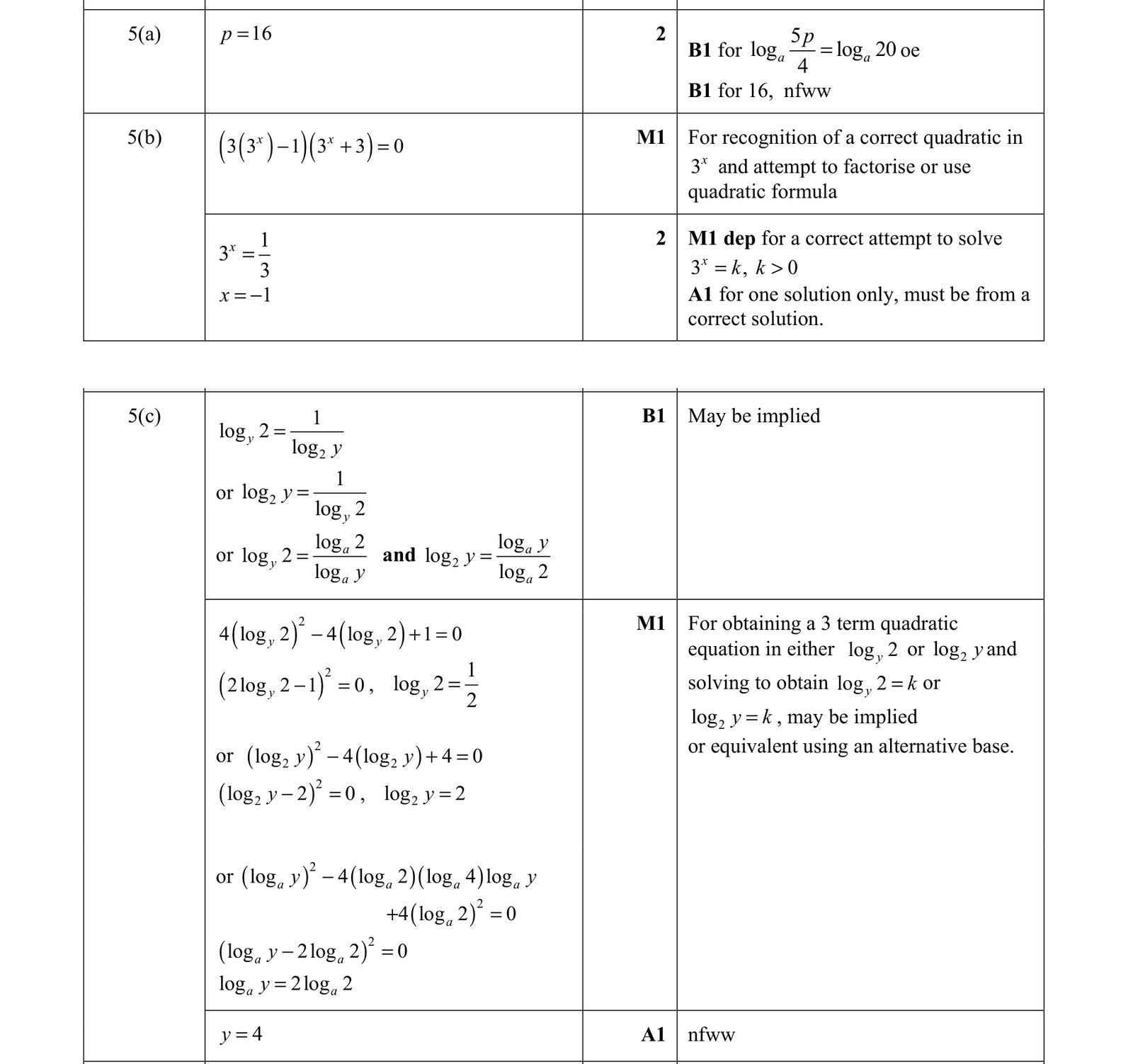
Answer: (a) \(p=16\); (b) \(x=-1\); (c) \(y=4\).
(a) Use the laws of logarithms:
\(\log_a p+\log_a 5-\log_a 4 =\log_a\left(\frac{5p}{4}\right).\)
Hence
\(\log_a\left(\frac{5p}{4}\right)=\log_a20.\)
So
\(\frac{5p}{4}=20,\)
and therefore
\(p=16.\)
(b) Let \(u=3^x\). Then \(3^{2x+1}=3(3^x)^2=3u^2\), so the equation becomes
\(3u^2+8u-3=0.\)
Factorising,
\((3u-1)(u+3)=0.\)
Since \(u=3^x\) is positive, \(u=-3\) is rejected. Thus
\(3^x=\frac13=3^{-1},\)
so
\(x=-1.\)
(c) Let
\(t=\log_y2.\)
Then
\(\log_2y=\frac1t.\)
The equation becomes
\(4t+\frac1t=4.\)
Multiplying by \(t\),
\(4t^2+1=4t.\)
So
\(4t^2-4t+1=0,\)
which gives
\((2t-1)^2=0.\)
Hence \(t=\frac12\). Therefore
\(\log_y2=\frac12,\)
so
\(y^{\frac12}=2.\)
Therefore
\(y=4.\)