Answer: (a) shown; (b) \(x=90^\circ,\ 221.8^\circ,\ 318.2^\circ\).
Answer: (a) shown; (b) \(x=90^\circ,\ 221.8^\circ,\ 318.2^\circ\).
(a) Start with the left-hand side:
\(\frac{\sin x}{1-\cos x}+\frac{1-\cos x}{\sin x}.\)
Use the common denominator \((1-\cos x)\sin x\):
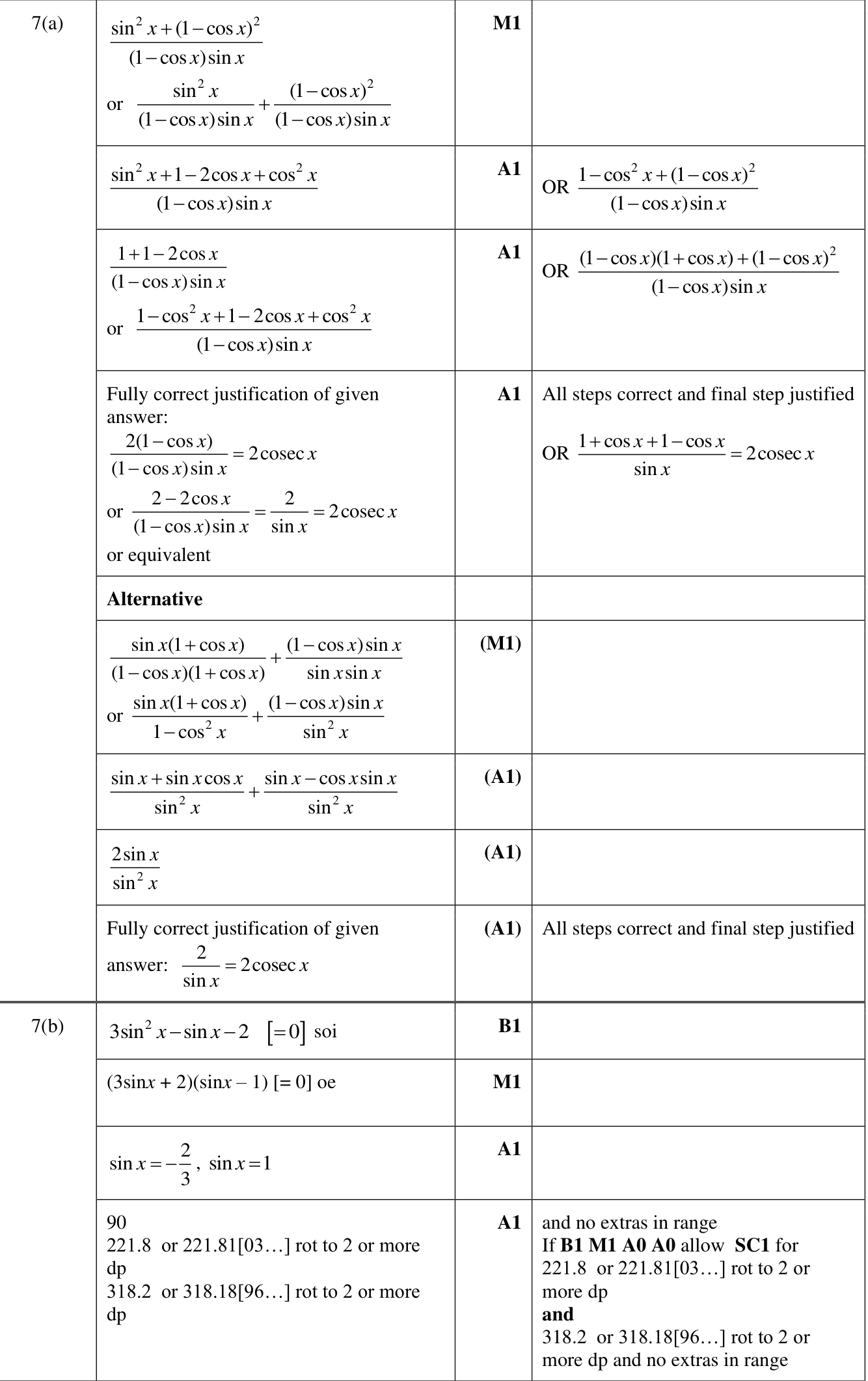
\(\frac{\sin^{2}x+(1-\cos x)^2}{(1-\cos x)\sin x}.\)
Expand the numerator:
\(\sin^{2}x+1-2\cos x+ \cos^{2}x.\)
Since \(\sin^{2}x+ \cos^{2}x=1\), this becomes
\(2-2\cos x=2(1-\cos x).\)
Therefore
\(\frac{\sin x}{1-\cos x}+\frac{1-\cos x}{\sin x} =\frac{2(1-\cos x)}{(1-\cos x)\sin x}.\)
Cancel \((1-\cos x)\):
\(=\frac2{\sin x}=2\operatorname{cosec}x.\)
(b) By part (a), the equation becomes
\(2\operatorname{cosec}x=3\sin x-1.\)
Since \(\operatorname{cosec}x=\frac1{\sin x}\),
\(\frac2{\sin x}=3\sin x-1.\)
Multiply by \(\sin x\):
\(2=3\sin^{2}x-\sin x.\)
So
\(3\sin^{2}x-\sin x-2=0.\)
Factorising,
\((3\sin x+2)(\sin x-1)=0.\)
Hence
\(\sin x=1 \quad\text{or}\quad \sin x=-\frac23.\)
For \(0^\circ\lt x\lt 360^\circ\), this gives
\(x=90^\circ, \quad x=221.8^\circ, \quad x=318.2^\circ.\)