9709 P11 - Jun 2012 - Q8
785
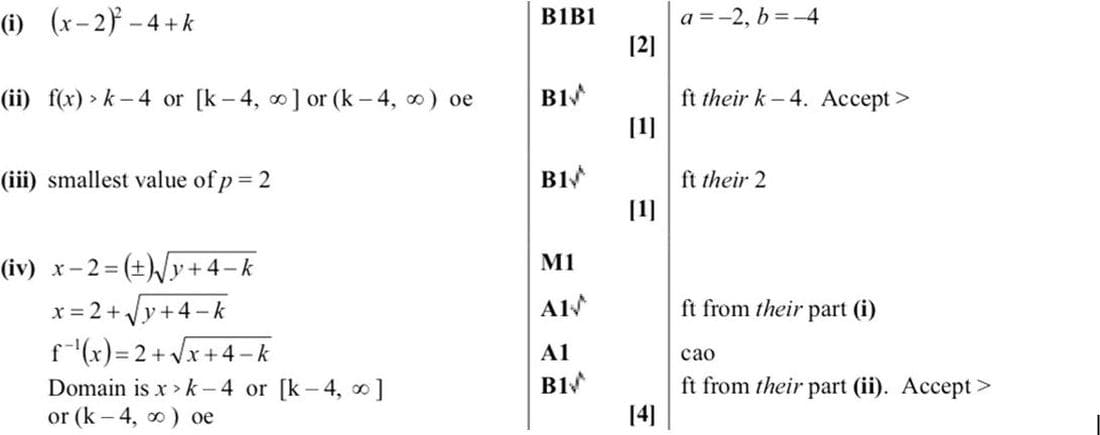
The function \(f : x \mapsto x^2 - 4x + k\) is defined for the domain \(x \geq p\), where \(k\) and \(p\) are constants.
- Express \(f(x)\) in the form \((x + a)^2 + b + k\), where \(a\) and \(b\) are constants. [2]
- State the range of \(f\) in terms of \(k\). [1]
- State the smallest value of \(p\) for which \(f\) is one-one. [1]
- For the value of \(p\) found in part (iii), find an expression for \(f^{-1}(x)\) and state the domain of \(f^{-1}\), giving your answers in terms of \(k\). [4]