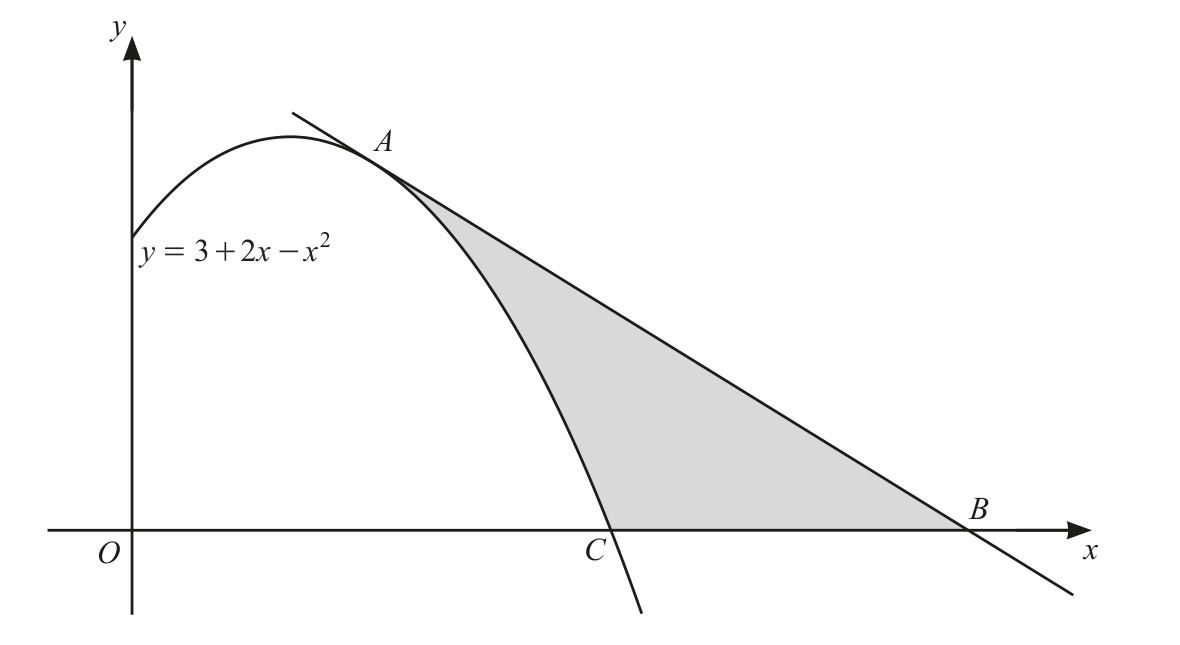
Answer: \(\displaystyle \frac{117}{32}\) square units.
At \(x=1.5\), the point \(A\) has
\(y=3+2(1.5)-(1.5)^2=3+3-2.25=3.75\).
So \(A=(1.5,3.75)\).
The gradient function is
\(\displaystyle \frac{dy}{dx}=2-2x\).
At \(x=1.5\), the gradient is
\(2-2(1.5)=-1\).
The tangent at \(A\) is therefore
\(y-3.75=-(x-1.5)\),
so
\(y=5.25-x\).
This tangent meets the \(x\)-axis when \(0=5.25-x\), so \(B=(5.25,0)\).
The curve meets the \(x\)-axis where
\(3+2x-x^2=0\).
That is
\(x^2-2x-3=0\),
so \((x-3)(x+1)=0\). The positive intercept is \(C=(3,0)\).
The shaded area is the area between the tangent and the curve from \(x=1.5\) to \(x=3\), plus the area under the tangent from \(x=3\) to \(x=5.25\):
\(\displaystyle \int_{1.5}^{3}\left[(5.25-x)-(3+2x-x^2)\right]dx+\int_{3}^{5.25}(5.25-x)\,dx.\)
The first integrand simplifies to
\(x^2-3x+2.25\).
So the first area is
\(\displaystyle \left[\frac{x^3}{3}-\frac{3x^2}{2}+2.25x\right]_{1.5}^{3}=\frac{9}{8}.\)
The second area is a triangle with base \(5.25-3=2.25\) and height \(5.25-3=2.25\), so its area is
\(\displaystyle \frac12(2.25)(2.25)=\frac{81}{32}\).
Therefore the total area is
\(\displaystyle \frac98+\frac{81}{32}=\frac{36}{32}+\frac{81}{32}=\frac{117}{32}.\)