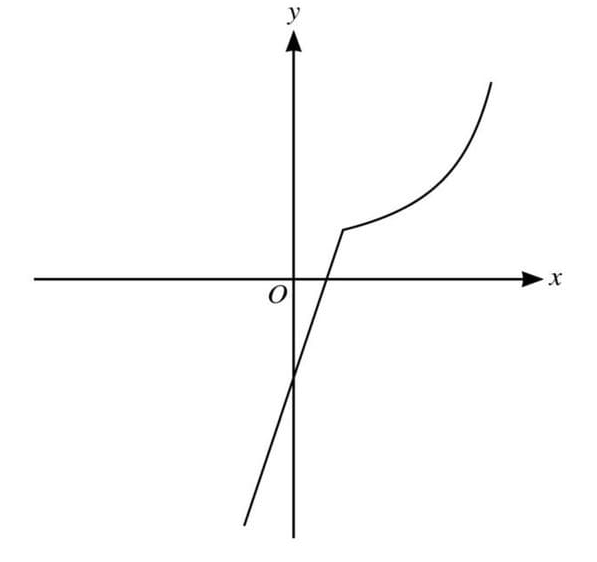
(i) For the linear part \(f(x) = 3x - 2\) with \(-1 \leq x \leq 1\), the range is calculated as follows:
\(f(-1) = 3(-1) - 2 = -5\)
\(f(1) = 3(1) - 2 = 1\)
Thus, the range for this part is \(-5 \leq f(x) \leq 1\).
For the rational part \(f(x) = \frac{4}{5-x}\) with \(1 < x \leq 4\), the range is calculated as follows:
As \(x \to 5\), \(f(x) \to -\infty\), but since \(x \leq 4\), the maximum value is \(f(4) = 4\).
Thus, the range for this part is \(-\infty < f(x) \leq 4\), but considering the domain, it is \(1 < f(x) \leq 4\).
Combining both parts, the overall range is \(-5 \leq f(x) \leq 4\).
(ii) To sketch \(y = f^{-1}(x)\), reflect the graph of \(f(x)\) over the line \(y = x\). The line segment from \((-5, -1)\) to \((1, 1)\) becomes \((-1, -5)\) to \((1, 1)\), and the curve from \((1, 1)\) to \((4, 4)\) becomes \((1, 1)\) to \((4, 4)\).
(iii) For the linear part \(f(x) = 3x - 2\), solve for \(x\):
\(y = 3x - 2 \Rightarrow x = \frac{y + 2}{3}\)
Thus, \(f^{-1}(x) = \frac{1}{3}(x + 2)\) for \(-5 \leq x \leq 1\).
For the rational part \(f(x) = \frac{4}{5-x}\), solve for \(x\):
\(y = \frac{4}{5-x} \Rightarrow y(5-x) = 4 \Rightarrow 5 - x = \frac{4}{y} \Rightarrow x = 5 - \frac{4}{y}\)
Thus, \(f^{-1}(x) = 5 - \frac{4}{x}\) for \(1 < x \leq 4\).