Browsing as Guest. Progress, bookmarks and attempts are disabled.
Log in to track your work.
0606 P13 - Jun 2022 - Q4 - 6 marks
7805
Variables \(x\) and \(y\) are such that when \(\mathrm e^{4y}\) is plotted against \(x\), a straight line of gradient \(\frac25\), passing through \((10,2)\), is obtained.
(a) Find \(y\) in terms of \(x\).
(b) Find the value of \(y\) when \(x=45\), giving your answer in the form \(\ln p\).
(c) Find the values of \(x\) for which \(y\) can be defined.
Since \(\mathrm e^{4y}\) is plotted against \(x\), the vertical variable is \(\mathrm e^{4y}\). The line has gradient \(\frac25\) and passes through \((10,2)\).
So its equation is
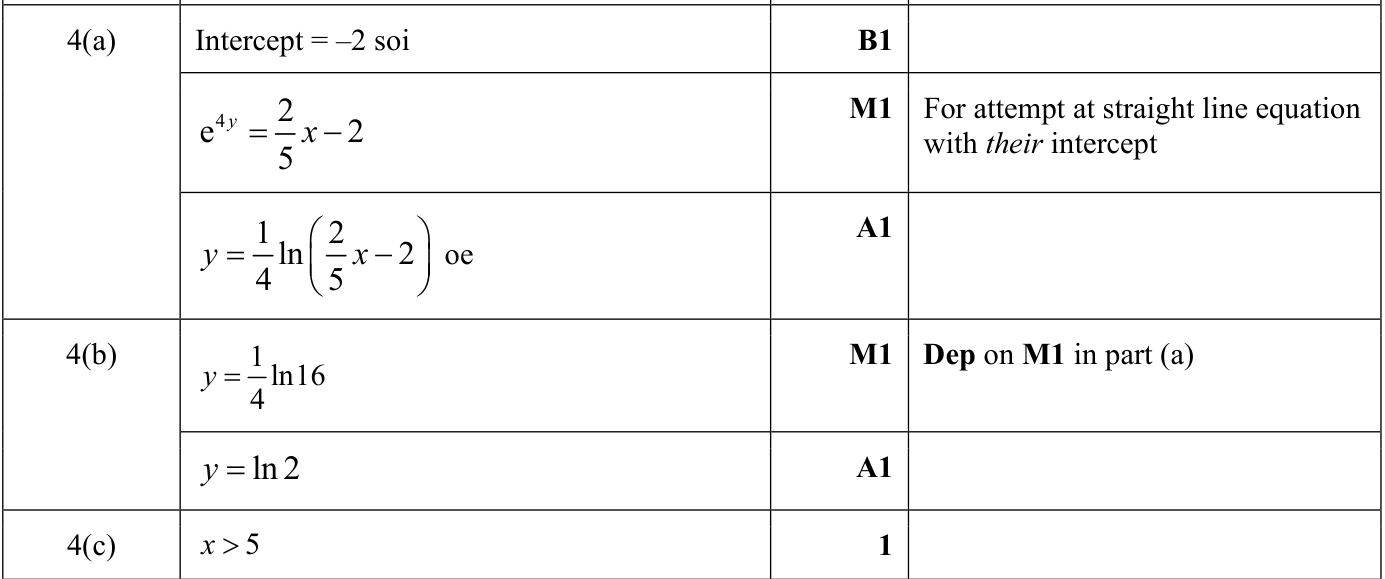
\(\mathrm e^{4y}=\frac25x+c.\)
Substitute \((10,2)\):
\(2=\frac25(10)+c=4+c,\)
so \(c=-2\). Therefore
\(\mathrm e^{4y}=\frac25x-2.\)
Taking natural logarithms gives
\(4y=\ln\left(\frac25x-2\right).\)
Hence
\(y=\frac14\ln\left(\frac{2x}{5}-2\right).\)
When \(x=45\),
\(\frac{2x}{5}-2=18-2=16.\)
So
\(y=\frac14\ln16=\ln2.\)
For \(y\) to be defined, the logarithm must have a positive argument: