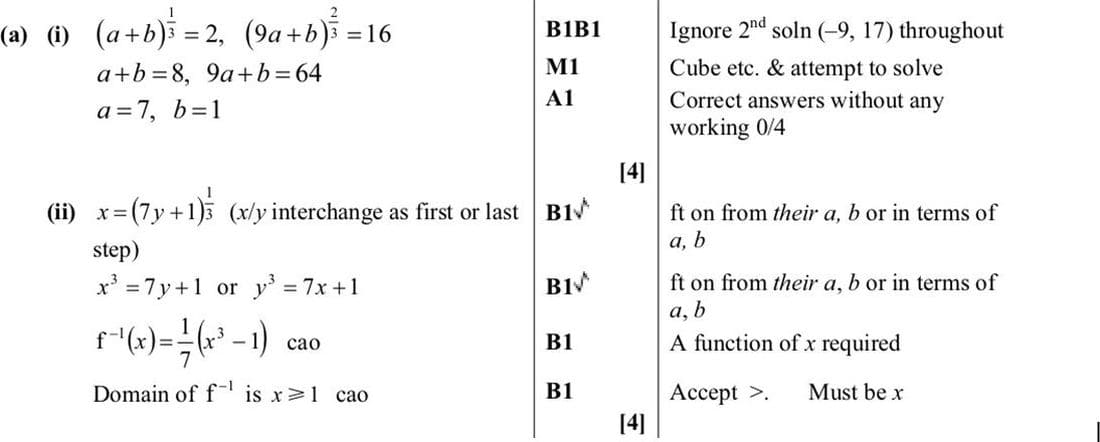
(i) Given \(fg(1) = 2\), we have \(f(g(1)) = f(1^2) = f(1) = (a \cdot 1 + b)^{\frac{1}{3}} = 2\).
This implies \((a + b)^{\frac{1}{3}} = 2\), so \(a + b = 8\).
Given \(gf(9) = 16\), we have \(g(f(9)) = g((9a + b)^{\frac{1}{3}}) = ((9a + b)^{\frac{1}{3}})^2 = 16\).
This implies \((9a + b)^{\frac{2}{3}} = 16\), so \(9a + b = 64\).
Solving the equations \(a + b = 8\) and \(9a + b = 64\), we find \(a = 7\) and \(b = 1\).
(ii) To find \(f^{-1}(x)\), start with \(x = (7y + 1)^{\frac{1}{3}}\).
Cubing both sides gives \(x^3 = 7y + 1\).
Solving for \(y\), we get \(y = \frac{1}{7}(x^3 - 1)\).
Thus, \(f^{-1}(x) = \frac{1}{7}(x^3 - 1)\).
The domain of \(f^{-1}\) is \(x \geq 1\) since \(f(x)\) is defined for \(x \geq 0\) and \(f(0) = 1\).