0606 P11 - Jun 2022 - Q3 - 10 marks
7783
A function \(f\) is such that \(f(x)=\ln(2x+1)\), for \(x\gt -\frac12\).
(a) Write down the range of \(f\).
A function \(g\) is such that \(g(x)=5x-7\), for \(x\in\mathbb R\).
(b) Find the exact solution of \(gf(x)=13\).
(c) Find the solution of \(f'(x)=g^{-1}(x)\).
Solution
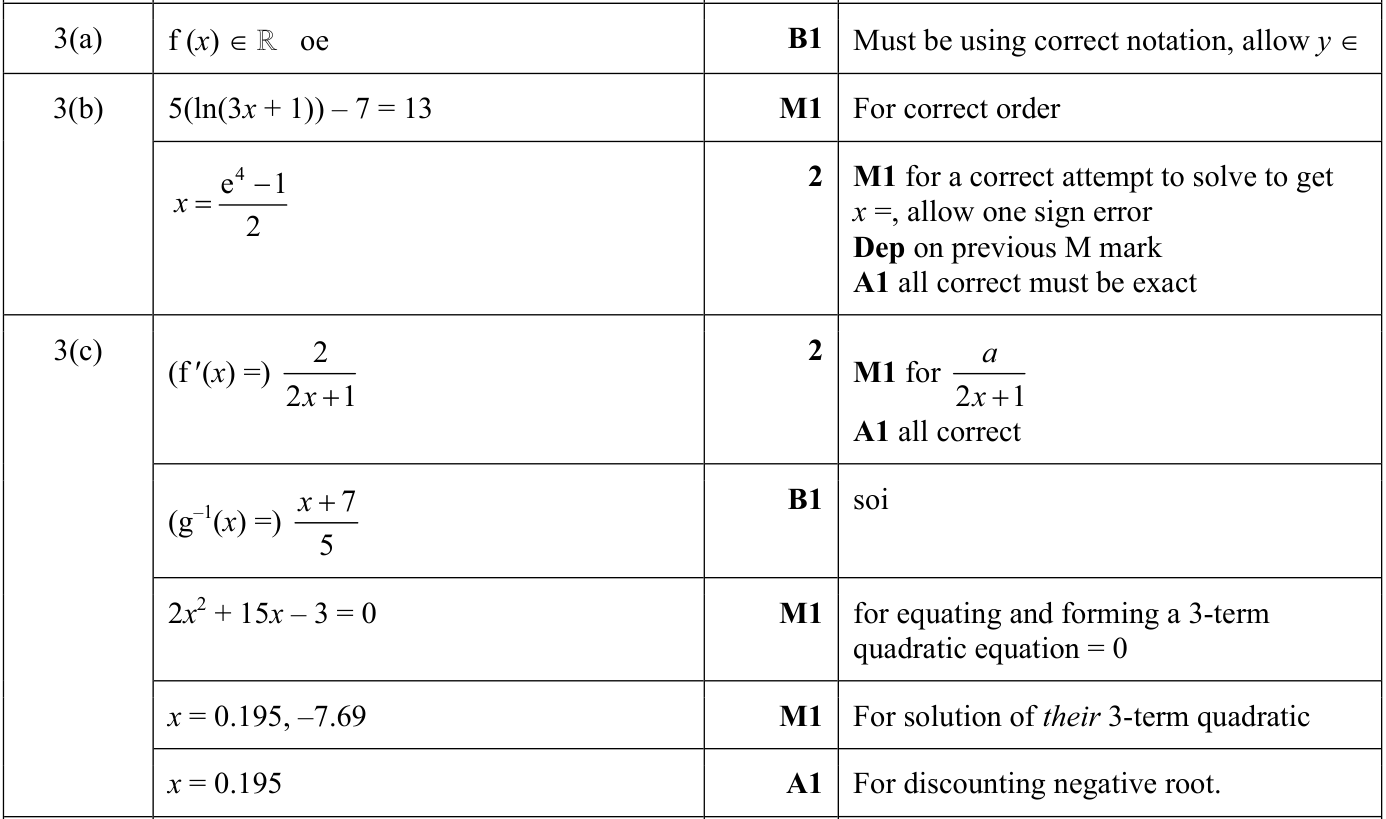
Answer: (a) \(\mathbb R\); (b) \(x=\frac{e^4-1}{2}\); (c) \(x=\frac{-15+\sqrt{249}}4\).
Answer: (a) \(\mathbb R\); (b) \(x=\frac{e^4-1}{2}\); (c) \(x=\frac{-15+\sqrt{249}}4\).
(a) Since \(2x+1\) can take any positive value, \(\ln(2x+1)\) can take every real value. The range is \(\mathbb R\).
(b) \(gf(x)=13\) means
\(5\ln(2x+1)-7=13.\)
So \(\ln(2x+1)=4\), hence \(2x+1=e^4\), giving
\(x=\frac{e^4-1}{2}.\)
(c) First,
\(f'(x)=\frac{2}{2x+1}.\)
Also, from \(y=5x-7\),
\(g^{-1}(x)=\frac{x+7}{5}.\)
Therefore
\(\frac{2}{2x+1}=\frac{x+7}{5}.\)
Cross-multiply:
\(10=(2x+1)(x+7).\)
So
\(2x^2+15x-3=0.\)
Using the quadratic formula,
\(x=\frac{-15\pm\sqrt{249}}4.\)
The negative root is outside \(x\gt -\frac12\), so
\(x=\frac{-15+\sqrt{249}}4.\)