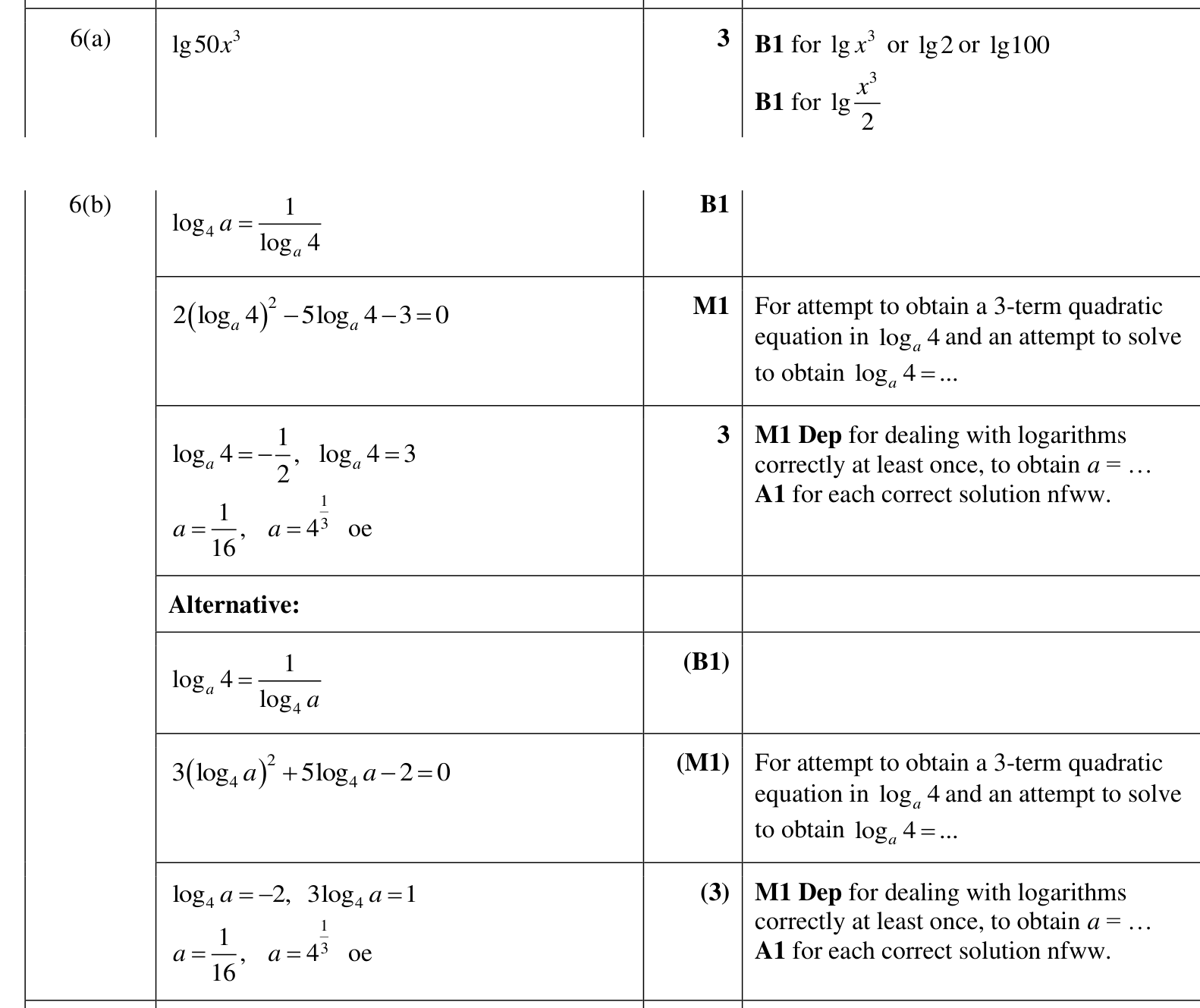
Answer: (a) \(\lg(50x^3)\); (b) \(a=\frac1{16}\) or \(a=\sqrt[3]{4}\).
Use the laws of logarithms and exponentials first, then check that any logarithm arguments are positive where required.
(a) Use the laws of logarithms:
\(3\lg x=\lg x^3\),
and
\(2=\lg100\).
Also,
\(\frac12\lg4=\lg\sqrt4=\lg2\).
Therefore
\(3\lg x-\frac12\lg4+2=\lg x^3-\lg2+\lg100\).
So
\(3\lg x-\frac12\lg4+2=\lg\left(\frac{100x^3}{2}\right)=\lg(50x^3)\).
(b) Let
\(u=\log_a4\).
Then
\(\log_4a=\frac1u\).
The equation becomes
\(2u-\frac3u-5=0\).
Multiply by \(u\):
\(2u^2-5u-3=0\).
Factorise:
\((2u+1)(u-3)=0\).
So
\(u=-\frac12\) or \(u=3\).
If \(\log_a4=-\frac12\), then \(a^{-1/2}=4\), so \(\sqrt a=\frac14\), giving \(a=\frac1{16}\).
If \(\log_a4=3\), then \(a^3=4\), giving \(a=\sqrt[3]{4}\).
Therefore
\(a=\frac1{16}\) or \(a=\sqrt[3]{4}\).