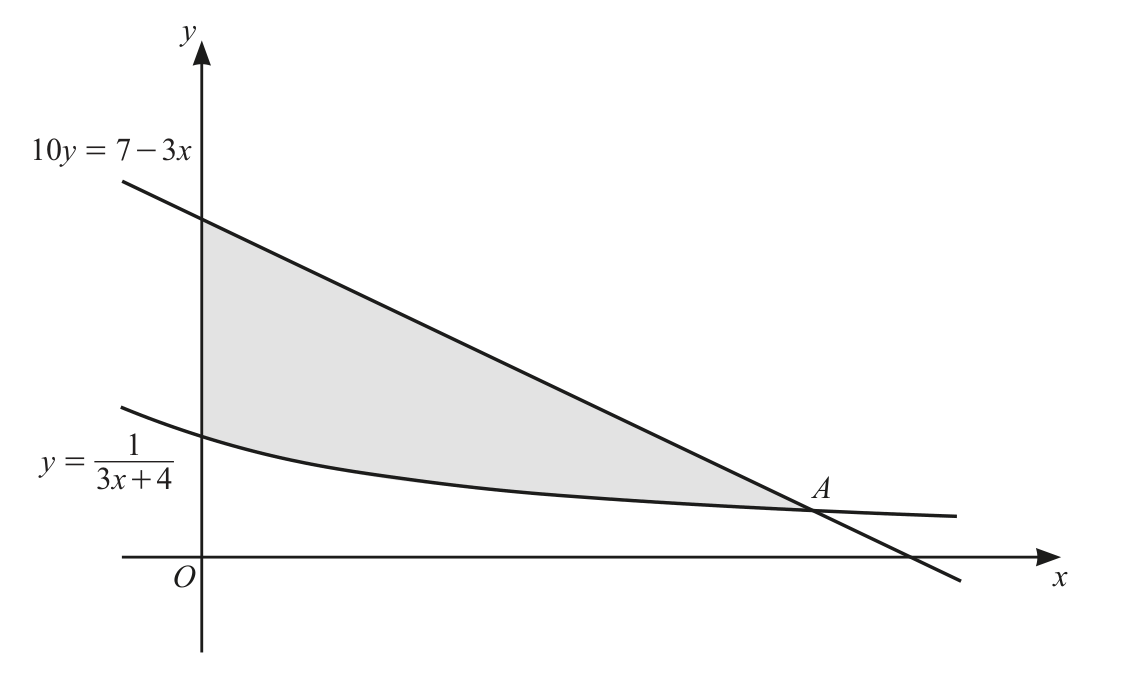
Answer: The shaded area is \(\displaystyle 0.8-\frac13\ln\frac52\), so approximately \(0.495\).
Set up the integral carefully. For an area between two curves, integrate the upper function minus the lower function over the correct interval.
(a) Rewrite the integrand:
\(\frac{x+4}{\sqrt[3]x}=x^{2/3}+4x^{-1/3}.\)
Therefore
\(\int\frac{x+4}{\sqrt[3]x}\,dx =\frac35x^{5/3}+6x^{2/3}.\)
So
\(\int_1^8\frac{x+4}{\sqrt[3]x}\,dx =\left[\frac35x^{5/3}+6x^{2/3}\right]_1^8.\)
At \(x=8\), since \(8^{1/3}=2\),
\(\frac35(8^{5/3})+6(8^{2/3}) =\frac35(32)+6(4) =19.2+24=43.2.\)
At \(x=1\),
\(\frac35+6=6.6.\)
Hence the value of the integral is
\(43.2-6.6=36.6.\)
(b) To verify the \(y\)-coordinate of \(A\), use \(y=0.1\).
For the line,
\(10(0.1)=7-3x.\)
Thus
\(1=7-3x,\)
so
\(x=2.\)
For the curve,
\(0.1=\frac{1}{3x+4}.\)
So
\(3x+4=10,\)
and again
\(x=2.\)
Therefore \(A=(2,0.1)\), so the \(y\)-coordinate is \(0.1\).
The shaded area is the area under the line from \(x=0\) to \(x=2\), minus the area under the curve from \(x=0\) to \(x=2\).
For the line, the endpoint \(y\)-values are \(0.7\) and \(0.1\), so the trapezium area is
\(\frac12(0.7+0.1)(2)=0.8.\)
For the curve,
\(\int_0^2\frac{1}{3x+4}\,dx =\frac13\left[\ln(3x+4)\right]_0^2.\)
Thus
\(\int_0^2\frac{1}{3x+4}\,dx =\frac13\left(\ln10-\ln4\right) =\frac13\ln\frac52.\)
Hence the shaded area is
\(0.8-\frac13\ln\frac52.\)
Numerically, this is approximately
\(0.495.\)